Showing posts with label music. Show all posts

Monday, March 10, 2014

Bill Crow (1958)

Bill Crow, double bass, Lambretta motor-scooter, West 4th Street, Greenwich Village, New York City, 1958

Jazz legend Bill Crow is a generous man. Not only was he kind enough to grant me permission to reproduce the above photo on today's post, but he spent some time answering a few questions that I thought would be of interest. Rarely on this blog do I explore the Italian motor-scooter aspect of the 20th Century modernist dispora, but this wonderful photo deserves some extra attention.

Bill starts off the story of his 1953 Lambretta 125 LD series 1 in 1954:

"I was living at 22 Cornelia Street in Manhattan in those days on the second floor. Cornelia Street only had parking on the east side and when the city went to alternate side parking, that street was only park-able on Tuesdays and Thursdays. I was driving an old Ford and was having so much trouble parking it that I sold it. I knew the writer Arnold Perl, who had a Lambretta over in the East Village. It may have been the first one in Manhattan. I realized that I could wheel it through my building and park it in the back yard so I bought one, their smallest model, from an agency in the west 50s that was selling them and figured out a way to carry the bass on it. I carried a small board with me that I could use to help me wheel the scooter up the three steps on my stoop at 22 Cornelia and I would chain it to a tree in the back yard."

The one-time blacklisted writer Perl has a fascinating tale of his own that certainly should be told in full some day. But back to our story. Crow was fortunate at the time to have a steady gig 3 miles uptown as part of pianist Marian McPartland's trio. He continues:

"At that time I was working six nights a week at the Hickory House on West 52nd Street and I left my bass there every night unless I had a record date or something. It was nice to ride the scooter midtown from my Village apartment and I could park it easily at the curb. I only carried the bass on it when I had a different job. While I was still living on Cornelia Street, the movie photographer Aram Avakian (George Avakian’s brother) shot a lot of footage of me carrying the bass on the scooter, which he intended to use in a documentary that he was planning about New York jazz clubs, but the film was sent to some funding organization in an appeal for a grant and I never heard any more about it."

Bill and I have discussed Avakian and film-making on these pages before (see link above), as that latter had an important role in the making of Jazz on a Summer's Day. Bill eventually found out that there was more to scootering than commuting for work:

"I took it camping one autumn, when Marian McPartland took 3 weeks off from the Hickory House to go home to England for a visit. I packed a pup tent and a sleeping bag on the luggage rack and drove up through the Adirondacks, up into Montreal, down along Lake Champlain, up to Baxter State Park in Maine, down to Acadia National Park, and on down the coast to Boston, where I met Marian who came back from England via Boston to visit some friends. We had lunch together and then I headed back to NYC. I stayed on the smallest roads I could find which still had a hard surface and really enjoyed seeing the northeast that way."

In 1956, Crow began a musical association with baritone saxophonist, composer, arranger, and bandleader Gerry Mulligan that would continue intermittently for several years. Mulligan was a bona fide international jazz star at the time which afforded Bill some unique opportunities:

"When I went to Italy around 1959 with Gerry Mulligan, I went to the Lambretta factory in Milano and bought a new scooter and had it shipped to New York. I sold the old one and I kept the new one in a garage on 7th Avenue next to Nick's. In the early 1960s I moved to West 20th Street in Chelsea and found another garage nearby where I kept the scooter chained to a water pipe."  


I asked Bill what finally signaled the end of this relationship with Lambrettas:


"When I returned from a later trip to Europe with Mulligan, I went to pick up the scooter and found that it had been smashed against the wall of the garage by a car or truck. The garage men claimed to not have noticed the damage. Their insurance company finally paid for the repairs, but I had already decided to buy a Volkswagen and I sold the scooter."

Thanks once again to Bill Crow for his time and consideration. It is truly an honor to have made his acquaintance via the internet.

**A footnote: according to Lambretta's official history; founded in 1947, the Milan, Italy motor-scooter manufacturing company did not start its USA division until 1955. Lambrettas were only available in a few American cities and in very limited quantities before that time.

Tuesday, March 4, 2014

Bird Lives! (1958)

Bird Lives! oil on canvas board painting by Ted Joans, 1958, courtesy of the de Young Museum, currently on exhibit through January 2015

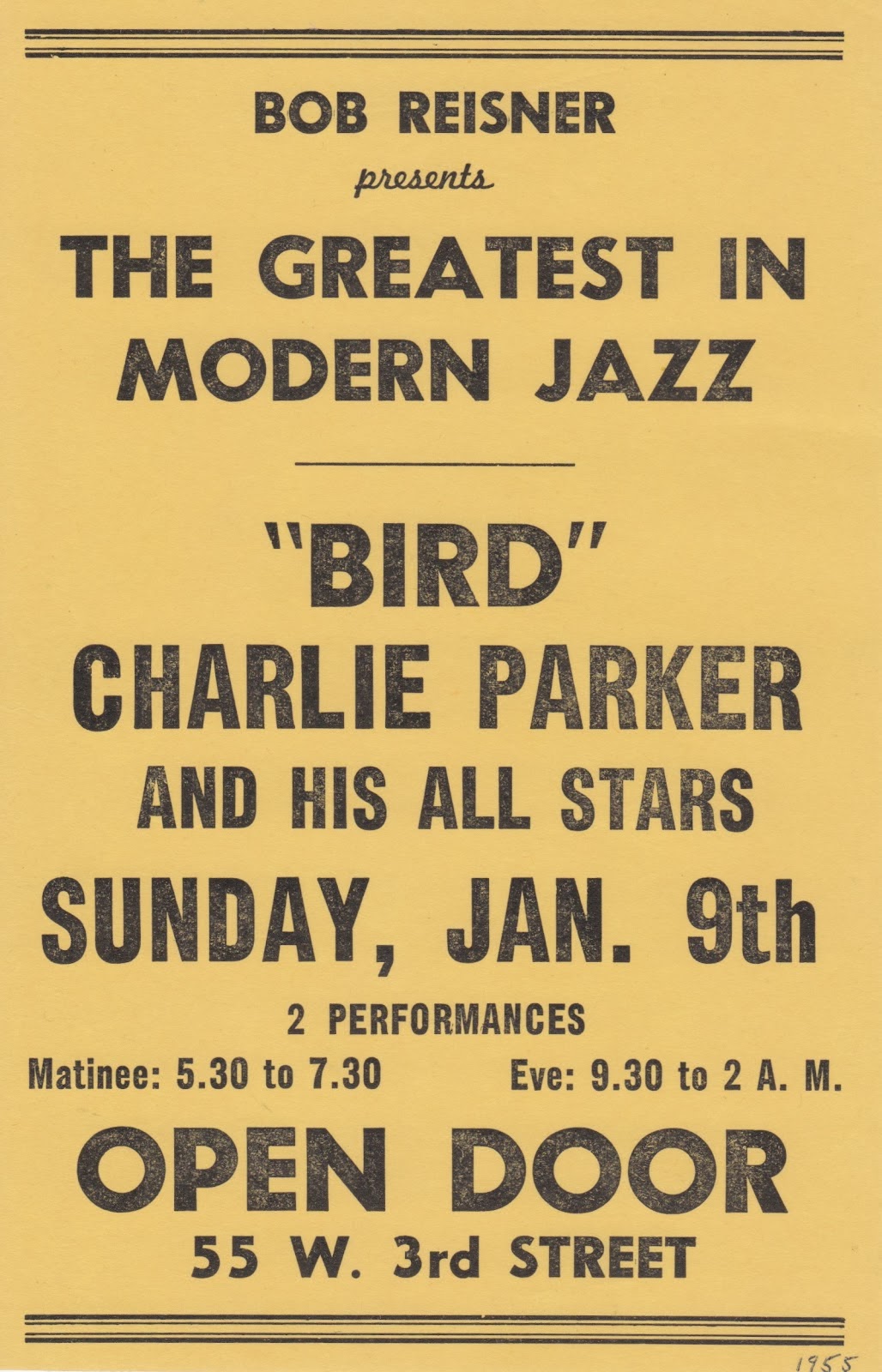
The death of Charlie Parker on March 12, 1955 had both an immediate and lasting impact on the New York art community. It wasn't just the musicians who grieved and grappled with the truth that Bird was dead, the painters and poets too strongly felt the loss of one of their idols. He was a hero made flesh: many of them knew Parker as much from seeing him around their Greenwich Village and Lower East Side (there wasn't an East Village yet) neighborhoods as much as they did from his stage appearances. Of course, they knew his records and would check him out at The Open Door on West 3rd Street when they could afford to do so, but the notion of the starving artist wasn't a punchline once upon a time.

Poster, The Open Door, Greenwich Village, New York City, 1955

According to the somewhat controversial record producer and writer Ross Russell, who owned Dial Records and who recorded some of Parker's most critically acclaimed music, within "a few days of the alto player's death there appeared among the graffiti on the walls in the Village and in subways, scrawled in black crayon or squirted out of pressurized paint canisters, the legend 'Bird Lives!" (Bird Lives: The High Life and Hard Times of Charlie (Yardbird) Parker by Ross Russell, New York; Charterhouse, 1973). Years later it was poet Ted Joans who was credited as the instigator of the graffiti. 

1955 newspaper obituary, source unknown

Ted Joans knew Charlie Parker and knew him somewhat well. Not too long after Joans arrival on the scene, he become known for his elaborate parties often costumed affairs. Author and promoter of the 1950s jazz sessions Robert Reisner claims that Bird turned up for one of these parties dressed as a Mau Mau and supposedly the January 1955 issue of John Preston Davis' groundbreaking African-American journal Our World featured one such party with Parker visible in the background. After returning from an extended engagement in Chicago in that same month, Bird was more or less a transient who relied upon the goodwill and couch space of others for shelter. At the time Joans shared a small apartment at 4 Barrow Street in the Village (don't go looking for it, it has been razed) just off of Sheridan Square and across the street from the Cafe Bohemia (that building is still there, occupied by the Barrow Street Ale House) and his roommate Ahmed Basheer brought a sick Parker home one night after finding Bird sprawled out on the sidewalk near their front door. As a result, Parker and Joans were de facto roommates off and on during last 2 months of the saxophonist's life.

Ted Joans at the Cafe Bizarre, Greenwich Village, New York, 1958

But just calling Ted Joans a poet is doing his legacy a disservice. Yes he was indeed a poet. In fact, he is now often referred to as one of of the original beat poets. Joans moved to Greenwich Village in 1951 around the age of 23 having moved to the big city from Illinois by way of Indiana University. Sadly, the history of the Beat Generation seems to have suffered from some degree of whitewashing as Joans seldom appears as more than a mere footnote. But he was clearly one of the first on the scene, connecting Gregory Corso not long after his arrival. He would later cite his biggest influences as Langston Hughes and André Breton. For his part, he thought himself as much as surrealist as he did a beatnik, although he certainly took advantage of the public interest in the latter as a way to have a forum for his art. By the time of his death in 2003, Joans had authored well over 30 books a remarkable body of work for any poet by anyone's standards.


The Hipsters by Ted Joans, Corinth Books, 1959

Joans creativity did not end with the printed word. At one point of time he was a trumpeter, although he reportedly threw his horn off a bridge as he felt the need to focus on other aspects of his life (this again according to Russell). He was a visual artist as well. Although largely known as a recluse, Joans befriended the Jackson Pollock and got to know the painter before Pollock died in the Summer of 1956. Joans most certainly was a painter, although examples of his work are relatively scarce both online and in the real world. However, one of his surviving works is from 1958 and is fittingly (for our story at least) titled Bird Lives!

The is only the tip of the iceberg that is the fascinating story of Ted Joans. I highly recommend digging deeper. 

Bird Lives! the painting is featured in San Francisco's de Young Museum Shaping Abstraction exhibit now through January 4, 2015.

As a teaser, here are a couple of short films that feature Joans a few years after the death of Charlie Parker. Bird Lives indeed!


Village Sunday by Stewart Wilensky, USA, 1960
(click on image above for fullscreen view)


Jazz and Poetry by Louis van Gasteren, Holland, 1964
(click through for a better screen view)

Monday, September 9, 2013

September Song (1938)


September Song, sheet music, 1938

It is quite easy to see why Kurt Weill and Maxwell Anderson's "September Song" from the 1938 Broadway production Knickerbocker Holiday has been front of mind as of late. While Summer still lingers (particularly for those experiencing Indian Summers), the days truly grow shorter and it is only a matter of weeks before Autumn will begin to show its colors.


Kurt Weill and Fritz Lang in Hollywood, April 1938

German-born Jewish composer Kurt Weill had been living in New York City for 3 years in 1938. His residence in the most American of American cities marked the end of the first phase of his career in which he contributed greatly to the Weimar Republic soundtrack thanks to his rightfully celebrated collaborations with Bertholt Brecht. While in Germany, Weill was not only an active in populist left-wing politics but his music was celebrated the world over by avant-garde modernist composers such as Stravinsky, Berg, and Milhaud. Fleeing the Nazi regime, Weill and his wife settled in New York after short stays in both London and Paris. Weill soon began to self-consciously reshape his music to fit the mold of his adopted country. To show just how far he had come, 1938 saw him not only his collaboration with Anderson premiering on Broadway, but he spent some time in Hollywood scoring a movie for the Austrian-expatriate, Fritz Lang.


Maxwell Anderson, Time, December 10, 1934

Maxwell Anderson was a somewhat odd pairing for Lang. Born in Pennsylvania in 1888, he was twelve years Weill's senior. A scholar and writer, Anderson was also an outspoken pacifist - something that jeopardized his professional career on more than one occasion. Bouncing between writing and teaching jobs from North Dakota to San Francisco, he eventually ended up in New York in 1918 working as a journalist and playwright. Before meeting Weill and working with the composer on Knickerbocker Holiday, Anderson had experienced several Broadway hits. But what was perhaps most interesting about this particular stage production was the sub-text of the play. With the memory of the executions of Sacco and Vanzetti only 11 years old in 1938, Anderson had more than a passing interest in leftist-influenced anarchism. In fact, Knickerbocker Holiday is most often characterized by critics as a thinly veiled attack on then-President Franklin Delano Roosevelt's New Deal, something Anderson felt veered to close to the fascism that was dominating Europe at the time. 


September Song, Walter Huston, Brunswick Records, 1938

One of the stars of Knickerbocker Holiday was 55-year old Walter Huston, who requested a song be written for his character of advanced age to help woo a younger love interest. Weill and Anderson obliged with 'September Song' reportedly written start-to-finish within the span of a day. With it's roots going back at least as far Geoffrey Chaucer's 14th Century 'Canterbury Tales' (see The Merchant's Tale), the symbolic use of months of the year to represent differing ages was certainly nothing new in the late-1930s. But Weill and Anderson managed to breathe some new life into a well-worn device as well as come up with a rather touching plea for love. It's not terribly sentimental, but rather sweet lyrically and the music manages to hint just enough at the inevitability of the protagonist's demise without being morbid. 


John Huston and his father Walter Huston, 1940

Irish-American Huston, the father of maverick film director and actor John Huston, and the grandfather of actors Angelica Huston and Danny Huston, had a minor chart hit with his original 1938 recording of 'September Song'. Huston's version was allegedly President John Kennedy's favorite song, with JFK performing the number for private affairs, intoning Huston's croon. Whether or not Jack was aware of the politic undercurrents of the song's source it not something that is documented. In addition to their other post-1938 achievements, all of the principals eventually found varying degrees of success in Hollywood: Huston won an Academy Award in 1948 for his supporting role in The Treasure of the Sierra Madre; Anderson wrote the screenplay to Alfred Hitchcock's The Wrong Man in 1956; and Weill scored a select few films. When Kurt Weill died in 1950, Maxwell Anderson delivered the eulogy. At the time of Weill's death 'September Song' experienced a resurgence of popularity, thanks in no small part to its use in that year's September Affair motion picture and by the end of the decade it was firmly established as a standard in what is now called the Great American Songbook.

Further reading: follow this link for a more musical look at the song.

Further listening: give this great 1946 version a listen by pianist/vibraharpist Dardanelle featuring Joe Sinacore on guitar which makes for an interesting comparison to Teddy Wilson's 1944 version featuring Sarah Vaughan on vocals, Remo Palmieri on guitar, and Charlie Ventura on tenor saxophone.

Tuesday, July 2, 2013

Tom Hannan (1957)


Paul Chambers Quintet, Blue Note Records LP 1564, 1957, design by Tom Hannan

I've mused rhapsodic on these pages previously about the early design legacy of New York's Blue Note Records, focusing mainly on the 10-inch LP era and such artists as Bill Hughes, John Hermansader, and Gil Melle. Recently, I saw a Japanese reissue of an early 12-inch and was struck by the abstract art design of the sleeve. With a little knuckle-grease and 'net digging, I learned that the cover was the work of a slightly obscure and now deceased artist named Tom Hannan whose story has some very interesting modernist intersections. 


Bone & Bari, Curtis Fuller, Blue Note Records LP 1572, 1957, design by Tom Hannan

The Blue Note 1500 series of LPs reflect a time period (1955-1958) where the independent jazz record label was both in transition and starting to find its rhythm. These were the first releases in the new and soon to be dominant 12-inch format. Somewhere in the middle of the run (1562 to be exact) the discs started being released in both monaural and the popular new stereo format. It is when both the label and the medium came of age, if you will pardon the phrase. From a design perspective, it is during this series the Reid Miles began to come to prominence and by the end of the decade would be synonymous with the look of the label.


Hank Mobley, Blue Note Records LP 1560, 1957, design by Tom Hannan

But Reid Miles had yet to establish his monopoly in 1957. Another artist, Tom Hannan, contributed several striking designs that mixed abstract imagery with striking typography. In some ways the balance of form and expression more accurately reflected the partially improvised music contained within the cardboard sleeves. At any rate, Hannan's contributions are definitely a glimpse of what could have been had Blue Note owners continued to experiment with a pool of designers throughout the end of the decade and into the 1960s.


Thelonious Monk and Sonny Rollins, Prestige Records LP 7075, 1956, design by Tom Hannan

The Blue Note work was neither the first nor the last record jacket design work that Hannan did. The year prior he had contributed a number of excellent designs to the Prestige Records catalog and he continue to freelance through the end of the decade to a number of other labels. Taken as a whole, the LPs show a consistency in concept if not execution. Hannan's original abstract work was set against linear typography (another specialty of his) and often his own photography that was as sharp as a freshly pressed Brooks Brothers button-down shirt.


Tom Hannan, c.1960, source unknown

So what about the artist? Tom Hannan was born in Michigan in 1927. He was a jazz fan early on, spending some time playing the drums before shifting his focus on the visual arts. He attended both Wayne State University as well as the Cleveland School of Art before moving to New York in 1950 to attend the Hans Hofmann School on a painting scholarship. The Hans Hofmann? Yes indeed. Hofmann was one of more explicit links between early European abstract art and the New York School that most people know as abstract expressionism. Hannan not only studied with Hofmann, but ended up working as his assistant for 3 years until 1953.


Magenta and Blue, Hans Hofmann, 1950, Whitney Museum of Art collection

History has been kind to Hofmann and there is ample information both online and in books on this important icon, so I will stick to the salient points. Born in Germany in 1880, Hofmann was in Europe the moment art took an abrupt turn towards the abstract near the beginning of the 20th Century. He studied in Paris prior to World War I and taught two Summer courses in Berkeley, California (1930, 1931), before finally leaving Germany for good in 1933. His teaching career lasted nearly four decades and his more well known students included Frank Stella and Lee Krasner, to name but two. He continued to paint, teach, and write up until his death in 1966.


Back Table at the Five Spot, photo by Burt Glinn, 1957

Following his years with Hofmann, Hannan immediately began to make a name of his own. He was one of the founding members of the James Gallery, which opened up in the Fall of 1954 at 70 East 12th Street. The James Gallery was one of the artist-owned cooperative exhibition spaces that later came to be known as the 10th Street Galleries (something else that I have written about on these pages). The same year he married a Parson's School of Design student named Allison Smith and the two lived the almost stereotypical existence of 1950s New York artists: a cold-water flat in SoHo, jazz at The Five Spot, and commercial work such as those for Prestige and Blue Note to keep food on the table. Although initially a way to fund his more creative endeavors, Hannan eventually shifted his focus on graphic design in the 1960s. He and Allison eventually left the City for Vermont and became successful dealers in American furniture some time around 1970, a pursuit he continued until his death in 2000.


Cu-Bop, Art Blakey and his Jazz Messengers with Sabu and a Bongo, Jubilee Records 1049, 1958, design by Tom Hannan

Tuesday, May 28, 2013

Le Sacre du printemps (1913)


The young girls of Le Sacre, original costumes and stage set, 1913 

Tomorrow, May 29th, 2013 marks the 100th anniversary of the premiere performance of Igor Stravinsky's Le Sacre du printemps, known more commonly by it's English title the Rite of Spring. There has already been much ballyhoo about the centennial and this entry may very well seem like another bit of carpetbagging (not unlike my Gatsby post of a few weeks ago), but the Rite is a fairly significant piece of music to me personally. Like many, I first heard it in a movie theater courtesy of Walt Disney's Fantasia. My Aunt Marianne took myself and my younger cousin Paul to see either the 1977 or 1982 theatrical run at the Cinema 21 in San Diego, California. Now Cinema 21 was not any run of mill movie theater: it was a single-screen 1,000-seat temple to modernity and one of the reasons I can't take today's multiplexes seriously. At the time of it's 1963 construction by Statewide Theaters it was the only movie house in the country set up to screen films in 35mm, 70mm, Cinerama, AND Cinema-scope. No small achievement. Even 15 years after it's opening it made an impression - certainly to a young boy such as myself. The experience obviously has stayed with me, reinforced over the years by countless visits to Disneyland capped off with what we called the dinosaur train: the Primeval World attraction.


Promotional postcard, Cinema 21, San Diego, California, 1963

The Rite of Spring sequence in Fantasia was of course set to visuals of the origins of the earth and the prehistoric days of the dinosaurs. And what 6 or 11-year-old boy doesn't like dinosaurs? I didn't care about the dissonance in Stravinsky's music, to my young mind it was just what the cogs of creation sounded like as fascinating creatures rose from the primordial ooze. I was captivated and I can recall the experience with some clarity to this day. I have revisited the film in recent years and am well aware that Stravinsky disowned the film upon it's 1940 release (although he cashed the check) not only for the truncated version of the score (due to time limits of the original theatrical release) but to the visual interpretation of the music. Yes it is flawed, but it served a purpose not only for my life but for so many other young ears across the United States that may have never been exposed to the savage beauty of Igor's music. Later through my development as a musician and as my interest in 20th Century modern jazz deepened, I approached Stravinsky's music from a different angle inspired at least in part by Charlie Parker's noted appreciation and admiration for the composer.


Walt Disney and Igor Stravinsky, Los Angeles, California, 1939

The performance that now intrigues me most is the Joffrey Ballet's painstaking 1987 recreation of the original 1913 Paris production. It was not only the music that ushered in the modern era of ballet, it was the angular, primitive choreography of the legendary Vaslav Nijinski and the earthy sets and costumes of Russian folklorist Nicholas Roerich combined with Stravinsky's brilliant music that made for such a revolutionary production at Sergei Diaghilev's Ballets Russes. For years, it was thought that everything buy the score was lost. After only a dozen or so performances in Paris and London, the ballet was not performed for 7 years by which time the choreography had already been forgotten by all of the principals. It's something of a modern miracle that the '80s reconstruction happened at all. But what the Joffrey most effectively did is help revive the exciting, primal nature of the piece: as Leonard Bernstein once famously exclaimed, 'it's about sex!'. And surely the Russian folk elements of the story which culminate in a virgin sacrifice thinly veils this strong subtext. But as the sacrifice of virginity can also be viewed as the creation of new life and rebirth, perhaps ol' Walt Disney wasn't so far off the mark after all!


Wednesday, February 27, 2013

New York City (2013)


Rudy's Barbershop, 29th Street at Broadway


The Empire State Building


White Forms by Franz Kline, 1955, MOMA


Oyster Bar, Seventh Avenue and 54th Street

Tuesday, February 12, 2013

The Street Swingers (1958)


The Street Swingers, Brookmeyer/Hall/Raney, World Pacific Records 1239, 1958

A true anomaly in both image and recording locale of the Pacific Jazz/World Pacific record catalogue is 1958's The Street Swingers LP. Credited to Brookmeyer/Hall/Raney with Osie Johnson and Bill Crow, it is a session nominally led by valve trombonist Bob Brookmeyer (who also provided the liner notes), but featuring compositions by all 3 of the principles - the other 2 being Jim Hall and Jimmy Raney. It was recorded in New York City on December 13 and 16, 1957 at Coastal Studios with production credited to label-owner Richard Bock. The cover photo was shot by Lee Friedlander. It's all very interesting enough, but is why does this warrant our time today?


Jazz on a Summer's Day opening sequence, filmed July 3, 1958, directed by Bert Stern

For me, the image Bob Brookmeyer is a very primary jazz image. Any time I see a photograph of him or hear his name, something in me recalls seeing him in the opening minutes of Bert Stern's beautiful color celluloid document of the 1958 Newport Jazz Festival. Even if for a moment, I remember being an impressionable 19 or 20 year old kid, eager to learn more about jazz and being captivated and confused by Jimmy Giuffre's trio - which seemed to be both hip and square at the same time. Brookmeyer looked more like a U.S. Naval officer with his cropped haircut and aviator glasses - but filtered through an Ivy League lens and playing challenging but funky (yeah that's right, I called him funky) modern jazz. At the time my modest jazz record collection consisted of the basics - Miles, Monk, Coltrane, and a smattering of organ-centric Blue Notes - but here was this lanky, kind-of-goofy-looking white cat ushering me down a whole new path.


Bob Brookmeyer, unknown (possibly Lee Konitz), Bill Crow, Jim Hall, Jimmy Raney, c.1957, photo by W. Eugene Smith

So needless to say, when I spied Brookmeyer in the corner of a W. Eugene Smith photo featured in Sam Stephenson's The Jazz Loft Project book (which I mentioned a couple of weeks ago), it resonated in some subtle way. And of course, seeing Bob engaged in a jam session with two guitarists that I have been paying more and more attention to over the past year and a legendary bass player with whom I have had the pleasure to exchange a few emails, I became more and more intrigued by the candid photograph. There is certainly a feel to The Street Swingers that could only come about due to the collaborative musical experimentation that can result in the best of casual jam sessions. The LP doesn't feel like a Prestige-styled blowing session or a over-formal presentation of compositions that one might find on a Capitol Records disc. The music exists somewhere between those extremes. I began to suspect that the two recording sessions perhaps may have come as a result of the Sixth Avenue sessions.


Brookmeyer, Hall, Raney, 1957, photo by Lee Friedlander taken from the rear of the LP sleeve 

After doing my basic due diligence and re-aquainting myself with the LP, I reached out to bass player Bill Crow. Bill is not only featured in the Smith photo but also on the World Pacific LP. As I did not know the exact date of the photo, I was curious how the Sixth Avenue loft fit into the story. Crow was kind enough to respond to me:

Raney and Hall played together at the loft several times, and Brookmeyer and I were there a lot, too. The two Jims would often be plugged into the same amplifier, since there was only one at the loft. Jim Hall had come to NYC with the Giuffre trio, with Jim Atlas on bass. When Giuffre found that Bob was available, he replaced Atlas with Brookmeyer.

Bill went on to tell me, "We were all living in Greenwich Village at the time, and hung out a lot together. The album was probably Bob's idea." Brookmeyer had an existing relationship with label-owner Dick Bock having had appeared on a number of Pacific Jazz sessions as both a sideman and leader before December 1957. Hall, too, had done a similar number of sessions for Bock in both roles, perhaps most notably the first Chico Hamilton Quintet LPs as well as Hall's debut disc under his own name. Brookmeyer and Raney had a history of collaboration stretching back over several years and several sessions. And Crow, of course, was a big part of the New York scene at the time. 


Lee Friedlander, 1960, photo by William Claxton

One final curious detail is that of the cover photograph. I suspect most who are in interested in 20th Century photography are familiar with Lee Friedlander. And while the cover has a great Winter in New York City feel, it is far from typical Friedlander, as it is not only in color but very much a posed portrait. At the time he was still 6 years away from his first solo museum show and the notoriety that came with it. At the time, he was a commercial photographer who shot a fair number of musicians particularly due to his association with New York's Atlantic Records as a house photographer starting in 1956. The World Pacific one-off gig very likely came about as the result of his friendship with Bock's main-man behind the camera William Claxton. Clax and Lee were good friends, the latter even served as the former's best man at his 1959 wedding to Peggy Moffitt that took place in NYC. As a footnote, when I mentioned how evocative the "street scene" of the cover photo was, Bill Crow corrected me, "Actually, the photo was taken on the roof of the recording studio. Lee wanted more light."

Editor's Note: if anyone knows where Coastal Studios was/is located, drop me a line. I could find only passing references to the facility.

Tuesday, December 25, 2012

Merry Christmas (2012)


The Christmas Song, Nat "King" Cole, live on The Nat King Cole Show, December, 17, 1957


Tuesday, November 20, 2012

Vertigo (1958)

The legacy of Alfred Hitchcock's Vertigo looms over the city of San Francisco - particularly for those of us with an interest in cinema, the 20th Century, and popular culture. For example just the other day this article ran in our local daily And, as you can see, there is no shortage of controversy over a seemingly simple matter - a facade that was preserved on celluloid for a mere few seconds. And yet, it manages to rile emotions to rival any other issue at hand. So what with that and Sascha Gervasi's Hitchcock opening in select theaters this Friday, I thought I would take another look at Hitch. More specifically, let's take another look at the opening title sequence credited to the great modern designer Saul Bass.


It's an impressive piece of film. Here is the sequence in stills, courtesy of Christian Annyas. The visual brilliance of Bass is married perfectly to the musical brilliance of Bernard Hermann.


Vertigo title sequence still, designed by Saul Bass, 1958

Or at least it is credited to Saul Bass.

One rabbit hole I recently went down led me to the Vortex concerts that took place here in San Francisco in 1957. While the concerts certainly deserve an entry of their own, in short the concerts took place at the Morrison Planetarium in Golden Gate Park, sponsored by KPFA and the California Academy of Sciences. The concerts were put together by Henry Jacobs, who I know of through his side-splittingly hip disc, The Wide Weird World of Shorty Petterstein on World Pacific Records (1958). I had re-listened to the disc on the way to a gig recently, when my interest in Jacobs was rekindled and I spent some time following what online leads there were on him.


A Chicago-native, Jacobs moved to SF in 1953. He was part sound collagist, part comic, and all hipster (in the best sense of the word). His "spoken word" recordings really deserve repeat listenings as they truly get funnier and funnier. His musique concrete works are admittedly over my head a bit, but still of interest. It is with the latter that he collaborated with visual artist Jordan Belson on the Vortex concerts. Jacobs was intrigued by the Planetarium's surround-sound which consisted of 38 speakers positioned throughout the auditorium. He saw the potential in such a system for musical performance and the visual aspect was a natural partnership. It was a successful happening and performances continued throughout 1959 (including a 1958 appearance at the World's Fair in Brussels). Folkways Records released a compilation of some of the music and remains in print. By all accounts, the performances were innovative precursors to the sound and light shows rock music would adopt in the late-1960s (not to mention "laserium" shows decades later).


Highlights of Vortex, Folkways LP, 1959

During the run of the Vortex series, Jacobs and Belson drew from the talents of several additional artists. On the musical side this included Bill Loughborough, whose shortlist of accomplishments included co-writing "Better Than Anything" (popularized by the great Bob Dorough) with room-mate and Kingston Trio bass player David "Buck" Wheat and playing percussion for Chet Baker's combo for several years in the mid-1950s. The group of contributing visual artists included two Southern California-born brothers named John and James Whitney.

John and James Whitney, c.1955

Both brothers were experimental film-makers whose abstract visual collaborations stretched back to 1939. John was born in Pasadena, California and went to college at the nearby Pomona College in Claremont (which among other things is where I wasted away a good portion of my high school years over copious amounts of Earl Grey tea!). Upon graduation he spent a year in Paris studying music with René Leibowitz. Liebowitz in turn had studied with both Maurice Ravel and Arnold Schoenberg and instructed Whitney in the latter's 12-tone system of music. But upon his return to California, Whitney shifted his focus to the visual arts often in partnership with his brother.


Variations on a Circle, John & James Whitney, 1941-1942

The imagery was linked back to music, certainly in the artists minds, but later more explicitly in the soundtracks the brothers selected for each. Early films were analogue in a true sense of the word, with the images being manipulated by hand for the camera. In this, the brothers were very successful. They continued using this method for just over a dozen years and just about as many films. Both worked on their own projects in addition to their collaborations. John even did 3 films for UPA. But some time in the early-to-mid-1950's the brothers hit upon a notion of how to use machinery to better articulate their goals. Using surplus military parts, John constructed their first "computers" which they used to make their animated features. Several years later, John explained for a documentary team:


Computers: Challenging Man's Supremacy, 1976

By now, I am pretty sure you can see where I am going. Well it turns out that one of John Whitney's side projects was a full-blown collaboration with the design firm of Saul Bass. The result of this collaboration? Why the title sequence to Vertigo of course! Several reliable sources confirm that the two produced the piece together, although Bass solely received the credit onscreen. What is perhaps most interesting when one takes another look at the sequence after ploughing through this weblog entry is how closely tied the titles are to the other work of the Whitneys. In fact, add Hermann's strikingly modern score and it is not a world away from what one may have experienced at the Morrison Planetarium in 1957 or 1958 at one of the Vortex concerts. And considering that Hitchcock was in San Francisco filming at that very time...well, let's just leave it there for now. A little suspense never hurt anyone and something tells me this is not the end of this story!


Catalog, John Whitney, 1961

Tuesday, October 2, 2012

Chelsea Bridge (1940)


Nocturne: Blue and Gold - Old Battersea Bridge by James McNeill Whistler, c.1872-1875

In 1876, American-born James McNeill Whistler was living London and had been doing so for the better part of a decade. He had left the United States in 1855 and spent the first few years living the life of a Bohemian in the Latin Quarter of Paris. It was in Paris that he was deeply influenced by the notion of modern art, not only the visual arts such as Impressionism but by other trends in literature and music, as well as the relationships between all 3. He then moved to London, back to Paris, and then briefly to Chile, before settling back into London. While in Chile that he painted the first in a series of what he called moonlights later re-cast as nocturnes, copping a musical term from one of his patrons. In 1876 that he exhibited the above Nocturne: Blue and Gold - Old Battersea Bridge (currently in the collection of the Tate in London).


                                Moonlight on Ryogoku Bridge, by Utagawa Hiroshige, c.1830

The painting is notable for a couple of reasons. First, in addition to the French influence, art critics and historians have made the case that Whistler was influenced by Japanese woodblock artists during this time and more specifically by a Hiroshige work, Moonlight on Ryogoku Bridge, created forty-some-odd years earlier. Secondly, the Whistler work was the subject of a large degree of criticism at the time including that of well-known art critic John Ruskin who ended up in a court battle with Whistler under charges of libel. Whistler won the case, although his award amounted to 1 farthing. 


                                Billy Strayhorn and Duke Ellington, photo Dave Dexter, Jr., c.1943

Seventy years later and back in the United States, bandleader Duke Ellington was posed with a repertoire problem. ASCAP had substantially increased its license fees in 1939, which resulted in the creation of BMI in 1940 by the National Association of Broadcasters. Radio was key to the success of any band of the day and Ellington quickly surmised that if the major radio stations refused to play music published by ASCAP (which was the practical upshot of the situation), he would need a whole new band book of BMI-published material. To this end he brought his son Mercer and Billy Strayhorn, to Los Angeles for a massive effort to re-build the band book. Neither were affiliated with ASCAP, so were able to provide the clean slate material. This also coincided with what many critics consider to be his finest band, the so-called Blanton-Webster band. The issue was eventually resolved by the Federal court system in 1941, but not before Ellington's Famous Orchestra went through something of a musical transition. To make this time period even more tidy for historians, it signaled Duke's return to RCA Victor Records and the end of his longtime romantic and songwriting relationships. A new day indeed.


Victor 27740-B, 1941

The results of the songwriting sessions were staggering: Passion Flower, A Flower is a Lovesome Thing, Take The A Train, to name but 3. Chelsea Bridge was another. The Billy Strayhorn composition is just beautiful, it's age-old comparisons to the work of Claude Debussy not only accurate but apt. To call it an impressionistic piece might be a bit lazy, but certainly justified particularly with the chords Strayhorn uses on the A sections. To put it in simple terms, the slight dissonance gives the song a hazy and uncertain feel, particularly at the slower tempo. Not really unsettling, just a little ambiguous - but beautiful. As it turns out, the very erudite Strayhorn's inspiration turned out to be Whistler's Nocturne: Blue and Gold - Old Battersea Bridge (that's Chelsea Church on the left far shore in the painting).


Chelsea Bridge debuted with the orchestra some time in early 1941 as evidenced by Ellington's radio broadcasts from the swing-era stalwart Casa Manana, located in the LA suburb of Culver City. The number remained in the book throughout the year, with Ellington recording it in September both at a Standard Radio Transcription session and at a commerical Victor record session (again, both in LA). He returned to the piece on December 2nd when he took his orchestra into RCA's Hollywood Studios to record it along with another Strayhorn composition, Raincheck, plus 2 others. It was this recording, featuring Ben Webster on tenor sax, that was the released master recording.


The song found favor with hip ears and was recorded several times from the 1950s onward by the likes of Gerry Mulligan, the (original) Vince Guaraldi Trio, and Ella Fitzgerald. Webster kept is as part of his featured repertoire for the remainder of his life. But perhaps the most notable post-Ellington recording of the composition was made by its creator. Billy Strayhorn, almost 6 years before his untimely death at the age of 51, recorded a solo piano version in May of 1961 during a brief stay in Paris - where it arguably all began for Whistler a century earlier.


Tuesday, July 3, 2012

Jazz on a Summer's Day (1958)

Now I am one of the last people anyone would accuse of being a flag-waiver. That said, I am actually looking forward to Independence Day (a.k.a the Fourth of July) here in the United States this year. Why? Well, I've begun a few little annual traditions that I very much look forward to. The first is tuning into Columbia University WKCR 89.9 FM's annual Louis Armstrong Birthday Broadcast. 24 hours of Pops who used to like to give his birthdate as July 4th. Tune in: you can do so online. And if you do, consider pledging a little bit of money to help support their amazing programming. The second tradition is taking the missus to the Marin County Fair up in her hometown of San Rafael. Not only are the fairgrounds in the shadow of Frank Lloyd Wright's beautiful Marin County Civic Center (completed in 1962), but it has all the hallmarks of a classic County Fair: corn dogs, rickety thrill rides, livestock, you name it. Plus Marin is always a few degrees warmer than the City, which helps one feel the Summer vibe. As an added bonus, the Preservation Hall Jazz Band has performed on the main stage on July 4th for the past 2 years. Once we return to the  City we usually barbecue something on the grill and, if we are feeling so moved by the spirit, head up to a local vantage point to watch the fireworks - or as they are known to San Francisco residents, "brightly colored fog".


I like to end the day off by watching one of my all-time favorite jazz-related films, Bert Stern's Jazz on a Summer's Day. It's easily one of the best documents of jazz music yet to be recorded. Before I wax rhapsodic on the topic. Take a look at the trailer:


Jazz on a Summer's Day, trailer


If you have never seen this film, you need to. As soon as possible. If it's been a few years since you've seen this film, you need to see it again. If you just recently have seen this film - well, you get the idea. It's one of those snapshots of history that reveals more and more every time one revisits it. And is it just beautiful to experience. Director Stern was a photographer perhaps most famous for his June 1962 shots of Marilyn Monroe - her last photo session conducted just weeks before her death. The eye of a still photographer shifts the perspective of the film. Rather than a staid documentary or straight-forward concert film, Stern is looking for something else, something fleeting and as beautiful as the music. Shot over the Fourth of July weekend in Newport, Rhode Island at the 1958 Newport Jazz Festival and intercut with footage from the America's Cup training which was going on concurrently in the area in advance of the finals held in September.


Bert Stern with his Rolleiflex


I will leave it to the jazz message boards to argue about what was and was what not included in the film. In short, Stern cut a deal with Columbia Records which greatly effected who was filmed and who ended up in the final cut. And for every historic performance that was not captured in the glorious color of the film (Ray Charles, being a notable example) there are plenty of unbelievable musical moments left for us to savor (Eric Dolphy with the Chico Hamilton Quintet). Taken as a whole, the film is a breathtaking snapshot of post-war America at work and play in 1958. Of course not everyone had access to this sort of lifestyle, but there is an impressive cross-section of people captured for posterity's sake. The film was completed in time to be shown at the 1959 Venice Film Festival in the Summer of that year and was saw limited release in the United States in March of the following year.


"The Train and the River" by the Jimmy Giuffre 3 featuring Jim Hall and Bob Brookmeyer in matching poplin sack suits


I learned about the film sometime in 1990 or so in a roundabout manner due to my mod/60s-revival scene interests. Van Morrison name-checked "The Train and the River" by the Jimmy Giuffre 3 in an article about his early influences as a jazz and blues fanatic in Belfast, Ireland. Steve Winwood (still my favorite English vocalist) went a step further and described in detail what an impact Jazz on a Summer's Day had upon him in his youth. The hunt was on. It took me a good year or so, but when I finally tracked down a copy of the film it made a major impact on me and my perception of jazz music. At a time when my concept of the music was limited mostly to Blue Note and Prestige reissue LPs, it opened be open to the width and breadth of the many musical traditions within the form. And something about the vivid colors as well as the balance between hot and cool in the film really captured my imagination. 


"As Catch Can" by the Gerry Mulligan Quartet featuring Art Farmer, Bill Crow, and Dave Bailey...and YES that is Beat Poet Gregory Corso a minute and eighteen seconds into the clip

Stern seldom returned to jazz after making this film, although he remanded a fan of the music. Most his of work was in fashion and advertising (he also shot the famous stills of Sue Lyon in 1962 for Lolita). And after this one, he never had another opportunity to make another film. Several large-scale folios of his photo work are available both new and use. A documentary was made about the photographer a couple of years ago, Bert Stern: Original Madman, although I have yet to see it and therefore won't comment on it. It's definitely on my list though. The Newport Jazz Festival (which began in 1954) continues to this day, around the same time of year, not too far from where it was filmed by Stern in 1958. Nearly all of the film's original performers have passed away, but a few of the legends are still with us and are worth celebrating by your support.

Hopefully, this entry has whetted your appetite and you are eager to watch Jazz on a Summer's Day in its entirety. If at all possible, try to do so on a big screen. If not in a revival house, try to see it at home on a large monitor. Most specialist video rental shops should stock it. But, if you MUST...here it is in all of its glory, thanks to YouTube...