Showing posts with label Charlie Parker. Show all posts

Tuesday, March 4, 2014

Bird Lives! (1958)

Bird Lives! oil on canvas board painting by Ted Joans, 1958, courtesy of the de Young Museum, currently on exhibit through January 2015

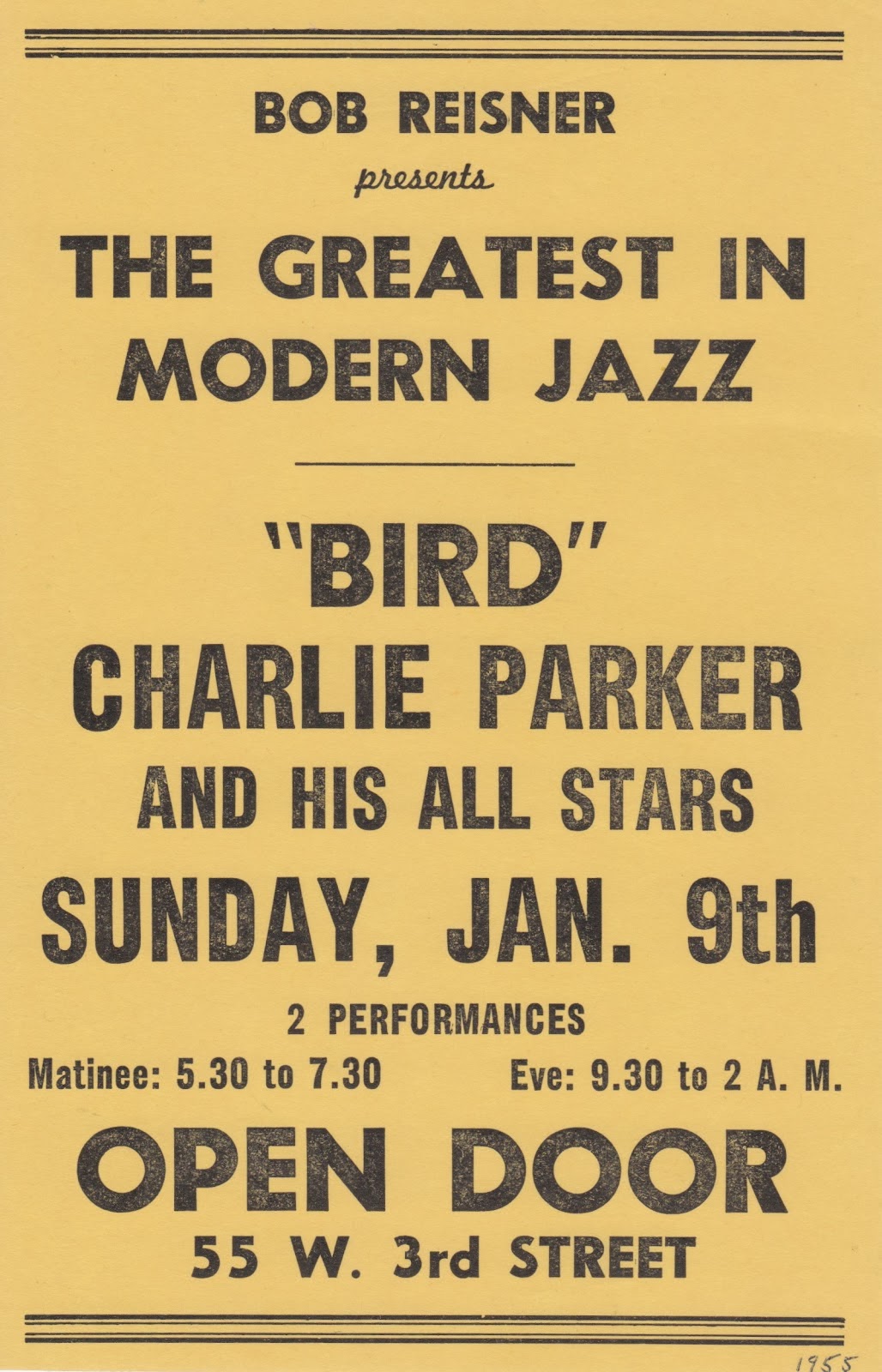
The death of Charlie Parker on March 12, 1955 had both an immediate and lasting impact on the New York art community. It wasn't just the musicians who grieved and grappled with the truth that Bird was dead, the painters and poets too strongly felt the loss of one of their idols. He was a hero made flesh: many of them knew Parker as much from seeing him around their Greenwich Village and Lower East Side (there wasn't an East Village yet) neighborhoods as much as they did from his stage appearances. Of course, they knew his records and would check him out at The Open Door on West 3rd Street when they could afford to do so, but the notion of the starving artist wasn't a punchline once upon a time.

Poster, The Open Door, Greenwich Village, New York City, 1955

According to the somewhat controversial record producer and writer Ross Russell, who owned Dial Records and who recorded some of Parker's most critically acclaimed music, within "a few days of the alto player's death there appeared among the graffiti on the walls in the Village and in subways, scrawled in black crayon or squirted out of pressurized paint canisters, the legend 'Bird Lives!" (Bird Lives: The High Life and Hard Times of Charlie (Yardbird) Parker by Ross Russell, New York; Charterhouse, 1973). Years later it was poet Ted Joans who was credited as the instigator of the graffiti. 

1955 newspaper obituary, source unknown

Ted Joans knew Charlie Parker and knew him somewhat well. Not too long after Joans arrival on the scene, he become known for his elaborate parties often costumed affairs. Author and promoter of the 1950s jazz sessions Robert Reisner claims that Bird turned up for one of these parties dressed as a Mau Mau and supposedly the January 1955 issue of John Preston Davis' groundbreaking African-American journal Our World featured one such party with Parker visible in the background. After returning from an extended engagement in Chicago in that same month, Bird was more or less a transient who relied upon the goodwill and couch space of others for shelter. At the time Joans shared a small apartment at 4 Barrow Street in the Village (don't go looking for it, it has been razed) just off of Sheridan Square and across the street from the Cafe Bohemia (that building is still there, occupied by the Barrow Street Ale House) and his roommate Ahmed Basheer brought a sick Parker home one night after finding Bird sprawled out on the sidewalk near their front door. As a result, Parker and Joans were de facto roommates off and on during last 2 months of the saxophonist's life.

Ted Joans at the Cafe Bizarre, Greenwich Village, New York, 1958

But just calling Ted Joans a poet is doing his legacy a disservice. Yes he was indeed a poet. In fact, he is now often referred to as one of of the original beat poets. Joans moved to Greenwich Village in 1951 around the age of 23 having moved to the big city from Illinois by way of Indiana University. Sadly, the history of the Beat Generation seems to have suffered from some degree of whitewashing as Joans seldom appears as more than a mere footnote. But he was clearly one of the first on the scene, connecting Gregory Corso not long after his arrival. He would later cite his biggest influences as Langston Hughes and André Breton. For his part, he thought himself as much as surrealist as he did a beatnik, although he certainly took advantage of the public interest in the latter as a way to have a forum for his art. By the time of his death in 2003, Joans had authored well over 30 books a remarkable body of work for any poet by anyone's standards.


The Hipsters by Ted Joans, Corinth Books, 1959

Joans creativity did not end with the printed word. At one point of time he was a trumpeter, although he reportedly threw his horn off a bridge as he felt the need to focus on other aspects of his life (this again according to Russell). He was a visual artist as well. Although largely known as a recluse, Joans befriended the Jackson Pollock and got to know the painter before Pollock died in the Summer of 1956. Joans most certainly was a painter, although examples of his work are relatively scarce both online and in the real world. However, one of his surviving works is from 1958 and is fittingly (for our story at least) titled Bird Lives!

The is only the tip of the iceberg that is the fascinating story of Ted Joans. I highly recommend digging deeper. 

Bird Lives! the painting is featured in San Francisco's de Young Museum Shaping Abstraction exhibit now through January 4, 2015.

As a teaser, here are a couple of short films that feature Joans a few years after the death of Charlie Parker. Bird Lives indeed!


Village Sunday by Stewart Wilensky, USA, 1960
(click on image above for fullscreen view)


Jazz and Poetry by Louis van Gasteren, Holland, 1964
(click through for a better screen view)

Thursday, June 20, 2013

Harry Babasin & The Jazzpickers (1958)

I thought that I would put up a quick post this afternoon. Truth be told, I have a bit of a backlog of entries at the moment. There are quite a few in the hopper, but I've been sidelined with some minor health issues and I should really be staying away from the computer. But I hate seeing the weeks fly-by without new posts, so here is most of the February 3, 1958 episode of ABC-TV's Stars of Jazz television program hosted by singer, pianist, and songwriter Bobby Troup (yes, he of Route 66 song and Emergency TV fame). Bobby's guests that week included bandleader turned manager Charlie Barnet, vocalist Pat Morrissey, and Harry Babasin. I believe I have mentioned this TV show before, but I will take this opportunity to point the curious reader to this wonderful blog which tackles the show in great detail.

Babasin, an unsung hero of jazz music on the West Coast of California, was initially a bassist who played with everyone from Louis Armstrong to Charlie Parker. He was also one of the first experimenters with the cello in jazz music. Of course my short shrift is not doing Harry justice and for a wealth of excellent information on Babasin and some of his more interesting musical activities of note, I highly recommend this page created by his son Von.

A final note. The guitarist in these clips is another talented obscurity by the name of Dempsey Wright, a fellow whose playing I have only recently been digging into. With 2 LPs of his own to his discographical credit, plus 3 appearances as a sideman, his recorded legacy is certainly less than proportionate to his chops. It's a shame, but thankfully we have these few more minutes of music to enjoy from someone else that may have been forever lost in the cracks of time. A special thank you to Babasin's son, Pierre, for making these clips available.


Tuesday, May 28, 2013

Le Sacre du printemps (1913)


The young girls of Le Sacre, original costumes and stage set, 1913 

Tomorrow, May 29th, 2013 marks the 100th anniversary of the premiere performance of Igor Stravinsky's Le Sacre du printemps, known more commonly by it's English title the Rite of Spring. There has already been much ballyhoo about the centennial and this entry may very well seem like another bit of carpetbagging (not unlike my Gatsby post of a few weeks ago), but the Rite is a fairly significant piece of music to me personally. Like many, I first heard it in a movie theater courtesy of Walt Disney's Fantasia. My Aunt Marianne took myself and my younger cousin Paul to see either the 1977 or 1982 theatrical run at the Cinema 21 in San Diego, California. Now Cinema 21 was not any run of mill movie theater: it was a single-screen 1,000-seat temple to modernity and one of the reasons I can't take today's multiplexes seriously. At the time of it's 1963 construction by Statewide Theaters it was the only movie house in the country set up to screen films in 35mm, 70mm, Cinerama, AND Cinema-scope. No small achievement. Even 15 years after it's opening it made an impression - certainly to a young boy such as myself. The experience obviously has stayed with me, reinforced over the years by countless visits to Disneyland capped off with what we called the dinosaur train: the Primeval World attraction.


Promotional postcard, Cinema 21, San Diego, California, 1963

The Rite of Spring sequence in Fantasia was of course set to visuals of the origins of the earth and the prehistoric days of the dinosaurs. And what 6 or 11-year-old boy doesn't like dinosaurs? I didn't care about the dissonance in Stravinsky's music, to my young mind it was just what the cogs of creation sounded like as fascinating creatures rose from the primordial ooze. I was captivated and I can recall the experience with some clarity to this day. I have revisited the film in recent years and am well aware that Stravinsky disowned the film upon it's 1940 release (although he cashed the check) not only for the truncated version of the score (due to time limits of the original theatrical release) but to the visual interpretation of the music. Yes it is flawed, but it served a purpose not only for my life but for so many other young ears across the United States that may have never been exposed to the savage beauty of Igor's music. Later through my development as a musician and as my interest in 20th Century modern jazz deepened, I approached Stravinsky's music from a different angle inspired at least in part by Charlie Parker's noted appreciation and admiration for the composer.


Walt Disney and Igor Stravinsky, Los Angeles, California, 1939

The performance that now intrigues me most is the Joffrey Ballet's painstaking 1987 recreation of the original 1913 Paris production. It was not only the music that ushered in the modern era of ballet, it was the angular, primitive choreography of the legendary Vaslav Nijinski and the earthy sets and costumes of Russian folklorist Nicholas Roerich combined with Stravinsky's brilliant music that made for such a revolutionary production at Sergei Diaghilev's Ballets Russes. For years, it was thought that everything buy the score was lost. After only a dozen or so performances in Paris and London, the ballet was not performed for 7 years by which time the choreography had already been forgotten by all of the principals. It's something of a modern miracle that the '80s reconstruction happened at all. But what the Joffrey most effectively did is help revive the exciting, primal nature of the piece: as Leonard Bernstein once famously exclaimed, 'it's about sex!'. And surely the Russian folk elements of the story which culminate in a virgin sacrifice thinly veils this strong subtext. But as the sacrifice of virginity can also be viewed as the creation of new life and rebirth, perhaps ol' Walt Disney wasn't so far off the mark after all!


Friday, March 22, 2013

Donn Trenner (1927)


Donn Trenner, Nola's Penthouse Studio, New York, New York, February 1947, photo by William Gottlieb

A belated Happy Birthday to pianist, arranger, and musical director Donn Trenner. Donn was born in New Haven, Connecticut on March 10, 1927 and has been in the music business since the age of 15. After many long, storied years he is back in Connecticut and often performs in New York City. His list of musical associations is just amazing, having performed and/or recorded with everyone from such modern jazz men as Charles Mingus and Stan Getz, to vocalists such as Nancy Wilson and Lena Horne...and not to mention legends such as Ben Webster. But of particular interest to readers is the fact that Donn Trenner is the member of a very exclusive club. A club whose membership is dwindling by the year. Donn is a rare bird indeed as he is one of the last surviving musicians to have played with Charlie Parker! 


Charlie Parker, Chet Baker, Donn Trenner, Larance Marable, unknown, The Tiffany Club, June 1952

To be honest, this may be just another footnote that I read with great interest, but then moved on to fill my head with more musical and historical knowledge, if it weren't for vocalist Shaynee Rainbolt who commented on a post of mine last year. One thing led to another and I found myself exchanging messages with Donn himself. So I took the opportunity to use this connection to ask Donn to go a little deeper into his association with Bird. The facts are pretty straight-forward. On May 29, 1952 the Charlie Parker Quintet opened up for a two and a half week run at The Tiffany Club in Los Angeles. The Tiffany Club was located at 3260 8th Street near the corner of Normandie, a part of LA was jumpin' in the early 1950s. The Haig club was just Northeast a few blocks, not to mention The Cocoanut Grove in The Ambassador Hotel. But that stretch of 8th Street itself was a hub with the 400 Club, The 331, and Agua Caliente all easily within walking distance from one another. Bird by this time had begun his latter-day association with Norman Granz and had most recently recorded for Mercury Records with the Joe Lippman Orchestra back in March in New York. Most of his live appearances at this stage of his career were as a single, that is appearing as a solo star backed by trio or quartet consisting of local musicians. Although Trenner spoke to James Gavin in depth for the latter's dark portrait of Chet Baker, Deep in a Dream, Donn was kind enough to answer some questions of my own about the experience:

A Modernist: Had you played with Parker before the rehearsals for the Tiffany engagement?

Donn Trenner: No, I had never played with him before 1952. 

AM: Tell me about how you got the call for the gig

DT: I received a call from an agent. The agent was Associated Booking Corporation. It's the same agency that Joe Glaser had in New York, only they had a Beverly Hills office. Cliff Aaronson called me and asked me if I would like to put the band together for Bird. And of course I said yes!

AM: What prompted you to hire the musicians you hired?

DT: I had some information from Cliff, that he [Parker] would like to have Larance Marable. And I think that he mentioned Chet Baker, although I knew Chet from all over for a long time. The story that Chet told was totally fictitious. It wasn't a trumpet competition, I called him and hired him.

AM: Did suffer any blowback from the other local musicians who you did not call for the gig?

DT: No, I did not suffer any fallout from anyone for not giving them a call.

AM: How about the claims that Parker changed his playing to allow for Baker's supposed deficiencies?

DT: I don't remember anything about Bird changing his playing to accomodate Baker's playing level. It's very possible. Although Chet was a wonderful player - perhaps inexperienced at that time in his own career, he played very well.

AM: Do you have any particular memories of Bird?

DT: My memories of Charlie were unbelievable. I remember that he loved Mexican food. So very often on breaks at The Tiffany Club we would take him over to a Mexican restaurant and he would stuff himself. He drank a lot. And he put it down rather quickly. But I found him delightful. Very personable. I found no friction or tension in the engagement with him.

AM: How about that photo of Helen Carr with the band?

DT: Of course, Helen sat in one night and that was the night that I guess Bill Claxton was there and took that picture.

Gavin's book provides some more info about the legend that sprang up regarding Baker's selection as the trumpeter in the combo. I can't really recommend the book (it's a tough read at times), but you can take a peek here.

If you want to dive a bit deeper into some of the highlights of Trenner's musical adventures, I strongly recommend this lengthy interview with Donn conducted by Harry Platcow. Enjoy!

Tuesday, January 29, 2013

David X. Young (1954)

Sam Stephenson's 2009 book, The Jazz Loft Project, was a recent holiday gift from my brother. Inspired by an upcoming trip to New York, I finally peeled off the plastic-wrap and and have started digging into it. The photos and text are just fascinating. Of course, it received a respectable amount of attention upon its initial publication, which is always a pleasant surprise for any jazz-related item. It also has an impressive web presence, thanks in no small part to a website dedicated to the project. Be sure to click through the links to access the 10-part radio series.


The Jazz Loft Project, Sam Stephenson, 2009

While Stephenson's book centers around the archives of and the era of photographer W. Eugene Smith, his neighbor and sublettor David X. Young piqued my curiosity. Young was the true start of the 'Sixth Avenue Loft' scene, having moved (illegally) into the space some time in 1953 or 1954. That part of Manhattan was years off from being zoned for residential use, but Young could not pass up the rent of $120 a month for 3 floors of the Mid-town building. Adjusted for inflation, that is less that a grand in today's money. So with a lot of determination, a little ingenuity, and a few well placed bribes, the painter Young innovated the work/live space concept right in the middle of Manhattan. 


Jimmy Raney Plays, Jimmy Raney, Prestige LP 156, 1954

Although he initially spent much his time with fellow abstract expressionist painters as Franz Kline and William de Kooning at The Cedar Tavern in Greenwich Village, Young was even more of a jazz fan than his contemporaries and preferred the company of jazz musicians. To that end, he moved an affordable, playable piano into his loft space and began hosting late- night jazz jam sessions.


The Modern Jazz Quartet, The Modern Jazz Quartet, Prestige LP 160, 1954

The sessions began to draw nearly every notable name on the New York scene, spanning several generations of musicians. Recollections by those who were there at the time, name not only the heavy hitters to whom history has been kind, but also many unknowns familiar to only the most fanatical discographers if at all. Miles Davis was there. As was Charlie Mingus, Jimmy Raney, Eric Dolphy, Jim Hall, Bill Crow, and Lee Konitz. In fact the list goes on and on into the hundreds. And while Bird was rumored to have made an appearance (once), it is known that Mingus was there in March 1955 when he learned that Parker had died.


Miles Davis Quartet, Miles Davis, Prestige LP 161, 1954

Although he did regular exhibit in galleries throughout New York and the East Coast, starting with his 1951 show at the Mortimer Levitt Gallery, Young took commercial art jobs to cover rent and keep food on his table. Through his increasing music connections he began doing sleeve design work for Bob Weinstock's Prestige Records, also based in New York City at the time. 


Art Farmer Quintet, Prestige 177, 1954

What is interesting and notable about Young's work compared to contemporaneous LP graphic designers such as John Hermansader or even Reid Miles, was Young's direct connection to the musicians. Young was not only a fan of modern jazz, but he spend a great deal of time in their company. To take it even further, it can be argued that in providing the venue for the laboratory-work that is the jam session, he had a deeper understanding of the music than even some of the most dyed-in-the-wool fans.


Leonard Feather Presents Jazz Club U.S.A. in Sweden, Jimmy Raney All Stars, Prestige LP 179, 1955

Also of note is the period of time when Young was doing his work for Prestige. The 10-inch Long Playing (LP) record was still relatively new, having been introduced to the record-buying public in 1948, but not catching on with jazz labels such as Blue Note until 1951. Of course, by the middle of the decade, the 10-inch LP was all but supplanted by the 12-inch LP, which not only provided higher-fidelity and more playing time, but also a larger canvas for commercial designers to work with. 


Encores, Phil Woods New Jazz Quintet featuring Jon Eardley, Prestige LP 191, 1955

Young was finally evicted from the space in 1964 and so ended the first chapter in New York's jazz loft scene story - although those familiar with the history of the music know it was just the beginning of that particular narrative. He managed to stay in Manhattan and continued to work up until his death in 2001. The address 821 Sixth Avenue (or Avenue of the Americas if you must) is now a legendary one and David X. Young's contribution to the music of the era can not only be seen on these 10 inch LP sleeves, but also in the music contained therein - as many of these combos first played together up in Young's loft.


Teddy Charles featuring Bobby Brookmeyer, Prestige LP 178, 1955

Editor's Note: as I continue to "discover"more LP cover art by Young, I will post them here. Please check back.

To view a gallery of Young's paintings, click through to his official site here.

For more Prestige Records 10" and 12" LP sleeves, check out this excellent site.


The Informer, David X. Young, 1961


Wednesday, August 29, 2012

Charlie Parker (1920)


Charlie Parker, Oscar Peterson, Ray Brown, July 1952 at Radio Recorders, Hollywood, photo by Esther Bubley

Today, Wednesday, August 29, 2012 marks the 92nd anniversary of the birth of the great Charlie Parker. Fortunately, there continues to be a tremendous amount of interest in (perhaps) the greatest modern jazz musician of the 20th Century.


Charlie Parker, Harry Babasin, Chet Baker, Helen Carr, Donn Trenner (at the piano, obscured), at The Tiffany Club, LA, May 1952, photo by William Claxton

I had planned on using the top photo of Bird in the recording studio for what was eventually released  as the first of Norman Granz' Jam Session LPs on Mercury Records, but this post covered the photo end of the topic much better than I could. By the way 4 sides were recorded that July day (actual date unknown) at Radio Recorders - and by sides I mean sides: each tune took up the entire side of a 33 1/3 RPM 12-inch disc.


I will also direct you to the above. This excellent 60-minute BBC documentary is both a great place to start for beginning Bird watchers as well as fans like myself who have already devoured a fair amount of info on the subject matter. Thanks to Marc over at JazzWax for originally bringing this to my attention. 

Finally, WKCR in New York is in the middle of their annual 72-hour back-to-back Lester Young/Charlie Parker birthday broadcast. If you jump now, you may still catch it. Otherwise, mark your calendars for next year, browse around their programming schedule, and maybe kick down a little cash if you can afford to do so.

Tuesday, May 29, 2012

Sonata for Flute, Viola, and Harp by Claude Debussy (1915)


The Jimmy Giuffre 3 photographed by William Claxton, an alternate shot of what was used on his first Atlantic LP

I've only recently (read as: last week) learned that Memorial Day here in the United States is also known as the unofficial start of Summer. Equinoxes aside, I guess I can accept this as it does make a certain amount sense. But what that means to me is not that I can start wearing white again, but rather that it is time to dig out the debut LP by the Jimmy Giuffre 3 on Atlantic Records. Recorded over the course of 2 sessions at Capitol Records Studios (possibly the Tower then in its first year of operation, but perhaps on December 3rd and 4th, 1956 in Los Angeles by reed player (and fellow Italian-American) Giuffre, Jim Hall (guitar) and Ralph Pena (bass), the LP gained its seasonal association for me due to my first exposure to "The Train and the River" as featured in Jazz on a Summer's Day (more on that one some other time). That aside, there is a warm breeze to the music that provides some aural hint of long sunny days. Something Los Angeles experiences more than many of us during the year perhaps, but at the very least there is vaguely something...well...Summery about the music.

For those of you who have not heard the original studio recording of the above mentioned classic, have a listen:


Every time I listen to this disc, I hear something more. Not only is it deep music but it swings like heck - even in the absence of a pianist or drummer. As I am want to do, I ended up spending a little time digging deeper into this topic. After retreading much of the same virtual ground online, I went to my bookshelf and reached for Ted Gioia's excellent West Coast Jazz: Modern Jazz in California, 1945-1960 from 1992. If you are a jazz head, dig those great West Coast sounds, and are looking to add to your Summer reading list, I cannot recommend this book enough. It's easily one of my favorite books written about jazz music. But (as usual) I digress. I recalled that Gioia devoted a chapter to Giuffre, which I re-read Monday morning. 


As well worn as my copy of West Coast Jazz is, it too is a work of art that always reveals a little something more every time I return to it. This time around concerned the origins Jimmy Giuffre 3. Giuffre is quoted by Gioia as having been inspired by Claude Debussy's Sonata for Flute, Viola, and Harp in putting together this particular combo with himself, Pena, and Hall in the respective flute, viola, and harp roles. Debussy! Of course the great French Romantic composer's name is familiar to those who have dug a little deeper into modern jazz, everyone from Duke Ellington to Gil Evans to Charlie Parker expressed admiration or showed some influence. But what is unique in this instance is how a single piece of music - and a piece of chamber music at that - influenced the concept of an entire combo, and across genres at that. 


Debussy and his daughter near the end of his life (and her's) enjoying a picnic.

This particular piece is one of Debussy's later works: he would die of rectal cancer only 3 years after completing this sonata. As a composer and artist, Debussy is fascinating, not only for his music and for the time he emerged from, but for his deep appreciation of and influences by the visual arts. He was remarkably modern, employing musical devices that many of us still have not caught up with. Dissonance and whole-tone scales aside, he composed beautiful and challenging music which fortunately has experienced a fair amount of appreciation over the years and is accessible both via recorded works and usually wherever large symphony orchestras perform regularly. 

I will in no way claim to be an expert on his music - I am a casual admirer - but I must say that it is one of his more interesting and appealing pieces. I've probably listened to it half a dozen times today and it, too, continues to reveal its layers with each subsequent listen. I suspect this will continue to be the case for years to come. But for now I am content with the perfect soundtrack for an early-Summer morning. Sit back, put on a pair of headphones, or stream this through your home hi-fi and enjoy!


Tuesday, May 22, 2012

Allen Edmonds Kenwood (2011)

Let's talk about Allen Edmonds. More specifically, their current version of the classic beefroll loafer, named the Kenwood. They introduced the production model, made in their Port Washington, Wisconsin factory, a few years back. Initially, I was a real fence-sitter. The burgundy and black versions were only available in gentry (aka brush-off aka plasticized) leather and the shell cordovan was a bit out of reach for me. And the tan saddle version shown above? Well, let's just say that the online catalog photo was a bit underwhelming.

But as I so often I do: I kept circling back around the Kenwood. Why? Well so often is the case a musician is involved. You see, when I was 14 (more specifically the Summer of 1985) I made a very important connection between music and clothing. I not only wanted to play music like my emerging heroes, but I wanted to dress like them as well. Of course it helped that Los Angeles (the closest metropolis to my suburban digs) was experiencing the Paisley Underground and a good friend fell in a group of kids he referred to as mods. In short, it was the first step on a lifelong path of the shoes matching the sound, as it well.

But let me get back to the Kenwood. You see, I never really dug beefroll loafers. Sure sure, I knew they had their admirers and their place - my English friends seemed particularly fond of them - but they just did not do it for me. And then I saw this...


That's West Coast jazz and pop master guitarist Howard Roberts circa 1955 or so in the recording studio in Los Angeles. For my eyes this shot (photographer, unfortunately, unknown) matches Francis Wolff's later celebrated Blue Note photographs in every way. It is just plain cool. But don't smoke, kids. Seriously. Most importantly with regards to this post, let's take a cue from my pal, Mod Male, and focus in on a detail...


Yes a beefroll loafer, probably black, replete with a rear seam detail that I had only seldom seen on examples of these shoes. OK, so maybe these shoes were alright after all. Fast forward to when I first saw the Kenwood, some of the details of the shoe appealed to me thanks to Mr. Roberts, namely the rear seam. But the Kenwood had another detail that appealed to me: the pinked edge of the tongue. And there was something about it that reminded me of another photo I had seen.


Miles Davis, photographed by the aforementioned Francis Wolff at Rudy Van Gelder's studio in Hackensack, New Jersey on March 6, 1954. Again, we can take a look at a detail up close...


While not as pronounced as the Allen Edmonds model, there is the pinked edge that had caught my eye. Very likely a tan saddle pair as well. And while we are at it, nice sock/trouser contrasts both in terms of color tone and fabrics. And while 1954 marked the beginning of Davis's adoption of Ivy League as part of his sartorial style (something I have written about a greater length elsewhere on this very same weblog), he was photographed 6 months earlier wearing what is most likely the same pair of shoes...


Chet Baker, Miles Davis, and Rolf Ericson photographed on September 13, 1953 at The Lighthouse Cafe in Hermosa Beach, California. Miles had kicked his habit and took a road trip to the Coast where he jammed with Baker and Ericson alongside his bandmate from the Charlie Parker Quintet days, Max Roach. By the way, a recording of this session was released decades later by Fantasy/OJC as At Last! And Miles's tan beefrolls were there...


So when I happened into the Allen Edmonds shop in Union Square last year during one of their semi-annual sales and saw the Kenwoods up close and personal, my perception had shifted enough to encourage me to try on a pair of the tan saddles. No gentry leather, decent looking, USA-made. Perhaps I could warm to these. Admittedly the slightly burnished look still left me a bit cold, but I was in the mood for something different and the price was right so I gave them a shot.

The verdict? Well, I've had a uneasy 8 month relationship with the shoes. On the plus side, they are sharp as a tack. The color was much more versatile than I had suspected. In fact, a couple of trips to A Shine & Co. (don't tell my tailor that I get my shoes shined - it's a long story) and several coats of Meltonian goldenrod shoe cream and the richness of the leather has really come to life. On the flip side, I broke a heel within a few weeks of owning the shoes. A simple repair for sure, but not terribly encouraging for my first Allen Edmonds experience. I should also say that they stretched rather quickly resulting in a not too pleasant fit for my 10.5 E feet. I've since solved that issue by wearing a pair of thick Wigwams or a cotton liner sock, but again somewhat rough seas for my maiden voyage with the shoemaker. Still, my Father swears by Allen Edmonds, so I will give them some more time. As for a recommendation? Well, I can only give a highly qualified one and I would love to hear about your Allen Edmonds experiences in the comments section below.

Friday, April 8, 2011

Bird at The Three Deuces (1948)

Recently, the wonderful Phil Schaap has posted several more installments of his (almost) daily radio show, Bird Flight on WKCR, to his online radio pagehere. Now if you are a fan of Charlie Parker and you are not familiar with Phil, I cannot urge you strong enough to give him some ear time. There are few people on the face of this earth that are able to marry such enthusiasm and scholarly knowledge of The Great One (Bird, with apologies to Wayne Gretzky).

The episode in particular that has caught my attention is from February 2, 2011 - incidentally his 41st Anniversary broadcast. You can listen to it here. Do note that you can download these for private use. In fact, I strongly suggest dropping it on your iPod/iPhone and taking a long walk outside. But I digress...

The gist of this particular installment is the argument offered that in March of 1948, Charlie Parker was at the peak of his musical prowess and his combo at that time - Charlie Parker and The All Stars - were never to be bettered. Highly subjective of course. But Schaap not only provides aural evidence by way of the Dean Benedetti recordings of the combo recorded at The 3 Deuces in NYC on 52nd Street. On top of that he has the written testimony of combo member Miles Davis, plus first-hand recollections from both Lennie Tristano and Tal Farlow, both of whom played interval combos opposite Parker's headlining combo at The Deuces. Bird at the top of his game? Perhaps. Give it a listen and give it some thought.

Subjective opinions aside, the most is compelling. Bird is easily in one of his most fluid and energetic modes and the excitement is still palpable - in spite of the low fidelity of the recordings (or computer speakers for that matter).

Here are a few images I trawled to give Schaap's narration some visual reference...

First, here is 52nd Street, in color, courtesy of photographer William Gottlieb in 1947 or 1948. We are looking East towards 5th Avenue. The 3 Deuces is on the South side of the street on our right...


Next, here is a close-up of the Deuces during the very engagement in question...


Next a somewhat familiar but still beautiful shot of Bird in flight, again courtesy of Gottlieb, quite likely shot during the same 1948 engagement...


Low res, I know, but here is a fairly rare shot of the All Stars on stage at the club. Nice bow tie, Miles. In fact, notice how everyone is wearing light-toned suits...


And finally, here is a shot of The Bill Harris-Charlie Ventura combo included only to show everyone just how damn small that stage was at The Deuces. Wow! I will never complain about a lack of square footage on a gig again...


Note: Schaap's broadcast does include the entire set of recordings from the March 31, 1948 date in question. Just be patient, he will get to them. It's just Phil's way of doing things.

Saturday, August 29, 2009

Charlie Parker (1920-1955)


Charles Parker, Jr.
Born August 29, 1920
Kansas City, Kansas

On today, the 89th anniversary of Bird's birthday, there are so many Parker-related topics I could riff on, but I wanted to talk a little bit about Dial Records - a record label that inexorably linked with the great musician.

Dial Records was founded in Hollywood in 1946 by UCLA alumn, jazz enthusiast, ex-Merchant Marine, pulp fiction writer, and Tempo Music Shop proprietor Ross Russell. Much has been written in praise and critical of Russell - but the simple fact remains that he was responsible for recording some of the most well-known Charlie Parker performances on disc. Tempo was located at 5946 Hollywood Boulevard, between Gower and Bronson right in the heart of Hollywood (don't go looking for the building now, it's a car lot). After witnessing the now legendary Dizzy Gillespie-Charlie Parker performances at Billy Berg's in December 1945 and inspired in part by Milt Gabler's Commodore Records/Record Shop, Russell began the label in early 1946 with what was supposed to be a session from the Gillespie-Parker combo. 16 jazz sessions, nearly all focusing on modern sounds, were recorded through 1948. After that time Russell focused on 20th Century Classical music. Several years later (1953) he even released a few folk and calypso discs. In 1954 the label folded and he sold the jazz masters which have since been reissued countless times. Parker died the following year.

The label was financially backed by Marvin Freeman, an attorney Russell had befriended while both were students at UCLA. Freeman was also responsible for the label's name, taking it from The Dial literary review, an influential transcendentalist journal published from 1840 to 1929. His law expertise was instrumental in seeing that Bird ended up in Camarillo State Hospital rather than harsher incarceration after his notorious 1946 breakdown. Freeman sold his share of the label to Russell sometime in late 1946.

Proto-beat artist, Wally Berman, was responsible for the record label's distinct and remarkably modern design - although it did clearly echo the journal which gave the label it's name. Berman was a Tempo Music customer and designed company letterhead as well as the canary and sepia label. In addition to credits for all of the performers on the disc (not standard practice on 78 records), the label bore the legend "Contemporary American Music" which was a bold (albeit true) statement for a jazz record company in the mid-20th Century.

Wednesday, June 17, 2009

Happy Birthday Igor Fyodorovich Stravinsky (June 17th)

Photo by Arnold Newman, 1946

Or Игорь Фёдорович Стравинский if you are so inclined. Born June 17, 1882 in Oranienbaum (renamed Lomonosov in 1948), Russia. Died April 6, 1971 in New York, New York.

I must admit that I hadn't given much ear time to Stravinsky's music until a few years ago when (somewhat on a lark), the missus and I attended a performance of the SF Symphony conducted by MTT. The highlight of the program by far was an earlier 20th Century piece from Stravinsky. It at once sounded both completely foreign and familiar. Now after having listened to much more of his work, I am struck by how much of an influence on popular music he was. What I mean by that is how much he influenced music that many of us take for granted - film scores. To call his work "cinematic" is actually inappropriate as he was composing long before our contemporary notion of cinema. And yet, you can hear the Stravinsky-influence in so many film scores from the 1940s through today. Of course, this is not only notable contribution to culture - modern classical and jazz music both absorbed his influence greatly. The latter has grown into somewhat legendary status with no less than Charlie Parker famously name-checking the Russian-born composer often as one of his favorites. Bird reportedly also had the opportunity to play for the man himself in 1951.

Saturday, May 30, 2009

Biddy Fleet (1939)

Biddy Fleet, 1940s, D'Angelico guitar
Photographer unknown
Used by permission by James H. Fleet

I recently read Brian Priestley's compact biography of Charlie Parker Chasin' the Bird. While I have been a longtime fan of Parker's recordings, I felt like taking a deeper dive into his history. Priestley give considerable ink to what had only been a footnote in most Parker biographies I had encountered to date; namely, the role that guitarist Biddy Fleet played in the Bird's exploration of melodies found in the extensions of the chords. Checking the endnote's I realized Priestley's source for Fleet's info was one of my favorite books about music ever - Ira Gitler's EXCELLENT oral history of the development of modern jazz, Swing to Bop. Referencing that book, I realized Fleet's interview runs a couple of pages and is a filled with great information about the era, Parker, and the guitar.

The guitar in jazz for years seemed to me to be such a post-modern instrument. Looking back now, perhaps I thought this because I was simply just so familiar with the guitar in a rock context and viewed instruments like the saxophone, trumpet, piano, upright bass, drums with some degree of romantic allure. "Discovering" bebop at the age of 21 with 7 odd years of guitar playing behind me, it just did not seem like my instrument was part of the pantheon. Bebop guitarists were for the the most part footnotes in the books and LP liner notes I read (pre 'net days naturally), and the few jazz guitarists I knew were more interested in people like Joe Pass and beyond.

One of the joys of returning to the guitar has been digging deeper into people like Charlie Christian, Oscar Moore, Bill De Arango, Chuck Wayne, etc. Information is so much more accessible now as are obscure recordings many of which 15 years ago were still only available as fragile second-hand shellac 78s. So, I was thrilled to find this small piece of history this morning while looking for some online images of Charlie Parker. Not only can I now put a face to the name Biddy Fleet, but now I can start to fill out his biography.

Saturday, May 16, 2009

Charlie Parker (1947)

It's YOUR Library of Congress.  Use it!

Thursday, August 7, 2008

Charlie Parker (1950)

I love Charlie Parker's music. From the moment I first heard Charlie Parker With Strings at Brandt Larson's (sp? sorry Brandt it's been a few years) house in high school, it resonated with me. Anyway, footage of Bird is as rare as hen's teeth (pardon the awful pun), so here is an excerpt from the Norman Granz production, directed by photographer Gjon Mili titled Improvisation from 1950, long believed to be lost. I could think of nothing more fitting to kick my blog off with than this. The full film is available on DVD now, so add head on down to your local video store or pick it up next time you are doing your shopping. Until then, dig this.