Showing posts with label film. Show all posts

Friday, March 20, 2015

Spring is Here (1938)


The first chart hit version of Richard Rodgers and Lorenz Hart's 1938 composition "Spring is Here", as adapted from the Broadway production of I Married an Angel. Reisman was an extremely popular bandleader during the 1930s who enjoyed success with his recordings of several songs that were to become jazz standards including "Yesterdays" and "Alone Together". The vocal refrain on his version of "Spring is Here" was by Felix Knight, known by most Statesiders of a certain age and older as Tom-Tom in Laurel and Hardy's Babes in Toyland.


4 years later, the song reached a wider audience courtesy of Jeanette McDonald and Nelson Eddy's performance of the song in the drastically tamer film version of I Married an Angel. The movie was a box-office and critical failure, known in the history books more for what it might have been rather than what audiences saw in the theaters. One can thank the Hays Code and its neutering effect on a lot of film adaptations of contemporaneous Broadway source material.


The first jazz version of song is a matter that is in dispute. The 1954 10" LP (and 7" EP) Interpretations by the Stan Getz Quintet featured a stand-out early adoption of the tune by younger modernists. Recorded in the Summer of 1953 in Los Angeles for Norman Granz's Norgran label, Getz was joined by Bob Brookmeyer on valve trombone, Johnny Williams (as in, yes, that John Williams) at the piano, Teddy Kotick playing the bass, and Frank Isola behind the drums.

For more details about this composition and its history, I heartily recommend the JazzStandards.com entry here.

Monday, March 10, 2014

Bill Crow (1958)

Bill Crow, double bass, Lambretta motor-scooter, West 4th Street, Greenwich Village, New York City, 1958

Jazz legend Bill Crow is a generous man. Not only was he kind enough to grant me permission to reproduce the above photo on today's post, but he spent some time answering a few questions that I thought would be of interest. Rarely on this blog do I explore the Italian motor-scooter aspect of the 20th Century modernist dispora, but this wonderful photo deserves some extra attention.

Bill starts off the story of his 1953 Lambretta 125 LD series 1 in 1954:

"I was living at 22 Cornelia Street in Manhattan in those days on the second floor. Cornelia Street only had parking on the east side and when the city went to alternate side parking, that street was only park-able on Tuesdays and Thursdays. I was driving an old Ford and was having so much trouble parking it that I sold it. I knew the writer Arnold Perl, who had a Lambretta over in the East Village. It may have been the first one in Manhattan. I realized that I could wheel it through my building and park it in the back yard so I bought one, their smallest model, from an agency in the west 50s that was selling them and figured out a way to carry the bass on it. I carried a small board with me that I could use to help me wheel the scooter up the three steps on my stoop at 22 Cornelia and I would chain it to a tree in the back yard."

The one-time blacklisted writer Perl has a fascinating tale of his own that certainly should be told in full some day. But back to our story. Crow was fortunate at the time to have a steady gig 3 miles uptown as part of pianist Marian McPartland's trio. He continues:

"At that time I was working six nights a week at the Hickory House on West 52nd Street and I left my bass there every night unless I had a record date or something. It was nice to ride the scooter midtown from my Village apartment and I could park it easily at the curb. I only carried the bass on it when I had a different job. While I was still living on Cornelia Street, the movie photographer Aram Avakian (George Avakian’s brother) shot a lot of footage of me carrying the bass on the scooter, which he intended to use in a documentary that he was planning about New York jazz clubs, but the film was sent to some funding organization in an appeal for a grant and I never heard any more about it."

Bill and I have discussed Avakian and film-making on these pages before (see link above), as that latter had an important role in the making of Jazz on a Summer's Day. Bill eventually found out that there was more to scootering than commuting for work:

"I took it camping one autumn, when Marian McPartland took 3 weeks off from the Hickory House to go home to England for a visit. I packed a pup tent and a sleeping bag on the luggage rack and drove up through the Adirondacks, up into Montreal, down along Lake Champlain, up to Baxter State Park in Maine, down to Acadia National Park, and on down the coast to Boston, where I met Marian who came back from England via Boston to visit some friends. We had lunch together and then I headed back to NYC. I stayed on the smallest roads I could find which still had a hard surface and really enjoyed seeing the northeast that way."

In 1956, Crow began a musical association with baritone saxophonist, composer, arranger, and bandleader Gerry Mulligan that would continue intermittently for several years. Mulligan was a bona fide international jazz star at the time which afforded Bill some unique opportunities:

"When I went to Italy around 1959 with Gerry Mulligan, I went to the Lambretta factory in Milano and bought a new scooter and had it shipped to New York. I sold the old one and I kept the new one in a garage on 7th Avenue next to Nick's. In the early 1960s I moved to West 20th Street in Chelsea and found another garage nearby where I kept the scooter chained to a water pipe."  


I asked Bill what finally signaled the end of this relationship with Lambrettas:


"When I returned from a later trip to Europe with Mulligan, I went to pick up the scooter and found that it had been smashed against the wall of the garage by a car or truck. The garage men claimed to not have noticed the damage. Their insurance company finally paid for the repairs, but I had already decided to buy a Volkswagen and I sold the scooter."

Thanks once again to Bill Crow for his time and consideration. It is truly an honor to have made his acquaintance via the internet.

**A footnote: according to Lambretta's official history; founded in 1947, the Milan, Italy motor-scooter manufacturing company did not start its USA division until 1955. Lambrettas were only available in a few American cities and in very limited quantities before that time.

Tuesday, March 4, 2014

Bird Lives! (1958)

Bird Lives! oil on canvas board painting by Ted Joans, 1958, courtesy of the de Young Museum, currently on exhibit through January 2015

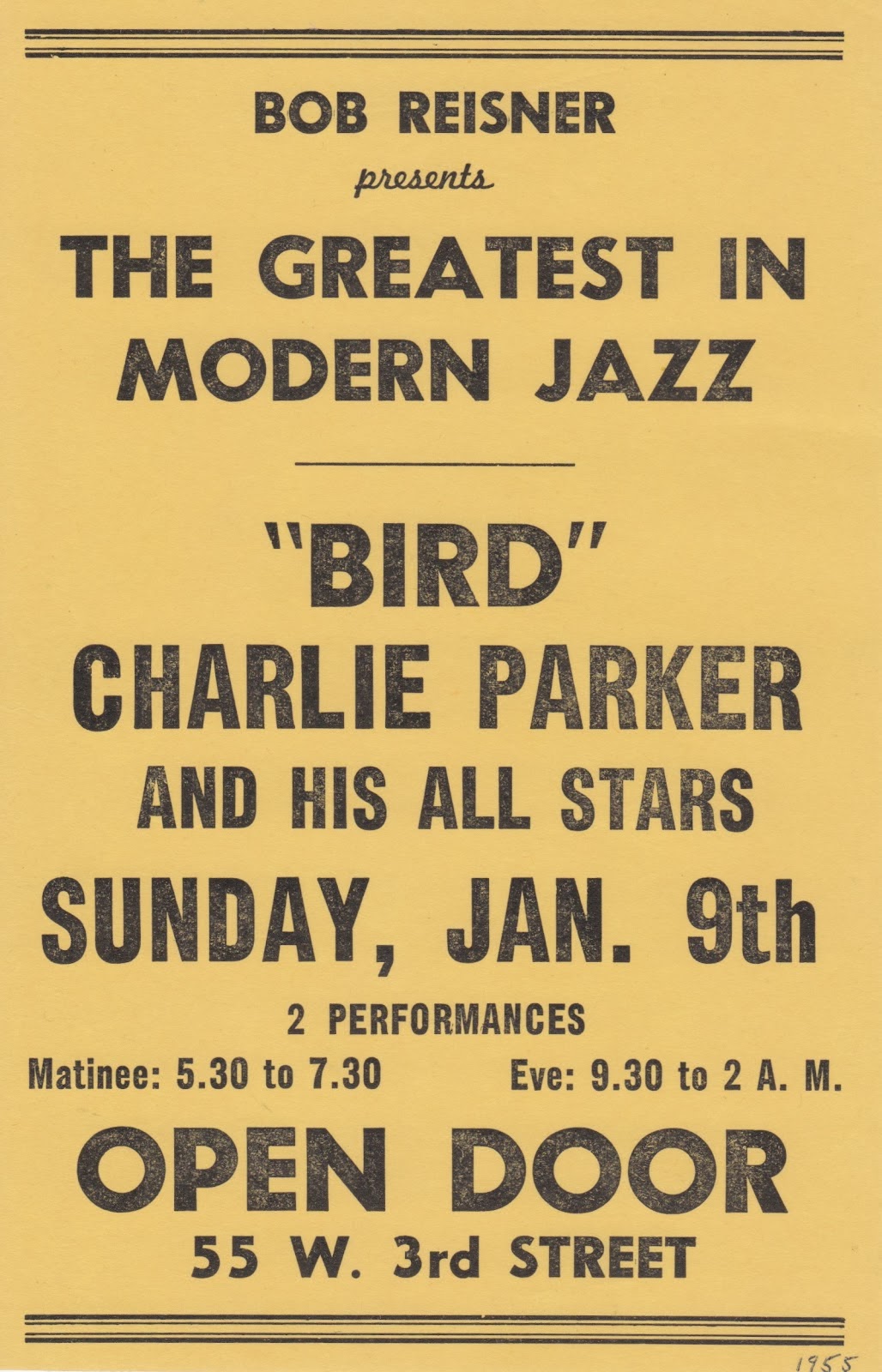
The death of Charlie Parker on March 12, 1955 had both an immediate and lasting impact on the New York art community. It wasn't just the musicians who grieved and grappled with the truth that Bird was dead, the painters and poets too strongly felt the loss of one of their idols. He was a hero made flesh: many of them knew Parker as much from seeing him around their Greenwich Village and Lower East Side (there wasn't an East Village yet) neighborhoods as much as they did from his stage appearances. Of course, they knew his records and would check him out at The Open Door on West 3rd Street when they could afford to do so, but the notion of the starving artist wasn't a punchline once upon a time.

Poster, The Open Door, Greenwich Village, New York City, 1955

According to the somewhat controversial record producer and writer Ross Russell, who owned Dial Records and who recorded some of Parker's most critically acclaimed music, within "a few days of the alto player's death there appeared among the graffiti on the walls in the Village and in subways, scrawled in black crayon or squirted out of pressurized paint canisters, the legend 'Bird Lives!" (Bird Lives: The High Life and Hard Times of Charlie (Yardbird) Parker by Ross Russell, New York; Charterhouse, 1973). Years later it was poet Ted Joans who was credited as the instigator of the graffiti. 

1955 newspaper obituary, source unknown

Ted Joans knew Charlie Parker and knew him somewhat well. Not too long after Joans arrival on the scene, he become known for his elaborate parties often costumed affairs. Author and promoter of the 1950s jazz sessions Robert Reisner claims that Bird turned up for one of these parties dressed as a Mau Mau and supposedly the January 1955 issue of John Preston Davis' groundbreaking African-American journal Our World featured one such party with Parker visible in the background. After returning from an extended engagement in Chicago in that same month, Bird was more or less a transient who relied upon the goodwill and couch space of others for shelter. At the time Joans shared a small apartment at 4 Barrow Street in the Village (don't go looking for it, it has been razed) just off of Sheridan Square and across the street from the Cafe Bohemia (that building is still there, occupied by the Barrow Street Ale House) and his roommate Ahmed Basheer brought a sick Parker home one night after finding Bird sprawled out on the sidewalk near their front door. As a result, Parker and Joans were de facto roommates off and on during last 2 months of the saxophonist's life.

Ted Joans at the Cafe Bizarre, Greenwich Village, New York, 1958

But just calling Ted Joans a poet is doing his legacy a disservice. Yes he was indeed a poet. In fact, he is now often referred to as one of of the original beat poets. Joans moved to Greenwich Village in 1951 around the age of 23 having moved to the big city from Illinois by way of Indiana University. Sadly, the history of the Beat Generation seems to have suffered from some degree of whitewashing as Joans seldom appears as more than a mere footnote. But he was clearly one of the first on the scene, connecting Gregory Corso not long after his arrival. He would later cite his biggest influences as Langston Hughes and André Breton. For his part, he thought himself as much as surrealist as he did a beatnik, although he certainly took advantage of the public interest in the latter as a way to have a forum for his art. By the time of his death in 2003, Joans had authored well over 30 books a remarkable body of work for any poet by anyone's standards.


The Hipsters by Ted Joans, Corinth Books, 1959

Joans creativity did not end with the printed word. At one point of time he was a trumpeter, although he reportedly threw his horn off a bridge as he felt the need to focus on other aspects of his life (this again according to Russell). He was a visual artist as well. Although largely known as a recluse, Joans befriended the Jackson Pollock and got to know the painter before Pollock died in the Summer of 1956. Joans most certainly was a painter, although examples of his work are relatively scarce both online and in the real world. However, one of his surviving works is from 1958 and is fittingly (for our story at least) titled Bird Lives!

The is only the tip of the iceberg that is the fascinating story of Ted Joans. I highly recommend digging deeper. 

Bird Lives! the painting is featured in San Francisco's de Young Museum Shaping Abstraction exhibit now through January 4, 2015.

As a teaser, here are a couple of short films that feature Joans a few years after the death of Charlie Parker. Bird Lives indeed!


Village Sunday by Stewart Wilensky, USA, 1960
(click on image above for fullscreen view)


Jazz and Poetry by Louis van Gasteren, Holland, 1964
(click through for a better screen view)

Wednesday, January 22, 2014

Nicholas Ray (1932)

A full two decades before film director Nicholas Ray was in his celluloid ascent - reaching a peak with 1955's Rebel Without a Cause - and long before Jean-Luc Godard declared that Ray indeed was cinema, the latter-day legend was just embarking on an artistic journey that eventually would lead him to the modern medium of film. This journey had some unlikely twists and turns, not the least of which was a year spent as an apprentice to famed architect Frank Lloyd Wright.


James Dean and Nicholas Ray, Los Angeles, California, 1955

Ray, later known as Nick to most of his West Coast friends and acquaintances, was born on August 7, 1911 in Galesville, Wisconsin with the given name of Raymond Nicholas Kienzle. 3 months earlier in Spring Green, 100 miles southwest of Ray's birthplace, the maestro Frank Lloyd Wright began work on his own personal residence and workplace. This came to be known as Taliesin, a Welsh word which in rough translation means shining brow and refers to Wright placing the structure on the top or brow of a hill. Wright was in transition, having recently returned from nearly a year in Europe which had marked the end of what was later called his Prairie Period.

Frank Lloyd Wright, 1930, around the time he first met Ray, photo by Price Studios

As a youth, Ray was an uneven student seemingly distracted by the big city delights of Chicago, where he spent much of his formative years. He returned to Wisconsin for his senior year in high school and showed a strong affinity for and ability in public speaking, English, and drama. Two years in a state college was followed by a tumultuous semester at the University of Chicago in the fall of 1931, after which he left for New York City to study theater. However the connections made in Chicago precipitated Ray joining the inaugural fellowship of Frank Lloyd Wright at Taliesin in 1932, some time after the two crossed paths again during an event at Columbia University.

Design Sketch, Capital Journal Building, Salem, Oregon by Frank Lloyd Wright, 1931-1932

Contrary to many claims and by his own account, Ray spent a year under Wright's tutelage. The concept of the Fellowship was that Wright felt only by living and working with apprentices around the clock could the understand his concepts and ideas. As a social experiment, it was quite interesting. Members of the Fellowship not only actively executed ideas on Taliesin itself (the buildings there in a state of constant change), but worked as draughtsmen, farmhands, and domestics on the property. Living was for the most part communal. One suspects that the strict rigors of life at Taliesin did not sit well with the restless Ray, but many have commented that a political rift between Wright, a strong believer in the power of democracy, and his more radical-leaning protege was the cause of the latter's return to New York, which would eventually lead him to Hollywood and the world of film-making.

Nicholas Ray, Hollywood, c.1945

However, the year spent with Frank Lloyd Wright would prove to have a tremendous impact on the artistic eye of Nicholas Ray. 34 years after his death, Ray's widow Susan stressed the importance of the period in an interview, citing the nature of the Fellowship as shaping Ray's ideal work methods, as well as the very idea that architecture (and film in Ray's) provided a framework for the arts. Ray himself professed that his love of what he called the vertical line was due to his time with Wright and attributed his fondness for Cinescope to an extension of that love.

Storyboard, Rebel Without a Cause, Nicholas Ray, 1955

An interesting footnote: the 2003 DVD release of Ray's masterful In a Lonely Place, made for Humphrey Bogart's Santana Productions, features a short film extra in which director Curtis Hanson sings Ray's praises and calls out some of the architectural elements in the film - citing the Frank Lloyd Wright period. Hanson, of course, directed 1997's L.A. Confidential a neo-noir film based on James Ellroy's novel. One of the buildings prominently featured in the film is the Lovell House designed around 1927 by Richard Neutra. Neutra had only recently moved the United States and one of his first employers before moving to California was Frank Lloyd Wright. The Lovell House is just 2 miles down the hill from the Griffith Park Observatory which is perhaps the most well-know location used in Ray's Rebel Without a Cause.

Tuesday, November 26, 2013

Chico Hamilton (1921-2013)


Blue Sands by The Chico Hamilton Quintet from Bert Stern's Jazz on a Summer's Day, 1958

Social media delivered the news that Forestorn "Chico" Hamilton passed away at the age of 92. The words legend and great are far too often abused these days, but Hamilton was both. As an innovative percussionist and bandleader, he was a somewhat singular modern American musician. I know people that have both studied and worked with him, so I can comfortably claim that he was also a true personality. For those interested in digging deep, I highly recommend listening to and reading his contribution to the Smithsonian Jazz Oral History Project here.


Print ad, Down Beat magazine, 1962

Regular readers will no doubt be well aware of my love of (and possible obsession with) Bert Stern's 1958 film Jazz on a Summer's Day. It has managed to work it's way onto these pages several times, but most notably here and here. Bassist Bill Crow also was kind enough to answer some of my related questions here.


Down Beat magazine, August 8, 1957

I have never really tackled the Quintet's performance of Buddy Collette's Blue Sands in print, mainly because - to me - it comes close to what many people call sacred music. More so than Mahalia Jackson's unquestionably moving spiritual in the film, Chico's appearance possesses a quality that transcends both genre and time. Deeply influential upon me too was the visual impact to the impeccably dressed quintet -which also featured at the time Collette's protege Eric Dolphy on flute and Italian-American guitarist John(ny) Pisano. To find out years later that the performance was filmed in front of an empty venue after the festival had completed for the evening due to a technical issue with the shoot made the power of the music all that more miraculous. Add to this his contributions to one of my other favorite films of all time (and something that I need to devote some more virtual ink to very soon), 1957's Sweet Smell of Success, and…well…almost needless to say, I am more than a little saddened to read of his passing in spite of his living a long, rich life.

Rest in Peace, Chico.

Tuesday, November 5, 2013

Deux Hommes Dans Manhattan (1959)


Released in France in October of 1959, Deux Hommes Dans Manhattan was director Jean-Pierre Melville's fifth feature film. A life-long Americanophile, the movie was one of only two that Melville shot in the United States. 


Cinema scholars and historians don't usually place Melville alongside the directors of what is now known as the French New Wave. Stylistically and thematically he was never entirely in sync with Godard, et. al. and he was several years older than many of the marquee names of that generation. That said, he was a mentor and inspiration to many of those film-makers. He also shared their love of American films, although he unashamedly loved big name productions rather than the more obscure favorites of the youngsters he inspired.


Deux Hommes Dans Manhattan treads some interesting ground between the "crime story" films that Melville would spend much of the remainder of his career pursuing and American film noir. The notion of film noir, of course, was something of a French construct in first place, it's moniker having been coined by French film critic Nino Frank in the mid-1940s. Melville's film comes at the end of the noir era and perhaps can be viewed as something of an homage to some of his inspirations that loosely fit stylistically into that genre.


There are also elements of what many consider French New Wave in the film: the film's pace and its moral ambiguity come immediately to mind. Interestingly enough, the location shots show this side of the film most explicitly, perhaps due to budget constraints and Melville's preferences when the camera was actually in his hand. New York is beautifully filmed and mostly done so at night, something very few American directors had done successfully up until that point. That said, the film sits very comfortably alongside - if not in between - Alexander Mackendrick's Sweet Smell of Success (1957) and John Cassavetes Shadows (1957-1959). I mention the former for its shared DNA of probing the somewhat sordid layer that exists just beneath the surface of Gotham society. The latter has the same feel of guerrilla film-making at times, although Melville's work shows no signs of improvisation.


All 3 films also share a driving jazz soundtrack, which by 1959 had become a signifier of sorts and almost requisite if one wanted to make a gritty film about big city living. In the case of Melville's film the bulk of the "jazz score" was provided by pianist Martial Solal making his debut as a film composer. Solal went on to compose the score to Jean-Luc Godard's groundbreaking À bout de souffle (aka Breathless) the year after this film, something he is perhaps best known for in spite of a career spent on the bandstand with some of the top names in French and American jazz. Incidentally, thanks to all of the interiors being shot by Melville in Paris, Solal may be seen briefly in a cameo as the pianist in the Pike Slip Inn scene.


As Deux Hommes Dans Manhattan went unreleased Stateside in 1959, it has been relegated to rep houses and film festivals for years, taking on an almost mythic quality due to its content, subject matter, and place in Melville's own film-making history. It was a box office flop, which seemingly did have some influence on Melville's subsequent career direction. It is a welcome surprise to see it now available on DVD and Blu-Ray from the Cohen Media Group (no relation to the contemporary American fraternal film-makers). Fans of noir, new wave, or just the crime jazz zeitgeist of the late-1950s will no doubt appreciate it at least one time around, while dyed-in-the-wool Melville fans (such as yours truly) look forward to being view another one of his films repeatedly with a critical eye.

Monday, September 9, 2013

September Song (1938)


September Song, sheet music, 1938

It is quite easy to see why Kurt Weill and Maxwell Anderson's "September Song" from the 1938 Broadway production Knickerbocker Holiday has been front of mind as of late. While Summer still lingers (particularly for those experiencing Indian Summers), the days truly grow shorter and it is only a matter of weeks before Autumn will begin to show its colors.


Kurt Weill and Fritz Lang in Hollywood, April 1938

German-born Jewish composer Kurt Weill had been living in New York City for 3 years in 1938. His residence in the most American of American cities marked the end of the first phase of his career in which he contributed greatly to the Weimar Republic soundtrack thanks to his rightfully celebrated collaborations with Bertholt Brecht. While in Germany, Weill was not only an active in populist left-wing politics but his music was celebrated the world over by avant-garde modernist composers such as Stravinsky, Berg, and Milhaud. Fleeing the Nazi regime, Weill and his wife settled in New York after short stays in both London and Paris. Weill soon began to self-consciously reshape his music to fit the mold of his adopted country. To show just how far he had come, 1938 saw him not only his collaboration with Anderson premiering on Broadway, but he spent some time in Hollywood scoring a movie for the Austrian-expatriate, Fritz Lang.


Maxwell Anderson, Time, December 10, 1934

Maxwell Anderson was a somewhat odd pairing for Lang. Born in Pennsylvania in 1888, he was twelve years Weill's senior. A scholar and writer, Anderson was also an outspoken pacifist - something that jeopardized his professional career on more than one occasion. Bouncing between writing and teaching jobs from North Dakota to San Francisco, he eventually ended up in New York in 1918 working as a journalist and playwright. Before meeting Weill and working with the composer on Knickerbocker Holiday, Anderson had experienced several Broadway hits. But what was perhaps most interesting about this particular stage production was the sub-text of the play. With the memory of the executions of Sacco and Vanzetti only 11 years old in 1938, Anderson had more than a passing interest in leftist-influenced anarchism. In fact, Knickerbocker Holiday is most often characterized by critics as a thinly veiled attack on then-President Franklin Delano Roosevelt's New Deal, something Anderson felt veered to close to the fascism that was dominating Europe at the time. 


September Song, Walter Huston, Brunswick Records, 1938

One of the stars of Knickerbocker Holiday was 55-year old Walter Huston, who requested a song be written for his character of advanced age to help woo a younger love interest. Weill and Anderson obliged with 'September Song' reportedly written start-to-finish within the span of a day. With it's roots going back at least as far Geoffrey Chaucer's 14th Century 'Canterbury Tales' (see The Merchant's Tale), the symbolic use of months of the year to represent differing ages was certainly nothing new in the late-1930s. But Weill and Anderson managed to breathe some new life into a well-worn device as well as come up with a rather touching plea for love. It's not terribly sentimental, but rather sweet lyrically and the music manages to hint just enough at the inevitability of the protagonist's demise without being morbid. 


John Huston and his father Walter Huston, 1940

Irish-American Huston, the father of maverick film director and actor John Huston, and the grandfather of actors Angelica Huston and Danny Huston, had a minor chart hit with his original 1938 recording of 'September Song'. Huston's version was allegedly President John Kennedy's favorite song, with JFK performing the number for private affairs, intoning Huston's croon. Whether or not Jack was aware of the politic undercurrents of the song's source it not something that is documented. In addition to their other post-1938 achievements, all of the principals eventually found varying degrees of success in Hollywood: Huston won an Academy Award in 1948 for his supporting role in The Treasure of the Sierra Madre; Anderson wrote the screenplay to Alfred Hitchcock's The Wrong Man in 1956; and Weill scored a select few films. When Kurt Weill died in 1950, Maxwell Anderson delivered the eulogy. At the time of Weill's death 'September Song' experienced a resurgence of popularity, thanks in no small part to its use in that year's September Affair motion picture and by the end of the decade it was firmly established as a standard in what is now called the Great American Songbook.

Further reading: follow this link for a more musical look at the song.

Further listening: give this great 1946 version a listen by pianist/vibraharpist Dardanelle featuring Joe Sinacore on guitar which makes for an interesting comparison to Teddy Wilson's 1944 version featuring Sarah Vaughan on vocals, Remo Palmieri on guitar, and Charlie Ventura on tenor saxophone.

Saturday, April 13, 2013

The Great Gatsby (1945)

The Great Gatsby, F. Scott Fitzgerald, 1925, first edition, cover by Francis Cugat * (see note below)

88 years ago, on April 10, 1925, Charles Schribner's Sons first published F. Scott Fitzgerald's The Great Gatsby. The novel was met with mixed critical reaction upon it's release and only moderate popular success. In fact, the first edition sold a mere 24,000 copies over the course of it's initial run. By the time Fitzgerald died on December 21, 1944 at the age of 44, the book had been out of print for several years.

F. Scott Fitzgerald, 1937, photo by Carl Van Vechten

Eight years prior, a second-year Harvard undergrad by the name of James Laughlin published the first New Directions anthology. The roll call of authors New Directions published in the subsequent few years is astounding, particularly as many were being introduced to the general public for the first time: Tennessee Williams, Lawrence Ferlinghetti, William Saroyan, Wallace Stevens, to name just four. In addition to spotlighting then-contemporary modernist literature, New Directions began reprinting many authors (such as Henry James and Evelyn Waugh) whose works had never been re-printed after their initial publishing runs had ended. 


The Wisdom of the Heart, Henry Miller, 1941, jacket by Alvin Lustig

Part of the spirit of New Directions was reflected in its strikingly modern dust jackets. In 1940, Laughlin was introduced to graphic artist, designer, and ex-Frank Lloyd Wright acolyte Alvin Lustig by bookseller and literary scene-maker Jacob Zeitlin in Lustig's Brentwood, California studio. Laughlin later said that he only needed to spend an hour with the artist before he knew he was in the presence of what he called "authentic creative genius". A commission for the jacket of the New Directions 1941 editions of Henry Miller's The Wisdom of the Heart and Carl Rakosi's Selected Poems soon followed. But while these works reflected the style Lustig had developed up until that time: his next series of work for New Directions, twenty-five books in the publisher's New Classics series, came to represent an iconic style for which Lustig (and to a lesser extent New Directions) is most well-known.

Alvin Lustig, 1945

Among the titles in the New Classics series was Fitzgerald's The Great Gatsby, which was published for only the second time in 1945. A new wave of book reviews followed in the wake of the release. This time around Fitzgerald's novel was being reconsidered, not as the period piece it had been regarded as for the most part over the prior twenty years, but rather as something important and perhaps great. To the point, the New Classics edition marked the beginning of The Great Gatsby as being a true classic of modern American fiction.

The Great Gatsby, F. Scott Fitzgerald, New Classics 9 / New Directions 1945 edition, jacket by Alvin Lustig

Momentum continued on both scholarly and popular fronts through the end of the decade. Somewhat ironically, Paramount Pictures in Hollywood began a film adaptation production in 1948 directed by Elliott Nugent and starring Alan Ladd which was released in July of 1949. The irony lies in the fact that Fitzgerald spent his last booze-soaked years in Los Angeles trying to eek out a living writing for films. This first film adaptation drew from both the original novel as well as Owen Davis's 1926 short-lived adaptation for the Broadway stage. Incidentally, the screenwriters were Cyril Hume and Richard Maibaum, the latter being the very same Richard Maibaum who wrote the screenplays of the majority of James Bond films from 1962-1989. In the academic world, at least two books were published in 1951 concerning themselves with Fitzgerald's life and importance. This opened the floodgates to several scholarly works at the highest levels of academia, the sum total of which set The Great Gatsby on the pedestal upon which it still rests today.

Alan Ladd, 1948 Paramount Pictures promotional photo

For further reading, I highly recommend this excellent 1960 New York Times piece.

* An entire weblog entry could be devoted to Francis Cugat's somewhat controversial cover art for the original 1925 edition. Here is what purports to be the untouched original painting, although I cannot vouch for its authenticity. Fitzgerald (perhaps influenced by Ernest Hemingway) later claimed he hated the cover and went to great lengths to apologize for it. And yes, Cugat was the brother of the famous New York-based bandleader who popularized the rhumba: Xavier Cugat. 

Tuesday, February 12, 2013

The Street Swingers (1958)


The Street Swingers, Brookmeyer/Hall/Raney, World Pacific Records 1239, 1958

A true anomaly in both image and recording locale of the Pacific Jazz/World Pacific record catalogue is 1958's The Street Swingers LP. Credited to Brookmeyer/Hall/Raney with Osie Johnson and Bill Crow, it is a session nominally led by valve trombonist Bob Brookmeyer (who also provided the liner notes), but featuring compositions by all 3 of the principles - the other 2 being Jim Hall and Jimmy Raney. It was recorded in New York City on December 13 and 16, 1957 at Coastal Studios with production credited to label-owner Richard Bock. The cover photo was shot by Lee Friedlander. It's all very interesting enough, but is why does this warrant our time today?


Jazz on a Summer's Day opening sequence, filmed July 3, 1958, directed by Bert Stern

For me, the image Bob Brookmeyer is a very primary jazz image. Any time I see a photograph of him or hear his name, something in me recalls seeing him in the opening minutes of Bert Stern's beautiful color celluloid document of the 1958 Newport Jazz Festival. Even if for a moment, I remember being an impressionable 19 or 20 year old kid, eager to learn more about jazz and being captivated and confused by Jimmy Giuffre's trio - which seemed to be both hip and square at the same time. Brookmeyer looked more like a U.S. Naval officer with his cropped haircut and aviator glasses - but filtered through an Ivy League lens and playing challenging but funky (yeah that's right, I called him funky) modern jazz. At the time my modest jazz record collection consisted of the basics - Miles, Monk, Coltrane, and a smattering of organ-centric Blue Notes - but here was this lanky, kind-of-goofy-looking white cat ushering me down a whole new path.


Bob Brookmeyer, unknown (possibly Lee Konitz), Bill Crow, Jim Hall, Jimmy Raney, c.1957, photo by W. Eugene Smith

So needless to say, when I spied Brookmeyer in the corner of a W. Eugene Smith photo featured in Sam Stephenson's The Jazz Loft Project book (which I mentioned a couple of weeks ago), it resonated in some subtle way. And of course, seeing Bob engaged in a jam session with two guitarists that I have been paying more and more attention to over the past year and a legendary bass player with whom I have had the pleasure to exchange a few emails, I became more and more intrigued by the candid photograph. There is certainly a feel to The Street Swingers that could only come about due to the collaborative musical experimentation that can result in the best of casual jam sessions. The LP doesn't feel like a Prestige-styled blowing session or a over-formal presentation of compositions that one might find on a Capitol Records disc. The music exists somewhere between those extremes. I began to suspect that the two recording sessions perhaps may have come as a result of the Sixth Avenue sessions.


Brookmeyer, Hall, Raney, 1957, photo by Lee Friedlander taken from the rear of the LP sleeve 

After doing my basic due diligence and re-aquainting myself with the LP, I reached out to bass player Bill Crow. Bill is not only featured in the Smith photo but also on the World Pacific LP. As I did not know the exact date of the photo, I was curious how the Sixth Avenue loft fit into the story. Crow was kind enough to respond to me:

Raney and Hall played together at the loft several times, and Brookmeyer and I were there a lot, too. The two Jims would often be plugged into the same amplifier, since there was only one at the loft. Jim Hall had come to NYC with the Giuffre trio, with Jim Atlas on bass. When Giuffre found that Bob was available, he replaced Atlas with Brookmeyer.

Bill went on to tell me, "We were all living in Greenwich Village at the time, and hung out a lot together. The album was probably Bob's idea." Brookmeyer had an existing relationship with label-owner Dick Bock having had appeared on a number of Pacific Jazz sessions as both a sideman and leader before December 1957. Hall, too, had done a similar number of sessions for Bock in both roles, perhaps most notably the first Chico Hamilton Quintet LPs as well as Hall's debut disc under his own name. Brookmeyer and Raney had a history of collaboration stretching back over several years and several sessions. And Crow, of course, was a big part of the New York scene at the time. 


Lee Friedlander, 1960, photo by William Claxton

One final curious detail is that of the cover photograph. I suspect most who are in interested in 20th Century photography are familiar with Lee Friedlander. And while the cover has a great Winter in New York City feel, it is far from typical Friedlander, as it is not only in color but very much a posed portrait. At the time he was still 6 years away from his first solo museum show and the notoriety that came with it. At the time, he was a commercial photographer who shot a fair number of musicians particularly due to his association with New York's Atlantic Records as a house photographer starting in 1956. The World Pacific one-off gig very likely came about as the result of his friendship with Bock's main-man behind the camera William Claxton. Clax and Lee were good friends, the latter even served as the former's best man at his 1959 wedding to Peggy Moffitt that took place in NYC. As a footnote, when I mentioned how evocative the "street scene" of the cover photo was, Bill Crow corrected me, "Actually, the photo was taken on the roof of the recording studio. Lee wanted more light."

Editor's Note: if anyone knows where Coastal Studios was/is located, drop me a line. I could find only passing references to the facility.

Tuesday, January 15, 2013

The Twilight Zone (1959)


One of my lasting childhood memories, is that of staying home from school when I was sick. I would typically stay in bed through the morning, sleeping off whatever bug I had. Some time close to Noon, I would gather my blankets and migrate to the couch. It was there I would spend the next few hours, sipping 7 UP, eating soup, and watching The Twilight Zone. The television station was KTLA, a local Los Angeles area station owned by the singing cowboy Gene Autry from 1964 through 1995 (the station was also home to Autry's professional baseball team the California Angels, who were our team in those suburban days). If memory serves me correct, The Twilight Zone was aired weekdays at Noon - possibly with 2 episodes back-to-back, obviously well into syndication as this was the late-1970s and early-1980s. Between this and KTLA's annual Fourth of July Twilight Zone marathon, it was ensured that I saw nearly all 156 of the original episodes at least a couple of times. So it was with these memories at the back of my mind that I embarked upon the first season of The Twilight Zone last month when I had the flu.


Rod Serling, CBS Television Studios, New York, 1955, photo by Loomis Dean

The first season of the original series ran from October 1959 through July 1960 on CBS in the USA. It was shown on Fridays at 10:00 PM Eastern Time. All of the episodes of the first season had a running time of just under 30 minutes. According to this exhaustive listing, the first 36 episodes were pre-empted 3 times and 2 reruns were shown before its inaugural run was complete. It was, of course, the brainchild of a very peculiar figure in television history: Rod Serling. Serling, who turned 35 during the first season, had already won 3 Emmy awards for his screenwriting efforts before the series debuted. The series would earn him his fourth. Serling, who had fought for the U.S. Army and earned a Purple Heart during the Second World War in the Philippines, had his fair share of conflict with both sponsors and censors in his early television career as he was not shy about tackling controversial social and political issues. At the time in a televised interview with Mike Wallace, he called The Twilight Zone the culmination of 12 years work. Perhaps most important was Serling's attitude towards the serial. In the same interview with Wallace he referred to the episodes as "adult...extremely polished films." He was also quick to categorize them as a mix of fantasy, imagination, and science fiction. In short, it was a very serious view of the burgeoning entertainment medium and one that set him apart from many of his contemporaries.


The Twilight Zone, Season One introduction, second variation


Seeing these early episodes again, thirty years since I first experienced them, I was not only pleasantly surprised by the longevity of writing but enjoyed discovering the many Mid-century modern Easter eggs that I know understand helped shaped my young consciousness. The overall mood and style is still arresting. If modern jazz captured the psychosis of post-war years in sound (as has often been argued), I can think of no single television program that managed to do the same on dramatic terms. There is an over-arching anxiety the permeates every episode. Not the manufactured fright of the Red Scare, but the rather palatable fear of modern life in the shadow of the mushroom cloud. There is the anxiety that society is not what it thought it was. And there is the dissolution of the American Dream, an idea upon which the counterculture of the late-1960s would hinge itself. Sure, not every episode hits the mark, particularly over the course of the first few months over which principle writer Serling finds his footing. But when it is good it is good in a way the resonates in a manner of the some of the best art of our time. Did television ever really get any better?


Alfred Hitchcock and Bernard Hermann on the set of Psycho, c.1959-1960

For us Moderns, there are treats at every turn. The original theme music, used throughout the first season, was composed by no less than the maestro of suspense himself Bernard Hermann. Hermann was quite well known by this time having recently scored Alfred Hitchcock's Vertigo. In fact, he was working concurrently on the score for Psycho at the same time as he scored some of The Twilight Zone  episodes (which he did in addition to the main title) and there are some stylistic similarities between the two ventures at times. It's a moody piece, not quite as aggressively avant garde as the theme written by Marius Constant for the second season (widely known to most as the theme to the series) and played by jazz great Howard Roberts on his Fender Telecaster electric guitar. The opening titles to the first season were created by the mad genius animators over at UPA and clearly echo the abstract feel of some of their more well-known work, particularly in the realm of children's animations. In fact, one of the cool things about the show is it's clear New York - Los Angeles axis, something not always evident in productions during this era. There is a definite New York feel to much of the show's content and story lines. But much of the production was done in and around Los Angeles (Serling himself remained a New York resident for quite some time). And of course, there are the many wonderful actors and directors who make their appearances at all points of their career junctures. It is simply amazing how many familiar faces grace the small screen over the course of the 18 hours of footage from the first season alone. But rather than bore you with a laundry list of names, I will just remark how surprised and pleased I was to see jazz and fashion photographer William Claxton's name appear onscreen as the director of The Last Flight (episode 18, February 5, 1960).


In parting, above is the Mike Wallace September 22, 1959 television interview that I referenced earlier in today's weblog. Clocking in at just over 20 minutes, it provides great context to this cornerstone of popular American culture at it's birth.

Tuesday, November 20, 2012

Vertigo (1958)

The legacy of Alfred Hitchcock's Vertigo looms over the city of San Francisco - particularly for those of us with an interest in cinema, the 20th Century, and popular culture. For example just the other day this article ran in our local daily And, as you can see, there is no shortage of controversy over a seemingly simple matter - a facade that was preserved on celluloid for a mere few seconds. And yet, it manages to rile emotions to rival any other issue at hand. So what with that and Sascha Gervasi's Hitchcock opening in select theaters this Friday, I thought I would take another look at Hitch. More specifically, let's take another look at the opening title sequence credited to the great modern designer Saul Bass.


It's an impressive piece of film. Here is the sequence in stills, courtesy of Christian Annyas. The visual brilliance of Bass is married perfectly to the musical brilliance of Bernard Hermann.


Vertigo title sequence still, designed by Saul Bass, 1958

Or at least it is credited to Saul Bass.

One rabbit hole I recently went down led me to the Vortex concerts that took place here in San Francisco in 1957. While the concerts certainly deserve an entry of their own, in short the concerts took place at the Morrison Planetarium in Golden Gate Park, sponsored by KPFA and the California Academy of Sciences. The concerts were put together by Henry Jacobs, who I know of through his side-splittingly hip disc, The Wide Weird World of Shorty Petterstein on World Pacific Records (1958). I had re-listened to the disc on the way to a gig recently, when my interest in Jacobs was rekindled and I spent some time following what online leads there were on him.


A Chicago-native, Jacobs moved to SF in 1953. He was part sound collagist, part comic, and all hipster (in the best sense of the word). His "spoken word" recordings really deserve repeat listenings as they truly get funnier and funnier. His musique concrete works are admittedly over my head a bit, but still of interest. It is with the latter that he collaborated with visual artist Jordan Belson on the Vortex concerts. Jacobs was intrigued by the Planetarium's surround-sound which consisted of 38 speakers positioned throughout the auditorium. He saw the potential in such a system for musical performance and the visual aspect was a natural partnership. It was a successful happening and performances continued throughout 1959 (including a 1958 appearance at the World's Fair in Brussels). Folkways Records released a compilation of some of the music and remains in print. By all accounts, the performances were innovative precursors to the sound and light shows rock music would adopt in the late-1960s (not to mention "laserium" shows decades later).


Highlights of Vortex, Folkways LP, 1959

During the run of the Vortex series, Jacobs and Belson drew from the talents of several additional artists. On the musical side this included Bill Loughborough, whose shortlist of accomplishments included co-writing "Better Than Anything" (popularized by the great Bob Dorough) with room-mate and Kingston Trio bass player David "Buck" Wheat and playing percussion for Chet Baker's combo for several years in the mid-1950s. The group of contributing visual artists included two Southern California-born brothers named John and James Whitney.

John and James Whitney, c.1955

Both brothers were experimental film-makers whose abstract visual collaborations stretched back to 1939. John was born in Pasadena, California and went to college at the nearby Pomona College in Claremont (which among other things is where I wasted away a good portion of my high school years over copious amounts of Earl Grey tea!). Upon graduation he spent a year in Paris studying music with René Leibowitz. Liebowitz in turn had studied with both Maurice Ravel and Arnold Schoenberg and instructed Whitney in the latter's 12-tone system of music. But upon his return to California, Whitney shifted his focus to the visual arts often in partnership with his brother.


Variations on a Circle, John & James Whitney, 1941-1942

The imagery was linked back to music, certainly in the artists minds, but later more explicitly in the soundtracks the brothers selected for each. Early films were analogue in a true sense of the word, with the images being manipulated by hand for the camera. In this, the brothers were very successful. They continued using this method for just over a dozen years and just about as many films. Both worked on their own projects in addition to their collaborations. John even did 3 films for UPA. But some time in the early-to-mid-1950's the brothers hit upon a notion of how to use machinery to better articulate their goals. Using surplus military parts, John constructed their first "computers" which they used to make their animated features. Several years later, John explained for a documentary team:


Computers: Challenging Man's Supremacy, 1976

By now, I am pretty sure you can see where I am going. Well it turns out that one of John Whitney's side projects was a full-blown collaboration with the design firm of Saul Bass. The result of this collaboration? Why the title sequence to Vertigo of course! Several reliable sources confirm that the two produced the piece together, although Bass solely received the credit onscreen. What is perhaps most interesting when one takes another look at the sequence after ploughing through this weblog entry is how closely tied the titles are to the other work of the Whitneys. In fact, add Hermann's strikingly modern score and it is not a world away from what one may have experienced at the Morrison Planetarium in 1957 or 1958 at one of the Vortex concerts. And considering that Hitchcock was in San Francisco filming at that very time...well, let's just leave it there for now. A little suspense never hurt anyone and something tells me this is not the end of this story!


Catalog, John Whitney, 1961