The Christmas Song, Nat "King" Cole, live on The Nat King Cole Show, December, 17, 1957
Tuesday, December 25, 2012
Tuesday, December 18, 2012
Leonard Bernstein (1963)
This will be our reply to violence: to make music more intensely, more beautifully, more devotedly than ever before.
- Leonard Bernstein after the death of President John F. Kennedy
Tuesday, December 11, 2012
Dave Brubeck (1920-2012)
Dave Brubeck, Cal Tjader, Ron Crotty, 1950
Last week's death of pianist, composer, and bandleader Dave Brubeck continues to be on my mind. So much so, that I have been working on a short series of weblog entries that I plan to publish these over the next few weeks. The focus will be on aspects of Brubeck that the ample coverage of his death may be overlooking in my humble estimation.
In the meantime, if you somehow missed the news, here's the New York Times obit.
For those of you that wish to dig deeper, I highly recommend this amazing interview with Brubeck conducted by Ted Panken in 2007. It focuses on his early years and is just fascinating.
May he rest in peace.
Labels:
California,
Dave Brubeck,
jazz,
San Francisco,
west coast
Tuesday, December 4, 2012
Oscar Moore and Fender (1951)
Oscar Moore was near the peak of his popularity in 1947. For over ten years, he had been a member of the King Cole Trio whose string of nationwide chart hits started in 1943, including in a number one pop record on the emerging independent Capitol Records, "(I Love You) For Sentimental Reasons" in the Autumn of 1946. The Down Beat readers voted Moore the top guitarist of 1945, 1946, and 1947. He appeared in print ads for Gibson guitars, had guitar transcriptions published, and appeared on all-star radio and recording dates. Moore also commanded a tremendous amount of respect among his peers and influenced guitar players ranging from his near-contemporay Barney Kessel to a then teenage Kenny Burrell.
The King Cole Trio up until the time had been more or less a collective, with Moore an equal partner in the enterprise. But the hits all prominently featured the vocals of pianist Nat "King" Cole. Buoyed by success and reportedly encouraged by his soon-to-be wife among others in his management, Cole made a power-play in the latter part of the Summer of '47 that would regulate Moore to the financial role of a sideman. Moore called his bluff and walked. And why not? Moore had already released a handful of "solo" discs on Atlas Records (onetime home to the King Cole Trio) featuring the Los Angeles based combo, Johnny Moore's Three Blazers. Johnny (Oscar's older brother) and the group were experiencing their own run of popular chart hits that betrayed their blues-baked Texas roots. So it seemed not only natural but something of a lateral career move when Oscar walked away from Nat and into the Three Blazers.
Unfortunately, the Three Blazers combo had vocalist issues of their own. Charles Brown, the trio's popular pianist and vocalist, decided to sign a solo recording contract in 1948 leaving the Three Blazers in the lurch. The age of the singer was in full swing, thanks in no small part to the extraordinary popularity of Frank Sinatra. The group struggled for years to find an adequate replacement but Oscar drifted further and further afield. At the dawn of the studio session era in Los Angeles, Moore found some work backing people such as Illinois Jacquet (Clef Records) and Billy Hadnott (Federal Records), as well as eventually cutting some discs on his own starting in 1954.
As I discussed on this weblog before, it was around this time that Leo Fender was perfecting his first great contribution to musical instruments, the Fender Telecaster, just a few miles from Moore. Leo was known to be a fan of Western Swing and quite famously made sure his guitar got in the hands of top players like Jimmy Bryant. What is not as well known is the fact that he got one in the hands of Moore. To add to the obscurity, Oscar Moore's "Nocaster" (so named as it was produced in the early to middle of 1951 just before the Broadcaster was renamed the Telecaster) was one of the most unique examples of the guitar in terms of finish and hardware that is know to have existed.
What makes Moore's Fender so unique? The biggest aspect is it's gold hardware. Based on other examples of these guitars from the same era, this is the first as well as the only for several years to sport gold metal hardware. Gold metal hardware was commonplace on higher-end archtops at the time, which most jazz guitarists preferred. But Leo's guitar was a working man's instrument seemingly fairly devoid of any such loft aspirations. This shows that maybe this is not the entire story. The guitar is also finished in white. A simple enough characteristic and certainly a color that would become fairly commonplace on Fenders by the end of the decade, but in the nascent days of the company nearly all of instruments produced blond(e). The gold pickguard, again, seems to be a complete one-off and unlike anything Fender would produce for years to come. If Guitar Geekery is your thing, you can read more about the actual instrument here.
Nat "King" Cole and Oscar Moore (possibly Jack Costanzo in foreground), 1951. Photo by Leo Fender.
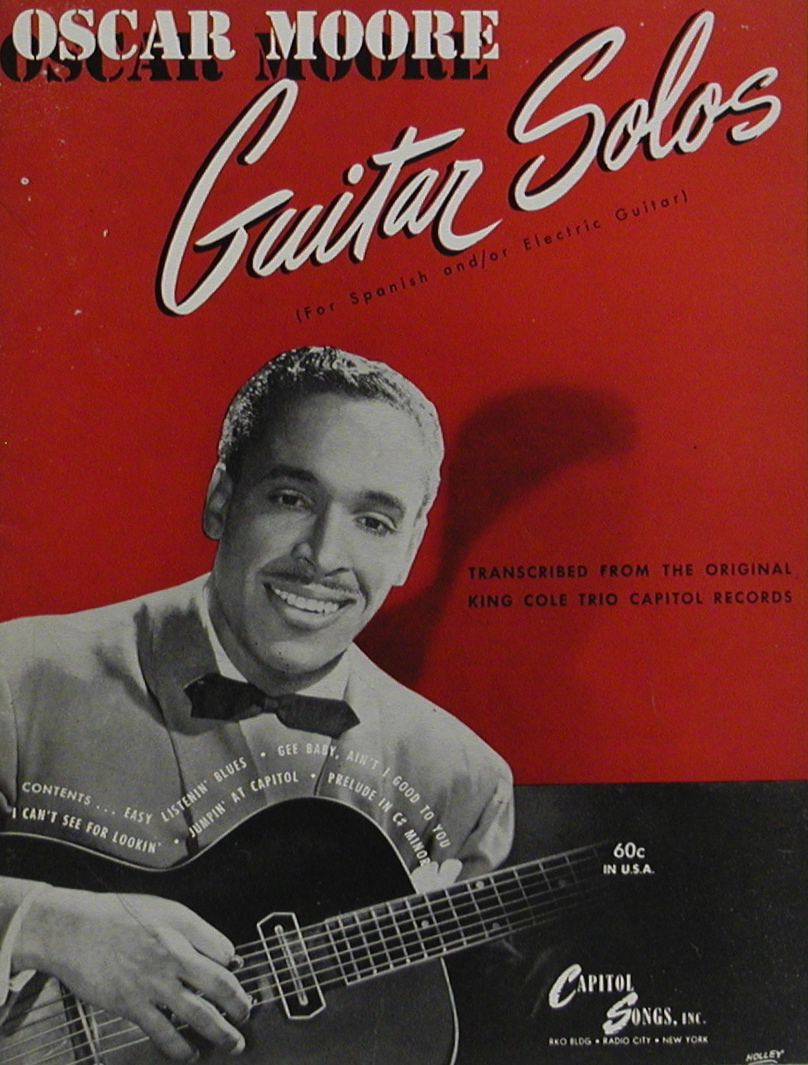
Oscar Moore Guitar Solos, published by Capitol Songs, 1946
Atlas Records, 1945
Ooh Chica, Billy Hadnott And His Orchestra (featuring an uncredited Oscar Moore), 1952, Federal Records
As I discussed on this weblog before, it was around this time that Leo Fender was perfecting his first great contribution to musical instruments, the Fender Telecaster, just a few miles from Moore. Leo was known to be a fan of Western Swing and quite famously made sure his guitar got in the hands of top players like Jimmy Bryant. What is not as well known is the fact that he got one in the hands of Moore. To add to the obscurity, Oscar Moore's "Nocaster" (so named as it was produced in the early to middle of 1951 just before the Broadcaster was renamed the Telecaster) was one of the most unique examples of the guitar in terms of finish and hardware that is know to have existed.
Fender "Nocaster" electric guitar, 1951, previously owned by Oscar Moore
Telephone Blues, Aladdin Records 78, 1951 (#4 R&B chart hit)
There seem to be as many questions about Moore and Fender as there are answers. It almost certainly was a custom guitar produced specifically for Moore. But why a jazz man like Oscar who seemed to be on the lee-side of success? It turns out that Fender was fairly aggressive in their efforts to get the Broadcaster/Nocaster/Telecaster into the hands of top players regardless of their primary field of music, which explains why everyone from Jimmy Wyble to Les Paul ended up with guitars from the company around this time. Moore, only 3 years since his last Down Beat honor was still a celebrity of some note particularly in Los Angeles thanks to rhythm and blues hits like Floyd Dixon's "Telephone Blues". Plus, Cole's continued success certainly must have helped rather than hindered Moore, even though he no longer performed with the now successful pop star. Or did he?
Curiously, the only evidence that Moore ever used his Fender in public comes from a photo snapped by Leo himself according to Richard Smith's Fender: The Sound Heard 'Round The World. It shows Moore in 1951 performing with Nat Cole! Moore was never known to rejoin Cole's group after his 1947 departure. In fact, the two were known to have been estranged for years, a situation which was not remedied until Moore's appearance on the June 1960 episode of TV's This is Your Life which spotlighted Cole. But 1951 was a transition year for Cole's working group. Moore's replacement, Irving Ashby, made his final appearances with Cole in the studio of March of 1951. One can suspect that his live appearances ceased soon after. In the studio, Cole was aided by the talents of guitarists Barney Kessel and Bob Bain until he found a permanent replacement in John Collins who joined at the end of the year. In fact, 1951 was the year the King Cole Trio was officially disbanded and Cole begin appearing solely as a single. As there is little to no other known documentation of Moore and Cole working together in 1951, one can reasonably assume that Moore was temporarily filling the guitar chair, perhaps even for the night.
Letter to Syd Heller from Don Randall, 1953
One final Fender connection is worth talking about. Jon Raney on his EXCELLENT website devoted to his father, the legendary jazz guitarist Jimmy Raney, published a letter from his archives that will serve as something of a final chapter to this story. Don Randall had been a key part of Fender's early success from the first days of the company. By 1953 he was the President of Sales and responsible for bridging Leo's innovations with both musicians and the public. Syd Heller was the owner of the Columbia Music Company in San Francisco, which had no relation to the record company, but rather was a retail shop and point of connection for many of the West Coast musicians of the time. Through Heller, Randall actively pursued Raney and tried to get a Telecaster into his hands. His selling point? Oscar Moore's endorsement! You can read two of the letters in the correspondence here.
Oddly enough, there is very little aural evidence to support today's story. Moore's record appearances were sporadic in 1951 and it is difficult to tell for sure how much use his Fender got at the time. He continued to make records until 1957 (with one more 1965 session providing an epilogue to his discography), but nearly every photo of Moore in the 1950s shows him playing a Gibson archtop guitar. Perhaps some time in this great digital age, someone will compile all of Moore's 1950s sessions as a sideman. It would be more than appropriate for an artist who truly was both an innovator and one of the most popular of his time, but who is now sadly in danger of falling in between the cracks of time.
Thank you to Jon Raney for allowing me to reproduce the Randall/Heller letter.
Presenting Oscar Moore, Five Star Recordings, reel-to-reel release, 1957
Thank you to Jon Raney for allowing me to reproduce the Randall/Heller letter.
Labels:
Bebop,
capitol records,
Gibson,
guitar,
jazz,
Jimmy Raney,
los angeles,
rhythm and blues,
San Francisco,
west coast
Tuesday, November 27, 2012
Pendleton Sport Shirt (1952)
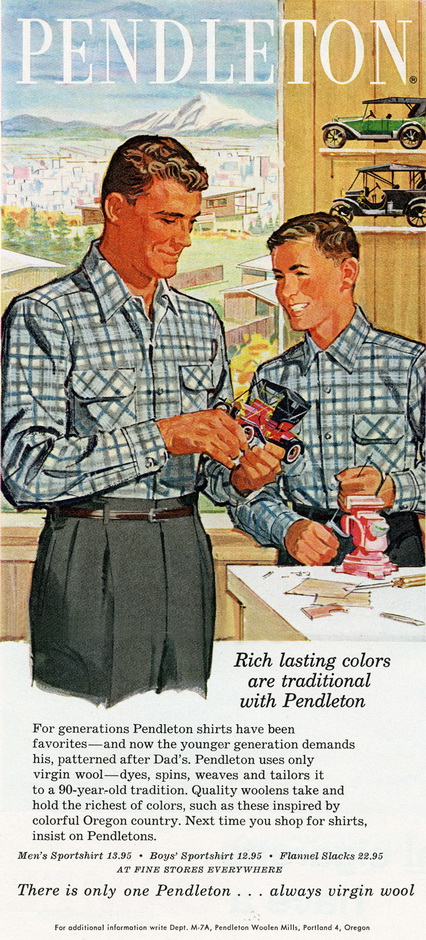
Print advertisement, 1952
Pendleton, Oregon is a small (population is currently just over 15,000 people) city located about mid-way between Portland, Oregon and Boise, Idaho. U.S. Route 30, which has stretched all the way from Atlantic City, New Jersey to Astoria, Oregon since 1926 runs directly through town. Before that it was served by the Union Pacific railway line. The Pendleton Round-Up, a Nationally-known rodeo, was started in 1910 and now draws some 50,000 cowboys, cowgirls, and assorted others to the area every September. More recently, the Eastern Oregon Correctional Facility has drawn some attention to its host city on account of its Prison Blues line of clothing. But without the shadow of a doubt, Pendleton, is most well-known for the Pendleton Woolen Mills.
Print advertisement, 1953
The mill existed before the 20th Century, but it was the acquisition of the facility and its subsequent rejuvenation by the Bishop family of Salem, Oregon in 1909 that is the real first chapter in this story. Eastern Oregon at the turn of the last Century was sheep country and more than a little rough and tumble. The Bishops made their living manufacturing Indian blankets, selling to both to the local tribes (Utatilla, Cayuse, and Walla Walla) as well as those the Southwest. But within fifteen years they expanded their product line to include their first men's shirts, which developed into a full line of men's clothing by 1929. Both were innovative at the time, mainly due to the rich colors and patterns that the company incorporated into its clothing, an anomaly particularly in the world of outdoor and work wear of the time.
Print advertisement, 1954
Pendleton shifted all of its production during the Second World War to supply the military and contribute to the war effort at home. At the conflict's end, production of consumer goods resumed and expanded in 1949 to include its first woman's line of clothing. There was also a tremendous shift after the war, that attempted to move away from it's workwear/outdoorsman image and court the mid-century spirit of leisure that was beginning to pervade so much of the United States. This only increased after the conclusion of the Korean War in 1953, both in terms of the types of items found in the men's line as well as in the spirit of the company's advertising campaigns.
Print advertisement, 1955
Some time during this era in the company's history, they introduced their Sport Shirt, more commonly known today as the Board Shirt in deference to West Coast surf culture's adoption of the garment in the early-1960s (more on that in a moment). I have yet to pinpoint the exact time of introduction, but the earliest print ad I have seen making mention of the Sport Shirt is 1952. This makes sense from a stylistic perspective, in that the sport shirt clearly draws is main design inspiration from the men's casual shirt of the mid-to-late-1940s style widely manufactured throughout the United States but very often so referenced as "California Style" and frequently made in gabardine. Incidentally, Pendleton's older shirt design was re-christened as its Regular Shirt to differentiate the two. A third style, the Sir Pendleton was introduced a short while later in the middle of the decade.
Print advertisement, 1959
What sets the Pendleton Sport Shirt apart from any other manufacturer of this style of shirt is not only its use of its trademark bold woolen plaids but the fact that the Pendleton Sport Shirt stayed in fashion long after men's casual wear moved onto to other styles and trends. In fact, the shirt has pretty much remained in production by Pendleton since the early-1950s and can be bought new today in 2012 for pretty much the same price (adjusted for inflation, of course). Perhaps even more remarkable is that it has done so with only slight concessions to the changing times. One could of course detail the differences between this year's model and the inaugural version, but in a larger scheme of things, they are remarkably similar. Another small miracle is not only how the Sport Shirt has usurped all prior versions of the same style casual shirt, so much so that many for decades have equated this style shirt with Pendleton; but also how it has become known to nearly as many as simply "a Pendleton."
Gerry Mulligan, Los Angeles, 1953, photo by Bob Willoughby
In addition to the typical man of leisure the shirt was marketed to, the Pendleton was quickly adopted by the West Coast Bohemian set. Jazz musicians as well as the emerging Beat Generation that they influenced can be seen in the soon-to-be ubiquitous Sport Shirt throughout the 1950s. The fact that Down Beat could be running a photo of Gerry Mulligan blowing his bari roughly around the same time that Pendleton was opening a retail shop in Disneyland, also speaks to the somewhat egalitarian status the shirt was reaching. A quick side note: the Pendleton shop located in Frontierland in the original Disneyland amusement park in Anaheim, California was open for nearly 35 years (July 1955 through April 1990)!
Brew Moore LP, 1956, Fantasy Records
That the shirt was at both ubiquitous and hip is what I suspect is behind its appropriation by Southern California surf culture in the early-1960s. Much of that youth culture was a mix of the suburban and Bohemian, drawing inspiration from equal parts Venice Beach boho and Hawthorne prefab. Of course much has been made of the early-Beach Boys moniker The Pendletones, as well as the photos of the group in Pendleton Sport Shirts on 2 of its first 3 LPs from 1962 to 1963. But it was truly part of the West Coast surfer uniform at the time. But why would a wool shirt be worn in a region known for the warmth of the sun? Well, as anyone on a coast will tell you, the ocean breeze blows cool and getting out of the water can be a bit of a shock to the system. And as noted surf culture historian, Domenic Priore, pointed out to me, surfers are up at 5 AM and in the water by 6 AM. The beach is cold that time of day! And let's not forget that good virgin wool breathes with the wearer making it fairly versatile and suitable for all but really warm days.
Disneyland, 1959
Fast forward fifty years and the Pendleton Sport Shirt (or Board Shirt) is still part of the conversation on cool. It's consistent production and relatively low cost has made it a thrift store staple for decades, ensuring its perpetual inclusion in the wardrobe of hipsters both young and old. It's egalitarian nature has been preserved and folks ranging from bearded Brooklyn youths to web-posting connoisseurs of 20th Century Classics ensure that it's legacy lives on.
Labels:
clothing,
Disneyland,
Gerry Mulligan,
Made in USA,
style,
west coast
Tuesday, November 20, 2012
Vertigo (1958)
The legacy of Alfred Hitchcock's Vertigo looms over the city of San Francisco - particularly for those of us with an interest in cinema, the 20th Century, and popular culture. For example just the other day this article ran in our local daily And, as you can see, there is no shortage of controversy over a seemingly simple matter - a facade that was preserved on celluloid for a mere few seconds. And yet, it manages to rile emotions to rival any other issue at hand. So what with that and Sascha Gervasi's Hitchcock opening in select theaters this Friday, I thought I would take another look at Hitch. More specifically, let's take another look at the opening title sequence credited to the great modern designer Saul Bass.
It's an impressive piece of film. Here is the sequence in stills, courtesy of Christian Annyas. The visual brilliance of Bass is married perfectly to the musical brilliance of Bernard Hermann.
Vertigo title sequence still, designed by Saul Bass, 1958
Or at least it is credited to Saul Bass.
One rabbit hole I recently went down led me to the Vortex concerts that took place here in San Francisco in 1957. While the concerts certainly deserve an entry of their own, in short the concerts took place at the Morrison Planetarium in Golden Gate Park, sponsored by KPFA and the California Academy of Sciences. The concerts were put together by Henry Jacobs, who I know of through his side-splittingly hip disc, The Wide Weird World of Shorty Petterstein on World Pacific Records (1958). I had re-listened to the disc on the way to a gig recently, when my interest in Jacobs was rekindled and I spent some time following what online leads there were on him.
A Chicago-native, Jacobs moved to SF in 1953. He was part sound collagist, part comic, and all hipster (in the best sense of the word). His "spoken word" recordings really deserve repeat listenings as they truly get funnier and funnier. His musique concrete works are admittedly over my head a bit, but still of interest. It is with the latter that he collaborated with visual artist Jordan Belson on the Vortex concerts. Jacobs was intrigued by the Planetarium's surround-sound which consisted of 38 speakers positioned throughout the auditorium. He saw the potential in such a system for musical performance and the visual aspect was a natural partnership. It was a successful happening and performances continued throughout 1959 (including a 1958 appearance at the World's Fair in Brussels). Folkways Records released a compilation of some of the music and remains in print. By all accounts, the performances were innovative precursors to the sound and light shows rock music would adopt in the late-1960s (not to mention "laserium" shows decades later).
Highlights of Vortex, Folkways LP, 1959
During the run of the Vortex series, Jacobs and Belson drew from the talents of several additional artists. On the musical side this included Bill Loughborough, whose shortlist of accomplishments included co-writing "Better Than Anything" (popularized by the great Bob Dorough) with room-mate and Kingston Trio bass player David "Buck" Wheat and playing percussion for Chet Baker's combo for several years in the mid-1950s. The group of contributing visual artists included two Southern California-born brothers named John and James Whitney.
John and James Whitney, c.1955
Both brothers were experimental film-makers whose abstract visual collaborations stretched back to 1939. John was born in Pasadena, California and went to college at the nearby Pomona College in Claremont (which among other things is where I wasted away a good portion of my high school years over copious amounts of Earl Grey tea!). Upon graduation he spent a year in Paris studying music with René Leibowitz. Liebowitz in turn had studied with both Maurice Ravel and Arnold Schoenberg and instructed Whitney in the latter's 12-tone system of music. But upon his return to California, Whitney shifted his focus to the visual arts often in partnership with his brother.
Variations on a Circle, John & James Whitney, 1941-1942
The imagery was linked back to music, certainly in the artists minds, but later more explicitly in the soundtracks the brothers selected for each. Early films were analogue in a true sense of the word, with the images being manipulated by hand for the camera. In this, the brothers were very successful. They continued using this method for just over a dozen years and just about as many films. Both worked on their own projects in addition to their collaborations. John even did 3 films for UPA. But some time in the early-to-mid-1950's the brothers hit upon a notion of how to use machinery to better articulate their goals. Using surplus military parts, John constructed their first "computers" which they used to make their animated features. Several years later, John explained for a documentary team:
Computers: Challenging Man's Supremacy, 1976
By now, I am pretty sure you can see where I am going. Well it turns out that one of John Whitney's side projects was a full-blown collaboration with the design firm of Saul Bass. The result of this collaboration? Why the title sequence to Vertigo of course! Several reliable sources confirm that the two produced the piece together, although Bass solely received the credit onscreen. What is perhaps most interesting when one takes another look at the sequence after ploughing through this weblog entry is how closely tied the titles are to the other work of the Whitneys. In fact, add Hermann's strikingly modern score and it is not a world away from what one may have experienced at the Morrison Planetarium in 1957 or 1958 at one of the Vortex concerts. And considering that Hitchcock was in San Francisco filming at that very time...well, let's just leave it there for now. A little suspense never hurt anyone and something tells me this is not the end of this story!
Catalog, John Whitney, 1961
Labels:
art,
California,
cartoons,
chicago,
design,
film,
jazz,
los angeles,
music,
San Francisco,
west coast,
WPA
Tuesday, October 2, 2012
Chelsea Bridge (1940)
Nocturne: Blue and Gold - Old Battersea Bridge by James McNeill Whistler, c.1872-1875
In 1876, American-born James McNeill Whistler was living London and had been doing so for the better part of a decade. He had left the United States in 1855 and spent the first few years living the life of a Bohemian in the Latin Quarter of Paris. It was in Paris that he was deeply influenced by the notion of modern art, not only the visual arts such as Impressionism but by other trends in literature and music, as well as the relationships between all 3. He then moved to London, back to Paris, and then briefly to Chile, before settling back into London. While in Chile that he painted the first in a series of what he called moonlights later re-cast as nocturnes, copping a musical term from one of his patrons. In 1876 that he exhibited the above Nocturne: Blue and Gold - Old Battersea Bridge (currently in the collection of the Tate in London).
Moonlight on Ryogoku Bridge, by Utagawa Hiroshige, c.1830
The painting is notable for a couple of reasons. First, in addition to the French influence, art critics and historians have made the case that Whistler was influenced by Japanese woodblock artists during this time and more specifically by a Hiroshige work, Moonlight on Ryogoku Bridge, created forty-some-odd years earlier. Secondly, the Whistler work was the subject of a large degree of criticism at the time including that of well-known art critic John Ruskin who ended up in a court battle with Whistler under charges of libel. Whistler won the case, although his award amounted to 1 farthing.
Billy Strayhorn and Duke Ellington, photo Dave Dexter, Jr., c.1943
Seventy years later and back in the United States, bandleader Duke Ellington was posed with a repertoire problem. ASCAP had substantially increased its license fees in 1939, which resulted in the creation of BMI in 1940 by the National Association of Broadcasters. Radio was key to the success of any band of the day and Ellington quickly surmised that if the major radio stations refused to play music published by ASCAP (which was the practical upshot of the situation), he would need a whole new band book of BMI-published material. To this end he brought his son Mercer and Billy Strayhorn, to Los Angeles for a massive effort to re-build the band book. Neither were affiliated with ASCAP, so were able to provide the clean slate material. This also coincided with what many critics consider to be his finest band, the so-called Blanton-Webster band. The issue was eventually resolved by the Federal court system in 1941, but not before Ellington's Famous Orchestra went through something of a musical transition. To make this time period even more tidy for historians, it signaled Duke's return to RCA Victor Records and the end of his longtime romantic and songwriting relationships. A new day indeed.
Victor 27740-B, 1941
The results of the songwriting sessions were staggering: Passion Flower, A Flower is a Lovesome Thing, Take The A Train, to name but 3. Chelsea Bridge was another. The Billy Strayhorn composition is just beautiful, it's age-old comparisons to the work of Claude Debussy not only accurate but apt. To call it an impressionistic piece might be a bit lazy, but certainly justified particularly with the chords Strayhorn uses on the A sections. To put it in simple terms, the slight dissonance gives the song a hazy and uncertain feel, particularly at the slower tempo. Not really unsettling, just a little ambiguous - but beautiful. As it turns out, the very erudite Strayhorn's inspiration turned out to be Whistler's Nocturne: Blue and Gold - Old Battersea Bridge (that's Chelsea Church on the left far shore in the painting).
Chelsea Bridge debuted with the orchestra some time in early 1941 as evidenced by Ellington's radio broadcasts from the swing-era stalwart Casa Manana, located in the LA suburb of Culver City. The number remained in the book throughout the year, with Ellington recording it in September both at a Standard Radio Transcription session and at a commerical Victor record session (again, both in LA). He returned to the piece on December 2nd when he took his orchestra into RCA's Hollywood Studios to record it along with another Strayhorn composition, Raincheck, plus 2 others. It was this recording, featuring Ben Webster on tenor sax, that was the released master recording.
The song found favor with hip ears and was recorded several times from the 1950s onward by the likes of Gerry Mulligan, the (original) Vince Guaraldi Trio, and Ella Fitzgerald. Webster kept is as part of his featured repertoire for the remainder of his life. But perhaps the most notable post-Ellington recording of the composition was made by its creator. Billy Strayhorn, almost 6 years before his untimely death at the age of 51, recorded a solo piano version in May of 1961 during a brief stay in Paris - where it arguably all began for Whistler a century earlier.
Labels:
art,
California,
Duke Ellington,
history,
jazz,
london,
los angeles,
music,
paris,
swing,
west coast
Subscribe to:
Posts (Atom)