Saturday, September 10, 2011

John Hermansader for Blue Note (1953-1955)


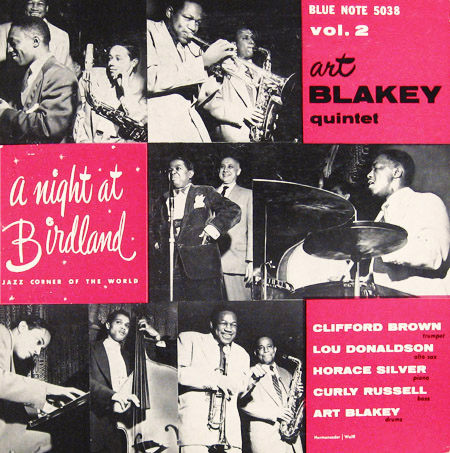
Graphic artist John Hermansader provides a direct link between early European modernist thought and a later mid-century icon of American modernism. Hermansader was born in 1916 near Reading, Pennsylvania. 3 years later Walter Gropius founded the Bauhaus in Weimar, Germany. Hermansader, probably in his late-teens or early-20s, went to Memphis to study design (possibly at the Memphis Academy of Arts). The Bauhaus moved to Dessau in 1925 and then to Berlin in 1932 before being closed due to political pressure from the German National Socialist Party. Hermansader continued his design studies at the New Bauhaus in Chicago, which was founded by ex-Bauhaus instructor László Moholy-Nagy in 1937 and existed for just a year before being reopened by Moholy-Nagy as the Chicago School of Design and eventually being incorporated as part of the Illinois Institute of Technology. 


After his studies, Hermansader returned to the East Coast by the end of the 1930s. He established his own design firm in New York City sometime in the 1940s and continued fostering his interest in contemporary jazz music which had reached back for some time. Through his friend and fellow designer Paul Bacon, he was introduced to the fold of the burgeoning Blue Note Records outfit. With the introduction of the 10-inch vinyl LP in 1948 and the accompanying need for sleeve design, Blue Note was faced with the challenge of how to present their catalog of music in a competitive and original manner. The first Blue Note microgroove 10-inch LPs were released in 1951 with striking, extremely modern covers by Bacon. Hermansader contributed his first designs to the "modern jazz series" in 1953 and was associated with the record label for the next 2 years.


Blue Note shifted focus to 12-inch LP releases in 1955. By this time, a young designer named Reid Miles had taken a position with Hermansader's firm as the latter's assistant. While it is quite possible that Miles contributed to some of the 10-inch LP designs credited to Hermansader (a fairly common practice in the design world), he almost certainly had a significant contribution to the first 12-inch LP designs that bore Hermansader's credit. 


With these last designs, Hermansader ended his association with Blue Note and passed the torch to his Miles, who was hired directly by Alfred Lion at the label. Although Hermansader reportedly designed some LP covers for Riverside Records, his work in this field quickly tapered off. By most reports he lived an interesting a full life before passing away at the age of 89 on July 4, 2009.

More, please? Be sure to read my entry on musician and visual artist Gil Melle for more early Blue Note LP images. 

Wednesday, August 31, 2011

Miles Davis and The Ivy League (1954-1958)


Miles, 1956
Photo by Herman Leonard
Blue blazer, grey flannel trousers, and a soft-roll button down striped oxford shirt with a wonderful roll to the collar

After several recent weblog entries and Facebook "conversations" (quotes intentional, I still don't buy into the notion that social media is true conversation as I appreciate the term), I've been doing some research on Miles Davis dalliance with Ivy League style in his clothing choices. Fortunately, it's been somewhat easy to put a timetable to matters. It seems to start "sometime in 1954" according to this article. Yes, I did just cite RL Magazine as a reference, but their source is Charlie Davidson who ran (and still runs) the legendary Andover Shop in Cambridge, Massachusetts. This makes sense. Miles returned to New York City at the very tail end of Winter in early 1954. He was for the first time in at least 4 years clean, having quit heroin cold with the help of his parents in St. Louis. After a quick trip to the West Coast and and extended stay in Chicago to get his chops back in shape, he hit New York hard recording for both Blue Note and Prestige records within weeks of his arrival. It would only stand to reason that Miles was on the hunt for some new threads and maybe even a new identity of sorts. Yes, this is conjecture, but anyone who has dealt with any kind of substance abuse knows well the desire to find some new skin as part of the process. Ivy League style was definitely a known trend by 1954 and obviously appealed to Davis.


Miles, March 1954
Hackensack, New Jersey
Recording for Blue Note Records, photo by Francis Wolff
Note the beef-roll penny loafers a la Sebago; trousers are possibly chinos but could also be gaberdine from the way they are hanging

The end of the stylistic time period is a little more difficult to pinpoint. Part of the challenge is the lack of photographs of Miles 1954-1958. It is well to remember that Davis was far from the icon he is today. Even in terms of popularity he was vying with the likes of Chet Baker and Dizzy Gillespie for much of the decade (although he did top the Down Beat Reader's Poll for trumpet in both 1955 and 1957). All that said, there is definitely more than a couple of photographs that do illustrate his often celebrated association with the style.


Miles, 1956
Underneath the Cafe Bohemia awning, Greenwich Village, NYC
Seersucker sack jacket, a bold gingham or madras shirt, and a ton of cool
For more photos from this night, click here


What is a little more discernible is when Miles moved on. By 1958 the mighty advertising machine of Columbia Records (who signed and recorded Davis in 1955, but did not release his first LP on that label until 1957) was in full swing and the camera shutters were clicking at an impressive speed for a jazz man. Music aside (as it is never 100% about the music), it could be very well argued that Columbia was instrumental in building Miles the man up to the icon status he was by the mid-1960s. At the very least, they certainly were a big help in boosting his profile. But I digress. My point is that by 1959 (or possibly as early as 1958), Miles style begins to show a distinctive, tailored Continental flair. I want to address this in a little more detail in a coming entry, but it is interesting to note that this much-more personalized style is one associated with Davis for nearly the next decade - certainly until the late-1960s. In retrospect, Miles Ivy Style lasted maybe 4 years tops which is remarkably brief considering how often one may see it referenced.


Newport, 1955, by Photo by Herman Leonard
It is not discernible in this photo by Miles is sporting a seersucker blazer, checked button-down club collar shirt, and a University stripe bow tie. And, yes, I am working on a detail shot.


Friday, August 19, 2011

William Holden (1954)

Dig, if you will, this beautiful 1954 color photo of silver screen legend William Holden...


I am sure some of you have seen it before. But take another look. Soak it in. There is a lot of good things going on. First, some background. This was shot during production of Billy Wilder's feature film Sabrina some time in 1954. The film was released in early September, so we can speculate it was Spring or so. Every reference to it says it was shot on Wall Street and the background bears this out. Unfortunately, I've yet to find a photo credit, so please do let me know if any of you out there have this information. A couple of words about Holden's role in Sabrina if you have never seen the movie. In it, Holden portrays a "playboy" type, the younger of two brothers. Interestingly, the film-makers chose not only to equip him with Nash-Healey roadster (also known as "America's first post-war sports car"), but also to outfit him primarily in an Ivy League-styled wardrobe in much of the film and attendant promo stills.


Fortunately, I was able to dig up a couple of other photos from the same shoot. What primarily concerns me here is Holden's clothes. Quintessential American Ivy League Style at Mid-Century! For starters, I would like to enter the first photo as evidence that the sack suit is a boxy, unflattering cut. Depending on the angle this particular example even veers towards slim. Custom suitmaker Jonathan Behr reckons it is a J. Press suit and presents his reasoning here. Regardless of the maker, it's a well cut 3/2 sack with a perhaps a bit more shoulder padding than one might expect - but, hey it's 1954! Zoot Suits were still a recent memory, so we'll go easy on him. Otherwise, all of the requisite Ivy hallmarks are there: button-down soft roll collar shirt, regimental stripe tie, and moccasin (possibly Bass Weejuns, my mind is not 100% on this point yet) loafers. Add to that a nice straw fedora and a TV-fold pocket square, plus just the right amount of color contrast for some élan.


Oh, did I mention the film co-starred Audrey Hepburn? If you can take your peepers off Audrey for a moment or two, be sure to check out some more of those details in Holden's ensemble.

Time Magazine had named William Holden the Top Star of the year in May of '54, so one can only imagine the influence his style had on the American male populace when the film was released in the Autumn.


Side Note A: Now would be a great time to point out that 1954 was also the year the Miles Davis adopted the Ivy League look, at least according to this article. Photographs pretty much bear this out.

Side Note B: As a contrast, Mark Robson's equally fine film Phffft! released just around the same time as Sabrina features Jack Lemmon, in a starring role, trying to shake his square image to show his ex-wife (played by the wonderful and underrated Judy Holliday) that he can be a playboy. His square duds are other great examples of Ivy style, while his "playboy" image includes such frivolities as a striped waistcoat and a mustache! The end result has definite Continental flair, which is a nice historical example of this then emerging style trend. It just so happened 1954 was something of a watershed for that look as well. Read on, if you are interested.

Saturday, August 6, 2011

The Subject is Jazz: Swing (1958)


Produced in New York City by National Educational Television for classroom use and in conjunction with the National Broadcasting Corporation for broadcast. If you had a television in 1957-1958 and were lucky enough to get one of the affiliate stations, this is a sample of what you would see Friday night at 5 PM.

I've been reading series host and pianist Billy Taylor's Smithsonian Jazz oral history transcript available here. Just follow the link and scroll down to Dr. Taylor. There were so many good things about Billy and The Subject is Jazz is just one of them. Check out the clips, read the transcript, and check out some of Taylor's recordings (many of which are available on iTunes).

Side note: this series features the wonderful guitarist Mundell Lowe, a personal favorite and probably one of the last dozen or so living musicians to have played with Charlie Parker.

Friday, July 1, 2011

High Society (1901-1959)

One of the pitfalls of learning about American jazz music of the 20th Century is that it is conducted in retrospection. In looking back, it's often difficult to see, hear, and feel the currents that propels the music forward. Also there is the historian's tendency to look for patterns and once establishing said patterns filing subject matter accordingly. Read enough jazz history books, for example, and one might walk around with the nothing that the Modern Jazz of the 1940s has nothing to do with the original Jazz music as created in New Orleans decades earlier. Of course this was not helped at all by the "modernists" versus the "moldy figs" debate during the bebop era. Hype for sure, but it does belie the American cultural tendency to always be looking for the next big thing, often at the expense of what came before. What I have here is a wonderful musical example something that flies in the face of that kind of thinking. Sit back, read on, and be sure to dig the sound clips.

In 1901, a fellow by the name of Porter Steele composed a song for marching band ensembles titled "High Society". Now at the turn of the last Century marching bands were some of the more popular bands of the day, performing everything from said marches to light classics. They were mainstream and ordinary folks dug them. Fair now. But down in New Orleans, a clarinetist and guitarist by the name of Alphonse Picou was instrumental a developing a new style of music, which later came to be known as jazz. Picou, a contemporary and sometime bandmate of the legendary Buddy Bolden, adopted Steele's "High Society" for this new sort of combo and improvised a clarinet line based on the piccolo part of Steele's composition. Picou was later cited as a big influence by such players as Johnny Dodds and Jimmy Noone and "High Society" might very well be his lasting contribution to music as we shall see. Unfortunately, there is no early recording available featuring this first adaptation.

The first jazz recording of "High Society Rag" (retitled) was on June 22, 1923 by Kid Oliver's Jazz Band. Although recorded in Chicago (for Okeh Records), it featured such NOLA stalwarts as Dodds and Louis Armstrong (cornet). In fact, it is safe to say that it is a fairly authentic recording of classic hot New Orleans jazz...


The arrangement supposedly is fairly close to Picou's adaptation most importantly Dodds clarinet line. In fact, dig the little riff he plays at about 2:17. Go ahead. Go back and listen again. Now the more astute heads among you may already recognize the riff. But let's move forward a few years...

1937 and Benny Goodman is the recently crowned "King of Swing". I am not going to spend my time arguing the validity of this title, but I will say that jazz music was reaching its commercial zenith in terms of mainstream popularity and "Swing" was on the tip of every music journalist's pen. Goodman was an extremely popular bandleader at the time both through live appearances and regular radio broadcasts. To his great credit (and perhaps discrediting American social values of the time), Goodman hired pianist Teddy Wilson in 1935 and thereby was the first significant white bandleader to appear in public with a mixed band. A year later he further challenged the color barrier by hiring Lionel Hampton in the vibraphone. Benny had chops, could swing - plus he had the drumming genius of Gene Krupa. Needless to say, it was a good band. Now dig this clip of Benny and the band in 1937 (introduced by Rudy Vallee!). Be sure to listen closely when Hampton comes in for his solo - about 52 seconds into the clip...


Did you hear it? Yep. "High Society" again. With a little more swing and sounding more than a little more modern. So with that in mind let's move forward another 8 years...

On November 26, 1945, Charlie Parker entered WOR Recording Studios in New York City to record his first session as a leader. It was later issued as Charlie Parker's Reboppers on the indie small group swing and bop specialist label Savoy. His contracted pianist, Bud Powell, was a no-show; he was having trouble with his horn; and his trumpeter (19-year-old Miles Davis) was struggling with the tunes. Any yet he managed to record not 1 but 3 widely acknowledged modern jazz classics on the session, one of which was something of a magnum opus and one of the most explosive examples of modern jazz improvisation captured on disc to that date - and was rarely equaled in the years after. Check out "KoKo" paying particular notice to Bird's alto at about 1:18...


HIGH SOCIETY! Yet again. From jazz to swing to bop. Where could we possibly go from here?

One of he biggest jukebox hits of 1947 was a double-sided modern jazz tenor battle featuring two of the music's more swinging Lester Young disciples. "The Chase" recorded in June by Dexter Gordon & Wardell Gray for Dial Records managed to interpolate the "High Society" riff we have been looking at into the the full melody of the song! Dexter also takes it about as far as anyone could in the opening bars of the his solo (yes, he solos first). It's a beautiful evocation of what Central Avenue in Los Angeles probably sounded like on a good night in the late-40s and a great way to end this post...


OK, not quite. Just to bring it all back home, let's go back to Alphonse Picou with this rare clip of him near the end of his life in 1959 playing - yes, you guessed it - his own solo on "High Society"....


Friday, June 24, 2011

D'Andrea Guitar Plectrum 351 (2011)


Near the end of last year, I was in Gryphon Stringed Instruments in Palo Alto trying to sort out a few spare parts for my recently purchased 1947 Epiphone Broadway guitar. It just so happened that the fellow helping me was luthier Steve Saperstein - something completely unbeknownst to me at the time. I had just recently gone down the rabbit hole of guitar picks and after spending far too much time on the Internet had decided the take the plunge and purchase a very expensive imitation tortoise shell plectrum.

Aren't they all tortoise shell, you ask? Well, interestingly no. Guitarists started using plectrums (similar to what pluck the strings in a harpsichord) some time in the 1800s and one of the early substrates that found favor was actual tortoise shell. But this material was expensive, somewhat fragile and eventually became illegal to use in 1973. At the same time that guitar players started picking the strings with things other than feathers or fingers, what later became known celluloid was first invented in England. In the spirit of the Industrial Age, it was soon being used for every item imaginable and by 1872 was known as celluloid in the USA.

Anyhow back to Palo Alto last year. Being somewhat insecure, I asked Steve what he thought of this expensive imitation tortoise shell pick. In fact, the older generation of jazz guitar men (or so I had read), swore by their old tortoise shell picks for its tone, feel, and durability. Well, Steve kind of blew the picks off and handed me a D'Andrea Pro Plec saying, "I've always been able to get a good sound out of these." Well, at less that $10 for a dozen it was a fraction of the cost of the other pick and frankly it had substance and both felt AND looked good. Sure, why not? I figured I would give it a try. I liked Steve, he seemed knowledgeable, and it was just a minimum risk.

I've been using the picks ever since. I just love them. Steve was right, one can get a really nice sound out of them. Not one to gush, but they might be the best pick I have ever used. And, yes, I have tried quite a few.

But there is something else about this item that would appeal to folks on a broader level. The picks are manufactured by D'Andrea in New York. You can (and should) read about their history here, but I will summarize. 1922, Luigi D'Andrea is credited with the first use of celluloid for guitar picks. Yes indeed, what became the predominant guitar pick material can be traced back to this company, not too long ago. The company developed scores of different shapes over the years, but is also credited with developing the most common shape used, their number 351 (see the photo above). Unfortunately, I could not find a date associated with this shape, but it surely was early on as nearly every pick maker had adopted the shape by late-1950s. Perhaps most surprisingly in this day and age, the company is still owned by the D'Andrea family and still make the picks here in the USA of celluloid material imported from Italy.

Saturday, June 4, 2011

Gil Mellé, Graphic Artist (1953-1956)

Native New Yorker Gil Mellé has a very interesting role in the history of 20th Century American music. As a composer and instrumentalist he is responsible for some of most thoroughly modern music released on Blue Note Records in the early 1950s. As an amateur sound recordist and audiophile (before there was even such a term), he was the man responsible for re-introducing and securing the legendary sound engineer Rudy Van Gelder into the Blue Note fold. On top of all of this, he was also a visual artist, reportedly one whose art was shown in galleries in New York City in the 1950s. What can be substantiated is the album cover designs he created for both Blue Note and Prestige Records during this time. I've plundered the wonderful archives of the Birka Jazz Archives to collect the majority of Mellé's designs below. Be sure to also read Marc Meyer's JazzWax piece on the man as a musician, as well as Marc's follow-up post here.


Side Note: the above Blue Note discs originally were released between 1953 and 1955 and were 10-inch Long Playing records. The Prestige platters were all released in 1956 in the newer 12-inch format. Both microgroove formats played at 33 1/3 revolutions per minute and were initially only available as monaural selections. RIAA guidelines of course applied.

Side-Side Note: for those of us that grew up in the television syndication age in the latter portion of the 20th century, might know Mellé for his intro theme to Rod Serling's Night Gallery.

Addendum (9/9/11): I found a couple more Mellé designs on another cover site. Enjoy.