Showing posts with label los angeles. Show all posts

Friday, March 20, 2015

Spring is Here (1938)


The first chart hit version of Richard Rodgers and Lorenz Hart's 1938 composition "Spring is Here", as adapted from the Broadway production of I Married an Angel. Reisman was an extremely popular bandleader during the 1930s who enjoyed success with his recordings of several songs that were to become jazz standards including "Yesterdays" and "Alone Together". The vocal refrain on his version of "Spring is Here" was by Felix Knight, known by most Statesiders of a certain age and older as Tom-Tom in Laurel and Hardy's Babes in Toyland.


4 years later, the song reached a wider audience courtesy of Jeanette McDonald and Nelson Eddy's performance of the song in the drastically tamer film version of I Married an Angel. The movie was a box-office and critical failure, known in the history books more for what it might have been rather than what audiences saw in the theaters. One can thank the Hays Code and its neutering effect on a lot of film adaptations of contemporaneous Broadway source material.


The first jazz version of song is a matter that is in dispute. The 1954 10" LP (and 7" EP) Interpretations by the Stan Getz Quintet featured a stand-out early adoption of the tune by younger modernists. Recorded in the Summer of 1953 in Los Angeles for Norman Granz's Norgran label, Getz was joined by Bob Brookmeyer on valve trombone, Johnny Williams (as in, yes, that John Williams) at the piano, Teddy Kotick playing the bass, and Frank Isola behind the drums.

For more details about this composition and its history, I heartily recommend the JazzStandards.com entry here.

Wednesday, November 19, 2014

Reid Miles (1956)


Patterns in Jazz by Gil Melle, Blue Note 12" LP 1517, 1956, cover design by Reid Miles

I know. I can hear it now. The last thing the internet needs is another blog post singing the praises of Reid Miles and his 12-year stint (1955 through 1967) as the principle LP artwork designer for Blue Note Records! Right? Well, of course one cannot laud Miles enough: his work for the New York jazz label was a masterful high-water mark of mid-century modernist design. But there was certainly more to  this well-known figure whose full story has remained remarkably illusive.


Mobley's Message by Hank Mobley, Prestige 12" LP 7061, 1956, cover design by Reid Miles

Born in Chicago on the 4th of July in 1927, Miles actually grew up on the West Coast of California. After the stock market crash of '29, his family moved out west as so many other families did during the Great Depression and ended up in Long Beach. A marital split left Miles in the care of his mother who supported he and his younger sister by working in a cannery in San Pedro. Most of his youth is undocumented, although it is known that Miles joined the U.S. Navy near the end of the Second World War, serving as a chauffeur. Upon his discharge he returned to Los Angeles and, according to Wayne Adams who would later assist Miles in the 1980s, chased after a girl and wound up enrolled in the Chouinard Art Institute. Chouinard was then located in MacArthur Park and would merge with the LA Conservatory of Music to form CalArts in 1961. Other Chouinard alumni, whose names will be familiar to regular readers of this blog, include graphic designer S. Neil Fujita and pop artist Ed Ruscha. Rushca and Miles almost certainly never crossed paths that the school as the former did not enroll until the mid-1950s. However, it is very likely that Fujita and Miles met at Chouinard as both attended the school around the same time - a very interesting idea considering how Fujita would later find him on the East Coast designing LP covers for Columbia Records a few years after studying in LA.


Herbie Nichols Trio by Herbie Nichols, Blue Note 12" LP 1519, 1956, cover design by Reid Miles

The person at Chouinard with whom Miles most definitely came into contact was the eventual head of the basic design program, Bill Moore. Moore is something of a West Coast design/art/animation legend who influenced generations of students over the course of nearly 40 years at Chouinard and CalArts. He is the thread the ties together such disparate names as Reid Miles, Ed Ruscha, Tim Burton, and Brad Bird - all of whom studied with Moore. Miles apparently had very little influences in his design life, but Moore was one of them and an early one at that.


Olio by Thad Jones, Prestige 12" LP 7084, 1956, cover design by Reid Miles

Leaving Chouinard before completing the courses required for graduation, Reid Miles made a bee line for New York City, scoring a job with designer John Hermansader. The timing was certainly right as Hermansader, through his friend and fellow designer Paul Bacon, began working with Blue Note Records in 1953 not too long after Miles arrived on the scene. Here is where the story gets a little hazy. While it is known that Miles worked on the Blue Note account, it is not known how much of the early (1953-1955) work was done by Hermansader, how much was done by Miles, and how much was a collaboration. May we indulge in some speculation? Based on the collective body of work Hermansader provided for Blue Note, he quite feasibly could have been another big influence on Miles.
Blue Note historians tend to downplay Hermansader's contributions, but his other surviving examples of visual art clearly indicate a notable talent. The raw materials are there in the work which Miles would develop into an art by the end of the decade, but the question remains just how much input Miles had into the Blue Note designs early on. Unfortunately, neither man is alive today to discuss and the period is poorly documented. At any rate, Miles - who would develop a history of transience - left Hermansader in 1955 for a job with Esquire magazine doing the layout and paste-up work. However, whatever his contributions were to Hermansader's Blue Note account, they were significant enough to catch the attention of the label's owners Alfred Lion and Francis Wolff who asked him to take a lead role in the design of 12-inch Long Playing records, the format that by mid-decade had emerged as the preferred format of most jazz releases industry-wide. Esquire was apparently well-aware of this arrangement and allowed Miles to moonlight - which usually meant working on 3 or so Blue Note LP covers on his Saturday off from the magazine, being paid $50 a job/cover. Later interviews would reveal Miles to be would could be termed a workaholic, in that to him his work was his life and the absence of former made the latter unbearable at times.


J.R. Monterose, Blue Note 12" LP 1536, 1956, cover design by Reid Miles

Contributing to an even more hazy story is the fact that a year after this transition and for a time space of nearly 2 years, Miles was also contributing 12" LP jacket designs to Blue Note's de facto, if not friendly rival Prestige Records. From 1956 until 1957, his name graced the jackets of nearly a dozen discs. Interestingly, this work is seldom cited by design aficionados, although there are some excellent covers that easily rival his contemporaneous work for Blue Note. There are definitely some similarities between the covers and one can see his style developing which each subsequent release. So here is one artist, simultaneously providing the visuals for some of the important modern jazz music recorded of its time (or any time for that matter). And, of course, Miles was famously not a fan of jazz, preferring classical. But this period is interesting, mainly as it is of such high quality and yet overlooked by most design fans.


Quadrama by the Gil Melle Quartet, Prestige 12" LP 7097, 1956, cover design by Reid Miles

A third influence should be mentioned at this time. After Moore and possibly Hermansader, Miles other major influence of the time was known to be Saul Bass. Bass needs no significant introduction to readers of this weblog, but it is perhaps helpful to put him into historical perspective. At the time that Miles was accepting a job with Esquire and getting down to business in earnest with Blue Note and Prestige, Bass was gaining widespread notoriety first for his work on the posters and titles for Carmen Jones (1954) and even more so for The Man With The Golden Arm (1955). His greatest innovation was perhaps the liberation of type from the galley, finding new ways to communicate the written word that flew (sometimes, literally) in the face of convention. Of course, in the design world Bass is a true legend and this history books have been kind to the legacy he has left behind.


6 Pieces of Silver by the Horace Silver Quintet, Blue Note 12" LP 1539, 1956, cover design by Reid Miles

Reid Miles perhaps enjoyed his most lucrative years well after his run with Blue Note. Some time in the early-1960s he started focusing on photography. By mid-decade it was his main focus. Miles returned to Los Angeles in 1971 and within a few years established a style and clientele that made him quite successful by anyone's terms - although he retained a drive and passion for his work which lasted until his death in 1993. Miles occasionally returned to album covers during the second act of his career, but his style by then had changed so significantly that few people made the connection. Fortunately, his mid-'50s experiments are well documented and, hopefully, well preserved for the ages.

Wednesday, August 13, 2014

Brooks Brothers (1940)

Print ad, Brooks Brothers Clothing, New Yorker magazine, 1940

The Internet is a funny thing. No earth-shattering statement there for sure, but it is very interesting how much our culture and society has changed over the past 2 decades and how much of that has to do with technology in general and the Internet in particular. Scholarship, research, and eduction are only 3 areas which have been drastically effected by the way we all communicate and share information. What does this have to do with Brooks Brothers in 1940? The emergence/re-emergence/codification of what is now know as Ivy League Style has increased significantly over the past decade due in a great part to the Internet. Online forums and blogs have become clearing houses of information, shared experiences, core knowledge, and (sometimes) interesting discourse. It has also become the breeding ground for a lot of misconceptions due to poor research habits. 

There was a time when primary resources were arguably the only resources that held water. Everything else - such as faint (or vivid for the matters) memories of events fifty years in the past - was secondary in every sense of the word. There were also standards of citation which the Internet has perhaps most effectively done away with. Is all of this bad? No, not necessarily. But it has helped create an increasingly hyper-informed and under-educated society. 

But again you ask, what does this have to do with Brooks Brothers circa 1940? OK, I will answer the questions. The above scan from a primary source shows the classic Brooks Brothers OCBD (Google those initials for a good time) in 1940. Now what is interesting to me is not that only 2 colors (white, blue) were available. Nor is it that a US-made Brooks Brothers shirt cost the equivalent of around $30 in 2014 dollars. No. What strikes me most is that it features a breast pocket! Why is that so important? Well, general internet knowledge ™holds that Brooks Brothers did not add breast pockets to their shirts until 1965 or so. Much has been written and discussed around that. I bought into it wholesale for sure, taking it as fact and being uncharacteristically ambivalent about digging deeper. Certainly - or at least as far as I know - the Brooks OCBD lost its pocket some time between 1940 and 1965, but when? Why? 

My challenge to all of us that are interested, if not fascinated in these slowly vanishing traces of 20th Century culture is to dig deeper. Do your homework. Know your sources. Quote your sources. Edit your work. I suspect these words I type right now may very well last longer than the fingers that type them. 

Wednesday, June 18, 2014

Portrait of a Spanish Poet (1959)

Portrait of a Spanish Poet by John Altoon, completed 1959

Los Angeles born artist John Altoon, spent nearly 5 years working on the painting he titled Portrait of a Spanish Poet. Often subtitled (Lorca), the piece is ostensibly a portrait of Spanish writer Federico García Lorca. It was completed in 1959 (the same year Altoon married B movie and television actress Fay Spain) and was included in Altoon's second solo show at the Ferus Gallery in 1961. By the time of that show Ferus had moved to its second location at 723 North La Cienega in West Los Angeles and had been under the direction of Irvin Blum for 3 years. Altoon's relationship with the gallery was firmly established by the late-'50s, being represented by Ferus. The painter had yet to fully transition to the more figurative approach he adopted in the 1960s, with the work being very much a product of his exposure to Abstract Expressionism due to his time spent in New York City as well as the Bay Area  School with exerted a strong influence on the LA art scene during the 1950s. 

John Altoon, Tony Lanreau, and Maggie Ryan, Venice, California, photo by William Claxton, 1959

The painting and Altoon made a cameo appearance on the dust jacket of the original 1959 edition of Laurence Lipton's The Holy Barbarians, the writer's survey of Beat Culture at the turn of the decade. Many (most?) had no idea that that giddy, shirtless beatnik in William Claxton's photo had painted the work of art hanging on the wall behind him, much less that he was the heart and soul of the burgeoning Ferus Gallery scene in West Los Angeles and Venice Beach. The connection was likely more due to Claxton, rather than Altoon laying any Beat Generation claims as the modern art circles on both Coasts tended to distance themselves from the Beat poets in spite of any lifestyle similarities.


Jazz Guitar: Jim Hall, Pacific Jazz 1227 12" LP, 1957, cover photo by William Claxton featuring John Altoon

Clax also played a role in Altoon's slightly earlier entree to mainstream exposure. As the staff photographer and cover art director for Dick Bock's Pacific Jazz Records, Claxton played a major role in the label's West Coast Artist Series that was begun some time in early 1956 as this excellent, highly recommended article outlines in detail. By the time it came to release guitarist Jim Hall's debut LP on the label, Bock and Claxton took a slightly different approach to the series by not only featuring the work or an emerging West Coast artist, but also by including a photo of the artist at work. The artist in question was John Altoon who was featured in the shot (albeit with his back to the camera). The device had already been used once the previously year for a Chico Hamilton Quintet release (also featuring Hall), but the Jim Hall/John Altoon/William Claxton image seems to capture the zeitgeist with slightly more authenticity. 

 Dick Bock, Jim Hall, John Altoon, and William Claxton, 1957

Altoon's career - and life - was short. He battled what some called true demons throughout his lifetime - but, in spite of his concerted efforts to manage his struggles, he died of a heart attack at the age of 44 in 1969. 

For more information about Altoon and the Ferus Gallery scene, I highly recommend Morgan Neville's 2008 documentary film The Cool School

If you live in or are going to be in the Los Angeles area before September 14, 2014, I strongly encourage you to visit the first major John Altoon retrospective, currently on exhibit at LACMA.


Tuesday, May 6, 2014

TK Smith (2014)


Desert Oasis: The Midcentury Modern Guitars of TK Smith by Nick Rossi, photos by Jacqueline Di Milia, courtesy of the Fretboard Journal

Issue number 32 of the Fretboard Journal is now available at newsstands everywhere. I am very pleased to announce that it includes an article penned by yours truly profiling guitarist and guitar-maker TK Smith. I first heard about TK in 1990 when Big Sandy & The Fly-Rite Trio released their debut LP on Dionysus Records and played in San Francisco to support the disc. I've been a fan of Smith's playing ever since. The path his life has taken is a very interesting one and it intersects with a lot of the topics covered on the pages of this weblog. I find his work to be beautiful, not only from the aesthetic perspective of someone who appreciates modernism, but also as someone who respects true craftsmanship. I also like that TK is part of a Southern California tradition - not in a convoluted way, but simple because he is both creative and curious. Plus he has great taste!

Fretboard Journal 32, Ry Cooder cover story, out now

TK Smith may be found online and you may also follow him on Instagram. And here's just a snippet of why he is one of the most interesting guitar players around…

Wednesday, January 22, 2014

Nicholas Ray (1932)

A full two decades before film director Nicholas Ray was in his celluloid ascent - reaching a peak with 1955's Rebel Without a Cause - and long before Jean-Luc Godard declared that Ray indeed was cinema, the latter-day legend was just embarking on an artistic journey that eventually would lead him to the modern medium of film. This journey had some unlikely twists and turns, not the least of which was a year spent as an apprentice to famed architect Frank Lloyd Wright.


James Dean and Nicholas Ray, Los Angeles, California, 1955

Ray, later known as Nick to most of his West Coast friends and acquaintances, was born on August 7, 1911 in Galesville, Wisconsin with the given name of Raymond Nicholas Kienzle. 3 months earlier in Spring Green, 100 miles southwest of Ray's birthplace, the maestro Frank Lloyd Wright began work on his own personal residence and workplace. This came to be known as Taliesin, a Welsh word which in rough translation means shining brow and refers to Wright placing the structure on the top or brow of a hill. Wright was in transition, having recently returned from nearly a year in Europe which had marked the end of what was later called his Prairie Period.

Frank Lloyd Wright, 1930, around the time he first met Ray, photo by Price Studios

As a youth, Ray was an uneven student seemingly distracted by the big city delights of Chicago, where he spent much of his formative years. He returned to Wisconsin for his senior year in high school and showed a strong affinity for and ability in public speaking, English, and drama. Two years in a state college was followed by a tumultuous semester at the University of Chicago in the fall of 1931, after which he left for New York City to study theater. However the connections made in Chicago precipitated Ray joining the inaugural fellowship of Frank Lloyd Wright at Taliesin in 1932, some time after the two crossed paths again during an event at Columbia University.

Design Sketch, Capital Journal Building, Salem, Oregon by Frank Lloyd Wright, 1931-1932

Contrary to many claims and by his own account, Ray spent a year under Wright's tutelage. The concept of the Fellowship was that Wright felt only by living and working with apprentices around the clock could the understand his concepts and ideas. As a social experiment, it was quite interesting. Members of the Fellowship not only actively executed ideas on Taliesin itself (the buildings there in a state of constant change), but worked as draughtsmen, farmhands, and domestics on the property. Living was for the most part communal. One suspects that the strict rigors of life at Taliesin did not sit well with the restless Ray, but many have commented that a political rift between Wright, a strong believer in the power of democracy, and his more radical-leaning protege was the cause of the latter's return to New York, which would eventually lead him to Hollywood and the world of film-making.

Nicholas Ray, Hollywood, c.1945

However, the year spent with Frank Lloyd Wright would prove to have a tremendous impact on the artistic eye of Nicholas Ray. 34 years after his death, Ray's widow Susan stressed the importance of the period in an interview, citing the nature of the Fellowship as shaping Ray's ideal work methods, as well as the very idea that architecture (and film in Ray's) provided a framework for the arts. Ray himself professed that his love of what he called the vertical line was due to his time with Wright and attributed his fondness for Cinescope to an extension of that love.

Storyboard, Rebel Without a Cause, Nicholas Ray, 1955

An interesting footnote: the 2003 DVD release of Ray's masterful In a Lonely Place, made for Humphrey Bogart's Santana Productions, features a short film extra in which director Curtis Hanson sings Ray's praises and calls out some of the architectural elements in the film - citing the Frank Lloyd Wright period. Hanson, of course, directed 1997's L.A. Confidential a neo-noir film based on James Ellroy's novel. One of the buildings prominently featured in the film is the Lovell House designed around 1927 by Richard Neutra. Neutra had only recently moved the United States and one of his first employers before moving to California was Frank Lloyd Wright. The Lovell House is just 2 miles down the hill from the Griffith Park Observatory which is perhaps the most well-know location used in Ray's Rebel Without a Cause.

Tuesday, November 26, 2013

Chico Hamilton (1921-2013)


Blue Sands by The Chico Hamilton Quintet from Bert Stern's Jazz on a Summer's Day, 1958

Social media delivered the news that Forestorn "Chico" Hamilton passed away at the age of 92. The words legend and great are far too often abused these days, but Hamilton was both. As an innovative percussionist and bandleader, he was a somewhat singular modern American musician. I know people that have both studied and worked with him, so I can comfortably claim that he was also a true personality. For those interested in digging deep, I highly recommend listening to and reading his contribution to the Smithsonian Jazz Oral History Project here.


Print ad, Down Beat magazine, 1962

Regular readers will no doubt be well aware of my love of (and possible obsession with) Bert Stern's 1958 film Jazz on a Summer's Day. It has managed to work it's way onto these pages several times, but most notably here and here. Bassist Bill Crow also was kind enough to answer some of my related questions here.


Down Beat magazine, August 8, 1957

I have never really tackled the Quintet's performance of Buddy Collette's Blue Sands in print, mainly because - to me - it comes close to what many people call sacred music. More so than Mahalia Jackson's unquestionably moving spiritual in the film, Chico's appearance possesses a quality that transcends both genre and time. Deeply influential upon me too was the visual impact to the impeccably dressed quintet -which also featured at the time Collette's protege Eric Dolphy on flute and Italian-American guitarist John(ny) Pisano. To find out years later that the performance was filmed in front of an empty venue after the festival had completed for the evening due to a technical issue with the shoot made the power of the music all that more miraculous. Add to this his contributions to one of my other favorite films of all time (and something that I need to devote some more virtual ink to very soon), 1957's Sweet Smell of Success, and…well…almost needless to say, I am more than a little saddened to read of his passing in spite of his living a long, rich life.

Rest in Peace, Chico.

Monday, September 9, 2013

September Song (1938)


September Song, sheet music, 1938

It is quite easy to see why Kurt Weill and Maxwell Anderson's "September Song" from the 1938 Broadway production Knickerbocker Holiday has been front of mind as of late. While Summer still lingers (particularly for those experiencing Indian Summers), the days truly grow shorter and it is only a matter of weeks before Autumn will begin to show its colors.


Kurt Weill and Fritz Lang in Hollywood, April 1938

German-born Jewish composer Kurt Weill had been living in New York City for 3 years in 1938. His residence in the most American of American cities marked the end of the first phase of his career in which he contributed greatly to the Weimar Republic soundtrack thanks to his rightfully celebrated collaborations with Bertholt Brecht. While in Germany, Weill was not only an active in populist left-wing politics but his music was celebrated the world over by avant-garde modernist composers such as Stravinsky, Berg, and Milhaud. Fleeing the Nazi regime, Weill and his wife settled in New York after short stays in both London and Paris. Weill soon began to self-consciously reshape his music to fit the mold of his adopted country. To show just how far he had come, 1938 saw him not only his collaboration with Anderson premiering on Broadway, but he spent some time in Hollywood scoring a movie for the Austrian-expatriate, Fritz Lang.


Maxwell Anderson, Time, December 10, 1934

Maxwell Anderson was a somewhat odd pairing for Lang. Born in Pennsylvania in 1888, he was twelve years Weill's senior. A scholar and writer, Anderson was also an outspoken pacifist - something that jeopardized his professional career on more than one occasion. Bouncing between writing and teaching jobs from North Dakota to San Francisco, he eventually ended up in New York in 1918 working as a journalist and playwright. Before meeting Weill and working with the composer on Knickerbocker Holiday, Anderson had experienced several Broadway hits. But what was perhaps most interesting about this particular stage production was the sub-text of the play. With the memory of the executions of Sacco and Vanzetti only 11 years old in 1938, Anderson had more than a passing interest in leftist-influenced anarchism. In fact, Knickerbocker Holiday is most often characterized by critics as a thinly veiled attack on then-President Franklin Delano Roosevelt's New Deal, something Anderson felt veered to close to the fascism that was dominating Europe at the time. 


September Song, Walter Huston, Brunswick Records, 1938

One of the stars of Knickerbocker Holiday was 55-year old Walter Huston, who requested a song be written for his character of advanced age to help woo a younger love interest. Weill and Anderson obliged with 'September Song' reportedly written start-to-finish within the span of a day. With it's roots going back at least as far Geoffrey Chaucer's 14th Century 'Canterbury Tales' (see The Merchant's Tale), the symbolic use of months of the year to represent differing ages was certainly nothing new in the late-1930s. But Weill and Anderson managed to breathe some new life into a well-worn device as well as come up with a rather touching plea for love. It's not terribly sentimental, but rather sweet lyrically and the music manages to hint just enough at the inevitability of the protagonist's demise without being morbid. 


John Huston and his father Walter Huston, 1940

Irish-American Huston, the father of maverick film director and actor John Huston, and the grandfather of actors Angelica Huston and Danny Huston, had a minor chart hit with his original 1938 recording of 'September Song'. Huston's version was allegedly President John Kennedy's favorite song, with JFK performing the number for private affairs, intoning Huston's croon. Whether or not Jack was aware of the politic undercurrents of the song's source it not something that is documented. In addition to their other post-1938 achievements, all of the principals eventually found varying degrees of success in Hollywood: Huston won an Academy Award in 1948 for his supporting role in The Treasure of the Sierra Madre; Anderson wrote the screenplay to Alfred Hitchcock's The Wrong Man in 1956; and Weill scored a select few films. When Kurt Weill died in 1950, Maxwell Anderson delivered the eulogy. At the time of Weill's death 'September Song' experienced a resurgence of popularity, thanks in no small part to its use in that year's September Affair motion picture and by the end of the decade it was firmly established as a standard in what is now called the Great American Songbook.

Further reading: follow this link for a more musical look at the song.

Further listening: give this great 1946 version a listen by pianist/vibraharpist Dardanelle featuring Joe Sinacore on guitar which makes for an interesting comparison to Teddy Wilson's 1944 version featuring Sarah Vaughan on vocals, Remo Palmieri on guitar, and Charlie Ventura on tenor saxophone.

Monday, August 5, 2013

The Tune is Red (1960)


The Tune is Red, oil on canvas, Hassel Smith, 1960 (full painting) 

I have often been asked why I like 20th Century abstract art. The phrasing of the questions have ranged from speculation on whether or not the questioner's child or grandchild could have easily done the same thing to something along the lines of I just don't get it. In truth, I cannot simply explain my attraction to abstract art both of and influenced by this period, so I thought I would muse on that notion a bit. 

My first art appreciation course was not until my second or third semester of college here in San Francisco. It was a fairly pedestrian course, one which covered all of the hits and a handful of misses. As a side note: I recall the end of term project that I created for this class: a piece of assemblage, which I white-washed with tempura paint, so I was already showing my colors so to speak. By this time, I had already been exposed to a few minor abstract works via 12-inch LP covers, having got hip to jazz records in high school. Another influence, no doubt, was psychedelic art of the 1960s, something that I spent no meager amount of time digging deep into during my high school and college years. The sum total was that abstract works just captured my interest and imagination more than any other form of visual art - save perhaps architecture and design. So I did which I so often do when something piques my interest, I dug deeper and deeper until I found the good stuff. 


The Tune is Red, oil on canvas, Hassel Smith, 1960 (detail 1)

Of course, no exploration of abstract art tunnels too far away from the New York School of the 1940s and 1950s, but living here in San Francisco, I am fortunate to have access to many of the fruits of the Bay Area School from roughly the same time period. Between the local works and visit to the Guggenheim and MOMA on East Coast trips, I have managed to see a fairly broad survey of modernist art from the last Century. I have my favorites, such as Franz Kline, but it's always exciting to be exposed to an exhibition such as the recent Richard Diebenkorn exhibit that I mentioned a few weeks ago.


The Tune is Red, oil on canvas, Hassel Smith, 1960 (detail 2) 

Back to the question of why. From an intellectual point of view, I have come to the opinion that figurative painting - for the most part - became less and less relevant as media such as photography, film, and video gained more and more traction. Surely the skill of the great masters is something to still admire, but I think it is important to note that those paintings are often the only visual records of those times. As the means to visually document the world around us have become more and more accessible and prevalent, it seems only natural to me that and older medium such as painting be used in a different manner. Of course that I have long been interested in some many other aspects of post-World War II culture certainly has resulted in a certain predisposition. Most certainly. But I think this has been a case where bias has been a virtue, in that I don't seem to have the aversion to this style of art that a lot of people exhibit.


The Tune is Red, oil on canvas, Hassel Smith, 1960 (detail 3) 

From a emotional point of view, I find abstract art captivating on a many levels - particularly when I am able to see a painting in person. In the works that have captivated me most, I have typically found a depth - in the colors, in the textures, in the movement - that just stimulates something in my brain and emotions. I don't look at them as Rorschach tests. I've ceased to look at them for meaning. But rather I have come to just experience them for what they are. And, yes, a good abstract painting can be similar in some ways to a good jazz performance in that it is a mix of skilled tradition and personal improvisation. So as my life as a jazz musician has been become more and more important, perhaps my affinity to abstract art and abstract expressionism in particular has achieved parallel importance.

Note: the painting featured on this page is currently residing at the Cantor Arts Center on the Stanford University campus. Admission is free, so all you need to do it get your self there to see this one. The artist, Hassel Smith, is one of the many of that era whose love for jazz music was reflected in his work. Smith spent a significant amount of time in the San Francisco-Bay Area and was also an important early part of the Ferus Gallery scene in Los Angeles. His remarkable timeline can be found here.

Thursday, June 20, 2013

Harry Babasin & The Jazzpickers (1958)

I thought that I would put up a quick post this afternoon. Truth be told, I have a bit of a backlog of entries at the moment. There are quite a few in the hopper, but I've been sidelined with some minor health issues and I should really be staying away from the computer. But I hate seeing the weeks fly-by without new posts, so here is most of the February 3, 1958 episode of ABC-TV's Stars of Jazz television program hosted by singer, pianist, and songwriter Bobby Troup (yes, he of Route 66 song and Emergency TV fame). Bobby's guests that week included bandleader turned manager Charlie Barnet, vocalist Pat Morrissey, and Harry Babasin. I believe I have mentioned this TV show before, but I will take this opportunity to point the curious reader to this wonderful blog which tackles the show in great detail.

Babasin, an unsung hero of jazz music on the West Coast of California, was initially a bassist who played with everyone from Louis Armstrong to Charlie Parker. He was also one of the first experimenters with the cello in jazz music. Of course my short shrift is not doing Harry justice and for a wealth of excellent information on Babasin and some of his more interesting musical activities of note, I highly recommend this page created by his son Von.

A final note. The guitarist in these clips is another talented obscurity by the name of Dempsey Wright, a fellow whose playing I have only recently been digging into. With 2 LPs of his own to his discographical credit, plus 3 appearances as a sideman, his recorded legacy is certainly less than proportionate to his chops. It's a shame, but thankfully we have these few more minutes of music to enjoy from someone else that may have been forever lost in the cracks of time. A special thank you to Babasin's son, Pierre, for making these clips available.


Friday, March 22, 2013

Donn Trenner (1927)


Donn Trenner, Nola's Penthouse Studio, New York, New York, February 1947, photo by William Gottlieb

A belated Happy Birthday to pianist, arranger, and musical director Donn Trenner. Donn was born in New Haven, Connecticut on March 10, 1927 and has been in the music business since the age of 15. After many long, storied years he is back in Connecticut and often performs in New York City. His list of musical associations is just amazing, having performed and/or recorded with everyone from such modern jazz men as Charles Mingus and Stan Getz, to vocalists such as Nancy Wilson and Lena Horne...and not to mention legends such as Ben Webster. But of particular interest to readers is the fact that Donn Trenner is the member of a very exclusive club. A club whose membership is dwindling by the year. Donn is a rare bird indeed as he is one of the last surviving musicians to have played with Charlie Parker! 


Charlie Parker, Chet Baker, Donn Trenner, Larance Marable, unknown, The Tiffany Club, June 1952

To be honest, this may be just another footnote that I read with great interest, but then moved on to fill my head with more musical and historical knowledge, if it weren't for vocalist Shaynee Rainbolt who commented on a post of mine last year. One thing led to another and I found myself exchanging messages with Donn himself. So I took the opportunity to use this connection to ask Donn to go a little deeper into his association with Bird. The facts are pretty straight-forward. On May 29, 1952 the Charlie Parker Quintet opened up for a two and a half week run at The Tiffany Club in Los Angeles. The Tiffany Club was located at 3260 8th Street near the corner of Normandie, a part of LA was jumpin' in the early 1950s. The Haig club was just Northeast a few blocks, not to mention The Cocoanut Grove in The Ambassador Hotel. But that stretch of 8th Street itself was a hub with the 400 Club, The 331, and Agua Caliente all easily within walking distance from one another. Bird by this time had begun his latter-day association with Norman Granz and had most recently recorded for Mercury Records with the Joe Lippman Orchestra back in March in New York. Most of his live appearances at this stage of his career were as a single, that is appearing as a solo star backed by trio or quartet consisting of local musicians. Although Trenner spoke to James Gavin in depth for the latter's dark portrait of Chet Baker, Deep in a Dream, Donn was kind enough to answer some questions of my own about the experience:

A Modernist: Had you played with Parker before the rehearsals for the Tiffany engagement?

Donn Trenner: No, I had never played with him before 1952. 

AM: Tell me about how you got the call for the gig

DT: I received a call from an agent. The agent was Associated Booking Corporation. It's the same agency that Joe Glaser had in New York, only they had a Beverly Hills office. Cliff Aaronson called me and asked me if I would like to put the band together for Bird. And of course I said yes!

AM: What prompted you to hire the musicians you hired?

DT: I had some information from Cliff, that he [Parker] would like to have Larance Marable. And I think that he mentioned Chet Baker, although I knew Chet from all over for a long time. The story that Chet told was totally fictitious. It wasn't a trumpet competition, I called him and hired him.

AM: Did suffer any blowback from the other local musicians who you did not call for the gig?

DT: No, I did not suffer any fallout from anyone for not giving them a call.

AM: How about the claims that Parker changed his playing to allow for Baker's supposed deficiencies?

DT: I don't remember anything about Bird changing his playing to accomodate Baker's playing level. It's very possible. Although Chet was a wonderful player - perhaps inexperienced at that time in his own career, he played very well.

AM: Do you have any particular memories of Bird?

DT: My memories of Charlie were unbelievable. I remember that he loved Mexican food. So very often on breaks at The Tiffany Club we would take him over to a Mexican restaurant and he would stuff himself. He drank a lot. And he put it down rather quickly. But I found him delightful. Very personable. I found no friction or tension in the engagement with him.

AM: How about that photo of Helen Carr with the band?

DT: Of course, Helen sat in one night and that was the night that I guess Bill Claxton was there and took that picture.

Gavin's book provides some more info about the legend that sprang up regarding Baker's selection as the trumpeter in the combo. I can't really recommend the book (it's a tough read at times), but you can take a peek here.

If you want to dive a bit deeper into some of the highlights of Trenner's musical adventures, I strongly recommend this lengthy interview with Donn conducted by Harry Platcow. Enjoy!

Tuesday, March 12, 2013

Garry Winogrand (2013)


Garry Winogrand, New York, 1957, photo by Lee Friedlander 


Los Angeles, 1964


New York, 1968

Those of you keeping score at home may have noticed that I have been on something of a New York kick recently. Well, a good visit to the Big City can do that to a guy! Obviously, someone has been paying attention for not too long after I returned home to San Francisco, the SFMOMA launched its Garry Winogrand photography exhibition. This is the first retrospective of its kind and is segmented into 3 sections: New York 1950-1971, Everywhere else during the same time period, and LA from 1971 until Winogrand's death in 1984. I was fortunate enough to get a preview last week and was knocked out. Frankly, I knew next to nothing about Winogrand walking into the museum that night but was captivated by his work. The photographer is widely being touted for showing both the promise of and disillusionment with the American Dream of post-war Middle Class Society. Who am I to argue? There is a gritty reality to many of his photos that rivals that of his friend and contemporary Lee Friedlander. New York is a city that always looks great in monochrome regardless of the era. It has a depth and texture that is well-served by the lack of color. Winogrand shot almost exclusively in black and white and with a solid third of this exhibit dedicated to New York and its environs over the span of twenty years...well, I think you get my drift. I highly recommend this exhibit if you are going to be in or around San Francisco now through June 2, 2013.

For more information on Winogrand the photographer, Eric Kim's post from last year is positively epic.

For more information on the SFMOMA exhibit, click here.

Tuesday, January 15, 2013

The Twilight Zone (1959)


One of my lasting childhood memories, is that of staying home from school when I was sick. I would typically stay in bed through the morning, sleeping off whatever bug I had. Some time close to Noon, I would gather my blankets and migrate to the couch. It was there I would spend the next few hours, sipping 7 UP, eating soup, and watching The Twilight Zone. The television station was KTLA, a local Los Angeles area station owned by the singing cowboy Gene Autry from 1964 through 1995 (the station was also home to Autry's professional baseball team the California Angels, who were our team in those suburban days). If memory serves me correct, The Twilight Zone was aired weekdays at Noon - possibly with 2 episodes back-to-back, obviously well into syndication as this was the late-1970s and early-1980s. Between this and KTLA's annual Fourth of July Twilight Zone marathon, it was ensured that I saw nearly all 156 of the original episodes at least a couple of times. So it was with these memories at the back of my mind that I embarked upon the first season of The Twilight Zone last month when I had the flu.


Rod Serling, CBS Television Studios, New York, 1955, photo by Loomis Dean

The first season of the original series ran from October 1959 through July 1960 on CBS in the USA. It was shown on Fridays at 10:00 PM Eastern Time. All of the episodes of the first season had a running time of just under 30 minutes. According to this exhaustive listing, the first 36 episodes were pre-empted 3 times and 2 reruns were shown before its inaugural run was complete. It was, of course, the brainchild of a very peculiar figure in television history: Rod Serling. Serling, who turned 35 during the first season, had already won 3 Emmy awards for his screenwriting efforts before the series debuted. The series would earn him his fourth. Serling, who had fought for the U.S. Army and earned a Purple Heart during the Second World War in the Philippines, had his fair share of conflict with both sponsors and censors in his early television career as he was not shy about tackling controversial social and political issues. At the time in a televised interview with Mike Wallace, he called The Twilight Zone the culmination of 12 years work. Perhaps most important was Serling's attitude towards the serial. In the same interview with Wallace he referred to the episodes as "adult...extremely polished films." He was also quick to categorize them as a mix of fantasy, imagination, and science fiction. In short, it was a very serious view of the burgeoning entertainment medium and one that set him apart from many of his contemporaries.


The Twilight Zone, Season One introduction, second variation


Seeing these early episodes again, thirty years since I first experienced them, I was not only pleasantly surprised by the longevity of writing but enjoyed discovering the many Mid-century modern Easter eggs that I know understand helped shaped my young consciousness. The overall mood and style is still arresting. If modern jazz captured the psychosis of post-war years in sound (as has often been argued), I can think of no single television program that managed to do the same on dramatic terms. There is an over-arching anxiety the permeates every episode. Not the manufactured fright of the Red Scare, but the rather palatable fear of modern life in the shadow of the mushroom cloud. There is the anxiety that society is not what it thought it was. And there is the dissolution of the American Dream, an idea upon which the counterculture of the late-1960s would hinge itself. Sure, not every episode hits the mark, particularly over the course of the first few months over which principle writer Serling finds his footing. But when it is good it is good in a way the resonates in a manner of the some of the best art of our time. Did television ever really get any better?


Alfred Hitchcock and Bernard Hermann on the set of Psycho, c.1959-1960

For us Moderns, there are treats at every turn. The original theme music, used throughout the first season, was composed by no less than the maestro of suspense himself Bernard Hermann. Hermann was quite well known by this time having recently scored Alfred Hitchcock's Vertigo. In fact, he was working concurrently on the score for Psycho at the same time as he scored some of The Twilight Zone  episodes (which he did in addition to the main title) and there are some stylistic similarities between the two ventures at times. It's a moody piece, not quite as aggressively avant garde as the theme written by Marius Constant for the second season (widely known to most as the theme to the series) and played by jazz great Howard Roberts on his Fender Telecaster electric guitar. The opening titles to the first season were created by the mad genius animators over at UPA and clearly echo the abstract feel of some of their more well-known work, particularly in the realm of children's animations. In fact, one of the cool things about the show is it's clear New York - Los Angeles axis, something not always evident in productions during this era. There is a definite New York feel to much of the show's content and story lines. But much of the production was done in and around Los Angeles (Serling himself remained a New York resident for quite some time). And of course, there are the many wonderful actors and directors who make their appearances at all points of their career junctures. It is simply amazing how many familiar faces grace the small screen over the course of the 18 hours of footage from the first season alone. But rather than bore you with a laundry list of names, I will just remark how surprised and pleased I was to see jazz and fashion photographer William Claxton's name appear onscreen as the director of The Last Flight (episode 18, February 5, 1960).


In parting, above is the Mike Wallace September 22, 1959 television interview that I referenced earlier in today's weblog. Clocking in at just over 20 minutes, it provides great context to this cornerstone of popular American culture at it's birth.

Tuesday, December 25, 2012

Merry Christmas (2012)


The Christmas Song, Nat "King" Cole, live on The Nat King Cole Show, December, 17, 1957


Tuesday, December 4, 2012

Oscar Moore and Fender (1951)

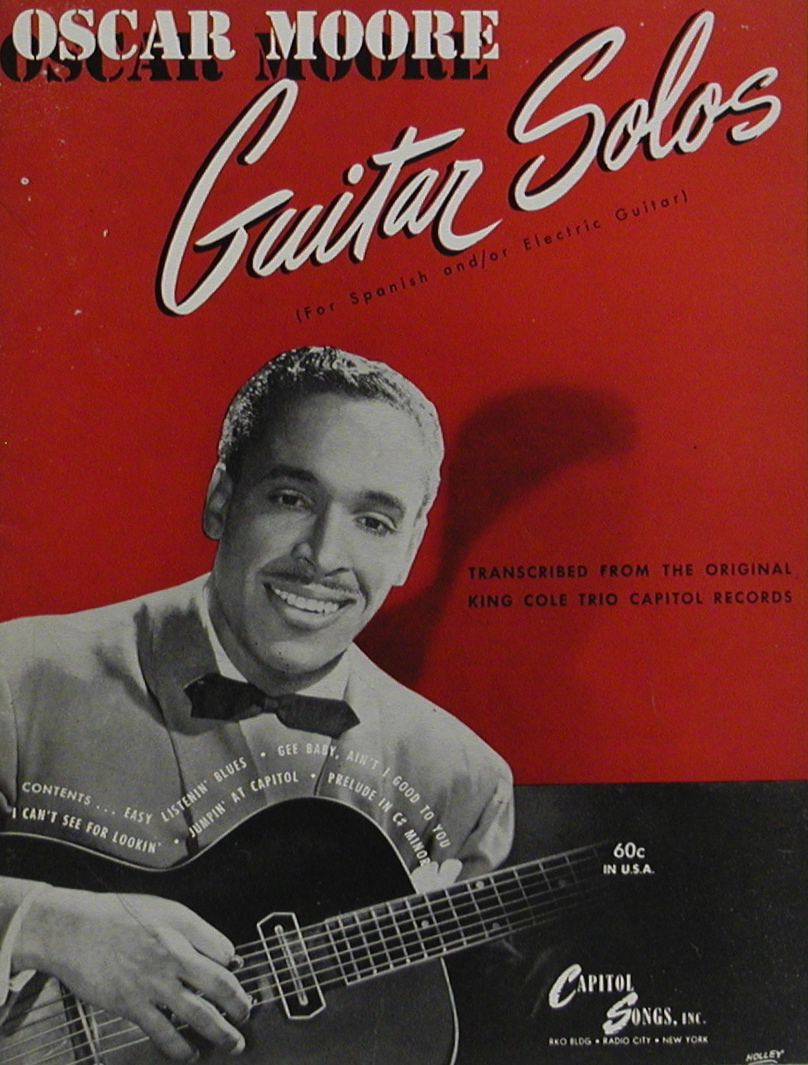
Oscar Moore was near the peak of his popularity in 1947. For over ten years, he had been a member of the King Cole Trio whose string of nationwide chart hits started in 1943, including in a number one pop record on the emerging independent Capitol Records, "(I Love You) For Sentimental Reasons" in the Autumn of 1946. The Down Beat readers voted Moore the top guitarist of 1945, 1946, and 1947. He appeared in print ads for Gibson guitars, had guitar transcriptions published, and appeared on all-star radio and recording dates. Moore also commanded a tremendous amount of respect among his peers and influenced guitar players ranging from his near-contemporay Barney Kessel to a then teenage Kenny Burrell.


Oscar Moore Guitar Solos, published by Capitol Songs, 1946

The King Cole Trio up until the time had been more or less a collective, with Moore an equal partner in the enterprise. But the hits all prominently featured the vocals of pianist Nat "King" Cole. Buoyed by success and reportedly encouraged by his soon-to-be wife among others in his management, Cole made a power-play in the latter part of the Summer of '47 that would regulate Moore to the financial role of a sideman. Moore called his bluff and walked. And why not? Moore had already released a handful of "solo" discs on Atlas Records (onetime home to the King Cole Trio) featuring the Los Angeles based combo, Johnny Moore's Three Blazers. Johnny (Oscar's older brother) and the group were experiencing their own run of popular chart hits that betrayed their blues-baked Texas roots. So it seemed not only natural but something of a lateral career move when Oscar walked away from Nat and into the Three Blazers.


Atlas Records, 1945

Unfortunately, the Three Blazers combo had vocalist issues of their own. Charles Brown, the trio's popular pianist and vocalist, decided to sign a solo recording contract in 1948 leaving the Three Blazers in the lurch. The age of the singer was in full swing, thanks in no small part to the extraordinary popularity of Frank Sinatra. The group struggled for years to find an adequate replacement but Oscar drifted further and further afield. At the dawn of the studio session era in Los Angeles, Moore found some work backing people such as Illinois Jacquet (Clef Records) and Billy Hadnott (Federal Records), as well as eventually cutting some discs on his own starting in 1954.


 Ooh Chica, Billy Hadnott And His Orchestra (featuring an uncredited Oscar Moore), 1952, Federal Records

As I discussed on this weblog before, it was around this time that Leo Fender was perfecting his first great contribution to musical instruments, the Fender Telecaster, just a few miles from Moore. Leo was known to be a fan of Western Swing and quite famously made sure his guitar got in the hands of top players like Jimmy Bryant. What is not as well known is the fact that he got one in the hands of Moore. To add to the obscurity, Oscar Moore's "Nocaster" (so named as it was produced in the early to middle of 1951 just before the Broadcaster was renamed the Telecaster) was one of the most unique examples of the guitar in terms of finish and hardware that is know to have existed.


   Fender "Nocaster" electric guitar, 1951, previously owned by Oscar Moore

What makes Moore's Fender so unique? The biggest aspect is it's gold hardware. Based on other examples of these guitars from the same era, this is the first as well as the only for several years to sport gold metal hardware. Gold metal hardware was commonplace on higher-end archtops at the time, which most jazz guitarists preferred. But Leo's guitar was a working man's instrument seemingly fairly devoid of any such loft aspirations. This shows that maybe this is not the entire story. The guitar is also finished in white. A simple enough characteristic and certainly a color that would become fairly commonplace on Fenders by the end of the decade, but in the nascent days of the company nearly all of instruments produced blond(e). The gold pickguard, again, seems to be a complete one-off and unlike anything Fender would produce for years to come. If Guitar Geekery is your thing, you can read more about the actual instrument here.


Telephone Blues, Aladdin Records 78, 1951 (#4 R&B chart hit)

There seem to be as many questions about Moore and Fender as there are answers. It almost certainly was a custom guitar produced specifically for Moore. But why a jazz man like Oscar who seemed to be on the lee-side of success? It turns out that Fender was fairly aggressive in their efforts to get the Broadcaster/Nocaster/Telecaster into the hands of top players regardless of their primary field of music, which explains why everyone from Jimmy Wyble to Les Paul ended up with guitars from the company around this time. Moore, only 3 years since his last Down Beat honor was still a celebrity of some note particularly in Los Angeles thanks to rhythm and blues hits like Floyd Dixon's "Telephone Blues". Plus, Cole's continued success certainly must have helped rather than hindered Moore, even though he no longer performed with the now successful pop star. Or did he?


Nat "King" Cole and Oscar Moore (possibly Jack Costanzo in foreground), 1951. Photo by Leo Fender.

Curiously, the only evidence that Moore ever used his Fender in public comes from a photo snapped by Leo himself according to Richard Smith's Fender: The Sound Heard 'Round The World. It shows Moore in 1951 performing with Nat Cole! Moore was never known to rejoin Cole's group after his 1947 departure. In fact, the two were known to have been estranged for years, a situation which was not remedied until Moore's appearance on the June 1960 episode of TV's This is Your Life which spotlighted Cole. But 1951 was a transition year for Cole's working group. Moore's replacement, Irving Ashby, made his final appearances with Cole in the studio of March of 1951. One can suspect that his live appearances ceased soon after. In the studio, Cole was aided by the talents of guitarists Barney Kessel and Bob Bain until he found a permanent replacement in John Collins who joined at the end of the year. In fact, 1951 was the year the King Cole Trio was officially disbanded and Cole begin appearing solely as a single. As there is little to no other known documentation of Moore and Cole working together in 1951, one can reasonably assume that Moore was temporarily filling the guitar chair, perhaps even for the night.


Letter to Syd Heller from Don Randall, 1953

One final Fender connection is worth talking about. Jon Raney on his EXCELLENT website devoted to his father, the legendary jazz guitarist Jimmy Raney, published a letter from his archives that will serve as something of a final chapter to this story. Don Randall had been a key part of Fender's early success from the first days of the company. By 1953 he was the President of Sales and responsible for bridging Leo's innovations with both musicians and the public. Syd Heller was the owner of the Columbia Music Company in San Francisco, which had no relation to the record company, but rather was a retail shop and point of connection for many of the West Coast musicians of the time. Through Heller, Randall actively pursued Raney and tried to get a Telecaster into his hands. His selling point? Oscar Moore's endorsement! You can read two of the letters in the correspondence here.


Presenting Oscar Moore, Five Star Recordings, reel-to-reel release, 1957

Oddly enough, there is very little aural evidence to support today's story. Moore's record appearances were sporadic in 1951 and it is difficult to tell for sure how much use his Fender got at the time. He continued to make records until 1957 (with one more 1965 session providing an epilogue to his discography), but nearly every photo of Moore in the 1950s shows him playing a Gibson archtop guitar. Perhaps some time in this great digital age, someone will compile all of Moore's 1950s sessions as a sideman. It would be more than appropriate for an artist who truly was both an innovator and one of the most popular of his time, but who is now sadly in danger of falling in between the cracks of time.

Thank you to Jon Raney for allowing me to reproduce the Randall/Heller letter.