Showing posts with label clothing. Show all posts

Friday, May 1, 2015

Chipp (1953)

Every so often an item pops up on eBay that somehow needs to be preserved. I am not necessarily talking about museum pieces, but rather curios that folks cut from a certain cloth just are interested in - or rather should be interested in.


Print ad, Gentry magazine, late-1952
purloined from The Ivy League Look

This wool odd jacket is one such item. Bearing the label of custom tailor Chipp, the item has the added bonus of a genuine date: September 11, 1953. What a garment like this represents is an actual connection to the past beyond the grip of latter-day Internet-based theoreticians and speculators. It is a glimpse of what actually was. These types of items help put things into perspective; they help answer a few questions - and perhaps prompt one to ask other questions.


The Chipp story is well documented elsewhere, particularly in this Ivy Style piece. In short, the operation was started in 1947 by Sidney Winston and Lou Praeger, two J. Press refugees keen to break out on their own. Their New York address was within curling distance of the mighty 346 Madison Avenue address of Brooks Brothers and were, at their peak, certainly vying for the same clientele if not a true competitor. Peter Lawford was a client and it was the Brother-in-Lawford himself that introduced Senator John F. Kennedy to the joys of Chipp. Kennedy was perhaps the company's most famous patron who continued having his suits made by Chipp into his presidency. Almost needless to say, it is one of those Ivy League legends often mentioned in the same breath as The Andover Shop, et al.


So what should be said about this particular example of Chipp's handiwork? Well, let's take into consideration the year first: 1953. One would expect much wider lapels based on contemporaneous photos and movies. In fact, it is remarkable how narrow the lapels are even with the button on center stance (yes, I am still trying to get in the habit of using that one over 3/2 button).


The cut, in general, looks more 1963 than 1953 - but again, that can be chalked up to the slight of hand tricks of history books. The shoulders? As natural as can be. The wool check pattern itself certainly smacks of the 1950s - walking the line between a classic Northeast country tweed and something Lanksy Brothers in Memphis would sell to a Beale Streeter or their world-be imitators.


A couple of final shots in the spirit of preservation for the ages, such as it would be...


Wednesday, August 13, 2014

Brooks Brothers (1940)

Print ad, Brooks Brothers Clothing, New Yorker magazine, 1940

The Internet is a funny thing. No earth-shattering statement there for sure, but it is very interesting how much our culture and society has changed over the past 2 decades and how much of that has to do with technology in general and the Internet in particular. Scholarship, research, and eduction are only 3 areas which have been drastically effected by the way we all communicate and share information. What does this have to do with Brooks Brothers in 1940? The emergence/re-emergence/codification of what is now know as Ivy League Style has increased significantly over the past decade due in a great part to the Internet. Online forums and blogs have become clearing houses of information, shared experiences, core knowledge, and (sometimes) interesting discourse. It has also become the breeding ground for a lot of misconceptions due to poor research habits. 

There was a time when primary resources were arguably the only resources that held water. Everything else - such as faint (or vivid for the matters) memories of events fifty years in the past - was secondary in every sense of the word. There were also standards of citation which the Internet has perhaps most effectively done away with. Is all of this bad? No, not necessarily. But it has helped create an increasingly hyper-informed and under-educated society. 

But again you ask, what does this have to do with Brooks Brothers circa 1940? OK, I will answer the questions. The above scan from a primary source shows the classic Brooks Brothers OCBD (Google those initials for a good time) in 1940. Now what is interesting to me is not that only 2 colors (white, blue) were available. Nor is it that a US-made Brooks Brothers shirt cost the equivalent of around $30 in 2014 dollars. No. What strikes me most is that it features a breast pocket! Why is that so important? Well, general internet knowledge ™holds that Brooks Brothers did not add breast pockets to their shirts until 1965 or so. Much has been written and discussed around that. I bought into it wholesale for sure, taking it as fact and being uncharacteristically ambivalent about digging deeper. Certainly - or at least as far as I know - the Brooks OCBD lost its pocket some time between 1940 and 1965, but when? Why? 

My challenge to all of us that are interested, if not fascinated in these slowly vanishing traces of 20th Century culture is to dig deeper. Do your homework. Know your sources. Quote your sources. Edit your work. I suspect these words I type right now may very well last longer than the fingers that type them. 

Tuesday, July 23, 2013

Brooks Brothers (1939)


Brooks Brothers print advertisements from the archive, all dated 1939. It is truly remarkable how little changed with the clothier for many, many years. Small concessions to contemporary conventions aside, there is a lot of recognizable aspects to all four of these ads. So much so, that it is easy to see why what many know today as Ivy League style or The Look, was widely known as the Brooks Brothers look for quite some time. I recall reading Graham Marsh's written introduction to the 1991 compendium of Blue Note cover art not long after it was released, where he made mention of still being able to get a Brooks button down with an air of assurance that some things had not changed. As I was just starting to get into that aspect of style at the time and still preoccupied with looking '60s, I did not get it. But over the years those written words became a little touchstone and looking at the above images from nearly 75 years ago when the world was a strikingly differently place - I do take some comfort that one can still stroll down Madison Avenue in New York City, pop into number 346, and buy a Brooks Brothers button-down shirt.

Tuesday, May 21, 2013

Sir Pendleton (1956)


1956 print ad

Four years after Pendleton Woolen Mills introduced their iconic Sport Shirt to the American male, the Sir Pendleton made it's debut. And while lesser known, it is an important part of the clothier's canon. Like it's predecessor it was made of virgin wool, but new addition was of an extremely lightweight worsted variety intended for yearlong use.


1959 print ad

The expansion of the garment line had deep roots. In 1912, the Pendleton company acquired additional woolen mills in Washougal, Washington nearly 200 miles West of it's Pendleton, Oregon location. Washougal sits on the Columbia River, just a few miles and across the border from Portland. The facilities allowed production of lighter-weight woolens, such as those used in men's suiting. Worsted wool, while stretching back several hundred years, made tremendous advances in the late-1800s due to industrialization in both England and the United States. By the early 20th Century it had started to gain the upper hand in men's suiting.


1961 print ad

Much like the Sport Shirt, the Sir Pendleton had a distinctive style that changed very little for quite a few years perhaps most notably it's classic open collar with a loop for the top button and a single breast pocket with a button rather than a flap. And like the Sport Shirt it was available in a variety of colors and plaids.


By the early-1960s the Sir Pendleton shirt gave way to an expanded Sir Pendleton full line which included everything from button-down collar shirts to blazers and jackets. And again like the Sport Shirt (nee Board Shirt), it has a presence in the current Pendleton clothing line. And the Washougal mill? It recently celebrated 100 years of operations and can be visited most days of the week.

Tuesday, April 2, 2013

John Simons Online (2013)


While your faithful editor spends the week back in Boston, our man in London, Jimmy Mellor, reports in with and exciting development for us Ivy enthusiasts who don't make it across the Atlantic nearly as often as we would like to...

Last month saw the launch of the long-awaited John Simons online shop: a brave new venture for John and his son Paul, as they have built their reputation on personal service and a personal relationship with their customers. You pop in for a shirt, a conversation develops, before you know it you are invited for a drink! The personal touch has always been the hallmark of shopping at  'John's' in each of his many shops over the years and so translating that same level of attention to detail has been the challenge in setting up the new online shop. Hence it being long awaited. Unless it could be done really well the feeling was why let down the customer with anything less?

The new website is still in development and growing daily - probably that will always be the case as there will always be new stock to showcase, new designs from John to debut, an dnew additions to the nature of the shop. Last time I was in, John showed me some vintage thermos flasks he'd acquired purely for the perfection of their design.


Being an independent retailer the London shop is a one-off and that has been the main reason for the move into online. Unless you could visit the shop or were happy to mail order over the telephone (a service John has always supplied) then the frustration for many was in wanting to see and get their hands on the clothes that kept on being discussed. Facebook helped to an extent in spreading the ethos and culture of the shop and Twitter provided updates on the latest, but in the computer-centric world we now all live in (for good or ill) the move to adding an online shop to what John has been doing since 1955 had to come.

And I think it's been well worth the wait. What I would have given for a service like this when I first started out as a 13 year old kid in 1978 with an instant obsession for the clothes I'd seen on my Uncle's old Modern Jazz LP sleeves. In England, unless you knew about John Simons (and I didn't back then), you simply could not get the clothes. You'd get something that came kind of close if you really hunted around but it never would be quite right. Trust me, before encountering John Simons I spent 8 years and wasted a lot of money on trying to get The Look. Now it's all there at the click of a mouse.


Already online from John you can equip yourself with an Ivy League wardrobe from head to toe. Especially of interest is the John Simons Apparel company range of John's own designs informed by his encyclopedic knowledge of menswear. All unique products that you just won't find anywhere else. The shirts due to their production runs have already attracted a 'stamp collector' mentality with John's earlier designs now changing hands for the sort of prices rare records attract. Again, trust me on this as I am putting together a John Simons archive of items from his earlier shops to date. Beyond the very generous donations from long time loyal customers there can be much haggling over all the rest - which is all great good natured fun.


Amongst the various rarities I've collected so far from The Ivy Shop, The Squire Shop, The Village Gate, J. Simons, and now John Simons Est.1955 (all the brain child of John), a Lion of Troy buttondown from The Ivy Shop purchased in 1969 by Mr. Ian Hingle especially stands out as he also enclosed a photograph of himself wearing the very same shirt from that year. So timeless is the style that it could have been taken yesterday. Ultimately the collection will be offered to the Victoria and Albert Museum, London.

For Ivy style fans in England things have rarely been so accessible and now also for the world due to the Internet. Which is just how the style should be.


Jimmy Frost Mellor, Ivy League Menswear Consultant and Archivist

Editor's Note: all of the items pictured are from John's current online inventory. Be sure to follow one of the links to see the full online selection. 

Wednesday, March 6, 2013

The Andover Shop (2013)


During my very first visit to Boston, Massachusetts last week, I finally had the opportunity to make a pilgrimage to the legendary Andover Shop across the river in Cambridge. What's the fuss, you ask? Well, The Andover Shop is the spot that directly links post-war modern jazz with Ivy League style. It has here that Roy Haynes had his suits custom made: the "slickest sh*t out"in his own words. It was here that a cleaned-up Miles Davis chose the threads that were to be part of his mid-1950s "comeback" image. And it was here that proprietor and acknowledged jazz-fan Charlie Davidson forged life-long friendships with customers such as Chet Baker.


The building itself is a simple unassuming modernist building located on a quaint (yes, I said quaint) New England side-street: 22 Holyoke to be specific. I have to admit, that I was taken a little a back upon arrival...and pleasantly surprised. I expected something along the lines of what Brooks Brothers on Madison Avenue is trying to be: more old club, old world. It is clear here that form followed function. The Cambridge shop is Charlie's second location, he opened the first on Main Street in Andover, Mass. back in 1949 after he left the employ of J. Press. But it was this place, the Cambridge address, which became the place.


I was greeted at the shop by Zach DeLuca who runs the excellent Newton Street Vintage shop on Etsy as well as The Suit Room weblog/Tumblr. Both are highly recommended if you are not familiar with them. I introduced myself formally (we had only met via the 'net) and set about exploring the store with Zach as my guide. I will admit to being slightly overwhelmed as I really wanted to soak it in. It is a dispensary in the best sense of the word: quite organized and well-stocked. The staff, who totaled four on this particular Monday morning, moved through the narrow aisles with knowing ease. 


Gerry Mulligan at The Andover Shop, photo by William Claxton (obscured), 1956

Meeting Charlie was exactly what I had hoped it would be. After some small talk about Roy Haynes and the Newport Jazz Festival, Charlie inquired if I was a musician. When I replied yes and that I played guitar, he responded with the jab, "That's not a real musician!" I expected nothing less. Ice broken, he proceeded to tell me some of his favorite six-stringers and I was very pleased to hear that Barney Kessel was near the top of his list - particularly since the neighboring Berklee School of Music seems to have it out for ol' Barney. Apart from some enjoyable jazz talk, I did pick up some basic, but essential clothier wisdom that the customer should be happy with the garment in the shop. It matters not what the clothier thinks, nor what the tailor may be able to do. This echoed a similar piece of advice that I picked up from Alden years ago (your shoes should feel good when you walk out of the shop...a "break-in" period is something of a myth). As I was paying for my American-made Hickey Freeman Hertling high-rise grey flannel trousers and saying my goodbyes, Charlie held out his hand and said, "I'm really glad you came into the shop today." Thank you Charlie. I am really glad that came into the shop too!

Tuesday, November 27, 2012

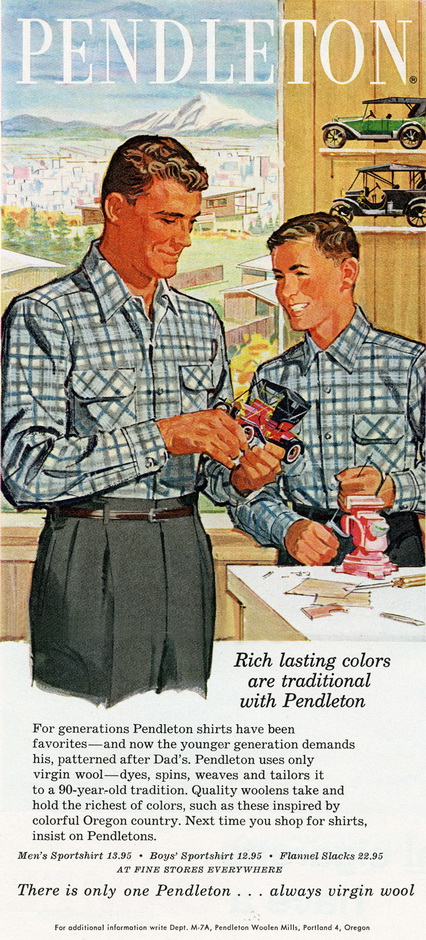
Pendleton Sport Shirt (1952)

Print advertisement, 1952

Pendleton, Oregon is a small (population is currently just over 15,000 people) city located about mid-way between Portland, Oregon and Boise, Idaho. U.S. Route 30, which has stretched all the way from Atlantic City, New Jersey to Astoria, Oregon since 1926 runs directly through town. Before that it was served by the Union Pacific railway line. The Pendleton Round-Up, a Nationally-known rodeo, was started in 1910 and now draws some 50,000 cowboys, cowgirls, and assorted others to the area every September. More recently, the Eastern Oregon Correctional Facility has drawn some attention to its host city on account of its Prison Blues line of clothing. But without the shadow of a doubt, Pendleton, is most well-known for the Pendleton Woolen Mills. 

Print advertisement, 1953

The mill existed before the 20th Century, but it was the acquisition of the facility and its subsequent rejuvenation by the Bishop family of Salem, Oregon in 1909 that is the real first chapter in this story. Eastern Oregon at the turn of the last Century was sheep country and more than a little rough and tumble. The Bishops made their living manufacturing Indian blankets, selling to both to the local tribes (Utatilla, Cayuse, and Walla Walla) as well as those the Southwest. But within fifteen years they expanded their product line to include their first men's shirts, which developed into a full line of men's clothing by 1929. Both were innovative at the time, mainly due to the rich colors and patterns that the company incorporated into its clothing, an anomaly particularly in the world of outdoor and work wear of the time.


Print advertisement, 1954

Pendleton shifted all of its production during the Second World War to supply the military and contribute to the war effort at home. At the conflict's end, production of consumer goods resumed and expanded in 1949 to include its first woman's line of clothing. There was also a tremendous shift after the war, that attempted to move away from it's workwear/outdoorsman image and court the mid-century spirit of leisure that was beginning to pervade so much of the United States. This only increased after the conclusion of the Korean War in 1953, both in terms of the types of items found in the men's line as well as in the spirit of the company's advertising campaigns. 


Print advertisement, 1955

Some time during this era in the company's history, they introduced their Sport Shirt, more commonly known today as the Board Shirt in deference to West Coast surf culture's adoption of the garment in the early-1960s (more on that in a moment). I have yet to pinpoint the exact time of introduction, but the earliest print ad I have seen making mention of the Sport Shirt is 1952. This makes sense from a stylistic perspective, in that the sport shirt clearly draws is main design inspiration from the men's casual shirt of the mid-to-late-1940s style widely manufactured throughout the United States but very often so referenced as "California Style" and frequently made in gabardine. Incidentally, Pendleton's older shirt design was re-christened as its Regular Shirt to differentiate the two. A third style, the Sir Pendleton was introduced a short while later in the middle of the decade.


Print advertisement, 1959

What sets the Pendleton Sport Shirt apart from any other manufacturer of this style of shirt is not only its use of its trademark bold woolen plaids but the fact that the Pendleton Sport Shirt stayed in fashion long after men's casual wear moved onto to other styles and trends. In fact, the shirt has pretty much remained in production by Pendleton since the early-1950s and can be bought new today in 2012 for pretty much the same price (adjusted for inflation, of course). Perhaps even more remarkable is that it has done so with only slight concessions to the changing times. One could of course detail the differences between this year's model and the inaugural version, but in a larger scheme of things, they are remarkably similar. Another small miracle is not only how the Sport Shirt has usurped all prior versions of the same style casual shirt, so much so that many for decades have equated this style shirt with Pendleton; but also how it has become known to nearly as many as simply "a Pendleton." 


Gerry Mulligan, Los Angeles, 1953, photo by Bob Willoughby

In addition to the typical man of leisure the shirt was marketed to, the Pendleton was quickly adopted by the West Coast Bohemian set. Jazz musicians as well as the emerging Beat Generation that they influenced can be seen in the soon-to-be ubiquitous Sport Shirt throughout the 1950s. The fact that Down Beat could be running a photo of Gerry Mulligan blowing his bari roughly around the same time that Pendleton was opening a retail shop in Disneyland, also speaks to the somewhat egalitarian status the shirt was reaching. A quick side note: the Pendleton shop located in Frontierland in the original Disneyland amusement park in Anaheim, California was open for nearly 35 years (July 1955 through April 1990)!


Brew Moore LP, 1956, Fantasy Records 

That the shirt was at both ubiquitous and hip is what I suspect is behind its appropriation by Southern California surf culture in the early-1960s. Much of that youth culture was a mix of the suburban and Bohemian, drawing inspiration from equal parts Venice Beach boho and Hawthorne prefab. Of course much has been made of the early-Beach Boys moniker The Pendletones, as well as the photos of the group in Pendleton Sport Shirts on 2 of its first 3 LPs from 1962 to 1963. But it was truly part of the West Coast surfer uniform at the time. But why would a wool shirt be worn in a region known for the warmth of the sun? Well, as anyone on a coast will tell you, the ocean breeze blows cool and getting out of the water can be a bit of a shock to the system. And as noted surf culture historian, Domenic Priore, pointed out to me, surfers are up at 5 AM and in the water by 6 AM. The beach is cold that time of day! And let's not forget that good virgin wool breathes with the wearer making it fairly versatile and suitable for all but really warm days.


Disneyland, 1959

Fast forward fifty years and the Pendleton Sport Shirt (or Board Shirt) is still part of the conversation on cool. It's consistent production and relatively low cost has made it a thrift store staple for decades, ensuring its perpetual inclusion in the wardrobe of hipsters both young and old. It's egalitarian nature has been preserved and folks ranging from bearded Brooklyn youths to web-posting connoisseurs of 20th Century Classics ensure that it's legacy lives on.

Thanks to the gang over at The Roll Call on Facebook for the inspiration. For further reading, I highly recommend checking out the archival entries in Pendleton's own weblog. For vintage Disneyland photos, one can do no better than Gorillas Don't Blog.

Tuesday, August 21, 2012

Brooks Brothers (1952)


Print advertising, 1952


Shirt label, c.1952

New Yorker magazine, October 18, 1952

This week's post features more Brooks Brothers print advertising to compliment one of my earlier entries, which can be found here. The top image is a very rare color print ad spotlighting some more casual items and is presented in stark contrast to the second image, that of a dinner jacket. The third image shows remarkably clean lines, clearly illustrating that the "Brooks Brothers Look" was well defined by 1952. 

For kicks, I've also included a cartoon from the New Yorker from the same year. It too is fairly timeless. Just ask my wife.

Addenda & Errata: in my profile of Alvin Lustig and JBL some weeks back, I mistakenly identified James B. Lansing as an Italian-American. Thanks to a very nice email that I received from one of Lansing's granddaughters, I know now that he was German-American. Thank you Ms. Quintero for your kind words and for taking the time to correct the facts.

Tuesday, June 19, 2012

Brooks Brothers (1955)

I have been traveling this week, so I am going to keep it short. Here's a great selection of 1955 Brooks Brothers print ads from a recent eBay auction. Plenty of details for the aficionados to savor. Until next week, enjoy!


Tuesday, June 12, 2012

Father's Day (2012)

One of the things that Jimmy Frost Mellor's guest post here a few weeks back got me thinking about was my first exposure to Ivy League style. And from madras cotton to loafers to Brooks Brothers clothes, much of this exposure was via my father. Much like the prevalent Mid-Century modern architecture of my native Southern California that did much to shape my design aesthetic, my father's own tastes in clothing and fond memories of his earlier years in San Diego provided some basis to my lasting affection for the style.


Interchange by Ansel Adams, Los Angeles, 1967

My first conscious memory relevant to this topic was some time in the mid-1980s when I was developing an interest in vintage clothes. We lived in suburban Los Angeles at the time and my father, a banker who wore a suit and tie to work everyday, spent a good portion of his work week traversing LA's serpentine freeway system in a company car going from branch to branch doing the sort of thing an area manager does. I recall him coming home one evening and telling me he had some seen some "bleeding Madras" shirts in a shop window on Melrose that were "very 60s". Truth be told, I was a little more interested in dressing like Cream-era Eric Clapton at the time, but obviously it made a lasting impression on me. From that point, we casually talked clothes frequently: he laying knowledge and predilections on me; me sifting through it all for what was important in the immediate and filing away the rest for later. Often times over the years we would compare notes, such as the time he extolled the virtues of his tasseled Allen Edmonds loafers (always meticulously polished) over my vintage Italian pointed numbers (which hurt my wide, flat feet). Much of what interested him most was Ivy League style, although he rarely referred to it as much beyond "very traditional". Recently, I took it upon myself to ask him a few questions about his early interests and inspirations when it came to clothing and style.


"Guaranteed to Bleed", real deal bleeding Indian Madras cotton garments available from this Etsy seller and select few other vintage resellers

I asked my father, Laurence "Larry" Rossi (born in San Diego, California, U.S.A. in 1947) about his early memories and experiences with Ivy League style. Among his first dates back to 1959 or 1960 when he was in the 7th grade and starting experiencing migraine headaches (one of many traits we share). When the doctor's suspected an enlarged optic nerve, glasses were duly subscribed and the style my father chose were "horn rims which were inspired by friend Joe Ledesma who was in turn inspired by jazz artists" adding that "those styles were not limited to Ivy Leaguers, but also lower income whites/hispanics who followed jazz greats". Dave Brubeck being name-checked and the probably most popular choice at the time. Ledesma stories are something close to my heart as my father speaks of his best friend Joe's older brother's record collection which included LPs by Brubeck and other popular West Coast jazzmen like Cal Tjader. Every so often my father blows my mind by mentioning another disc he discovered during these years thanks to his pal Joe. (Side note: years later my Dad was the first person I would ever hear use the term "Poor Boys" to describe a particular style of eyeglasses, but that is a topic for another post.)


Dave Brubeck (ready for his close-up), UK EP, 1960

If I were to name the most important musical artist of the Rossi household growing up, it would have to be The Kingston Trio. My father owned all of their LPs and loved them dearly. Well. All of their early LPs that featuring the original trio with Dave Guard (and often the VERY intriguing and important David "Buck" Wheat on upright bass, again a topic himself who deserves his own entry). At any rate, as I have mentioned before, I can recall pouring over the sleeves of these discs myself for years, with their distinctive striped short-sleeve button-down shirts. Correction. Make that HALF-sleeves! As my Dad told me, "They were half-sleeve shirts, NOT short sleeve. You had to make that distinction otherwise you didn't get the right style." But he did confirm the the "other inspiration was indeed the Kingston Trio whose album covers were always showing them in button-down shirts. Having gone to Catholic school we had to wear white shirts and I was alway begging mom to buy me one with a button-down. There was a kid school who wore it and was just so cool. Incidentally, the premier shirt maker of button downs was Gant, especially because it had the back collar button plus the locker loop." Incidentally, the Northern California-based Kingston Trio purchased many of their shirts from Johnson & Gray in Sausalito just over the Golden Gate Bridge from San Francisco in Marin County - although a Kingston Trio insider tells me that their first ones were purchased by a Bay Area department store (probably Roos Brothers) and were tailored to half-sleeves (again note the distinction!).


The Kingston Trio...from the "Hungry i", recorded live in North Beach, San Francisco, released on Capitol Records in 1959...I remember pouring over the line drawing in the background for ages as a kid!

Speaking of which, I asked him where one could find these styles in a some-what sleep military town like San Diego back in the day. He replied:


"4 stores in San Diego, Roberts and The Highlander (which is still alive). The third, The Ascot Shop in La Jolla, is still there as well, but we were too poor to even drive to La Jolla. The last was Lion Clothing. Right on Broadway downtown. Long since gone. They sold the absolute best traditional clothing. This is where I bought my suit when I got married. Funny story here. Dad [his father Ugo Rossi, ed.] bought all of his Ivy League suits at Roberts usually during the January sales and from his high school friend, David Reed. I remember because their connection beyond high school was that David went to Reed College and my uncle went to Portland. David had a son, also a David, who also went to Reed is a famous artist. I have to say that my dad was the style guy with his cuffed pants, vented-jackets, and, of course, wingtips, which I had to shine for him weekly."


Early-1900s newspaper advertisement for Lion Clothing

I pressed him a bit further on details. What were the hallmarks? Were there any particular regional favorites within the style? He was happy to oblige:


"Hickey-Freeman suits: all wool. English Walkers wingtips. My dad wore them all the time. Don't confuse with British Walkers. They are not the same. Other popular shoes were saddles and Bass Weejun penny loafers. Black and white saddles were the rage worn with powder blue slacks and with button-downs. Everyone in high school wore these kinds of clothes because we also had to wear blazers every day which were bought at only one place...Roberts! As a senior you could choose another color and we chose olive drab. All underclassmen had to wear black. Fridays you had to wear a tie, so getting dressed up was the thing. Add a skinny tie and you were good to go. It was also the beginning of the "dry" look. No more Brylcream or Wildroot Hair Tonic. The greasy look was dead to coincide with the clothes. Grease started leave in the late 50's. Again, Kingston Trio influence as well as surfer influence."


Manufacturer stamp from the extremely illusive English Walkers brand shoe

When I asked him why he thought we were even talking about the style, he remarked, "In the end, this style has lasted through the times. It never goes out of style and tends to label you as one who won't compromise and chase after fads." Well, far be it from me to argue with my father.

One final story. When I finally purchased my first new Brooks Brothers oxford cloth button-down shirt from their Century City shop in 1996, I immediately called my father with the news. I was immensely proud of myself and felt like I had attained some degree of maturity and success. And indeed I had.

Happy Father's Day Pops!

Tuesday, May 15, 2012

You Never Forget Your First Time (1984)

Yes, there IS a first time for everything. This week, for the first time, I am featuring a guest piece here on what has been a personal endeavor. Jimmy Frost Mellor, main man of the Talk Ivy Forum, shares with us some of his memories of one of the icons of The Look. I am also debuting my new weekly publishing schedule, namely Tuesday 07:01 ante meridian, Pacific Time. Yes, this means you can expect regular posts here on A Modernist in the coming weeks. See you next Tuesday.  


"Kensington High Street, October 1984. Rain. And not just any old rain either, this was that very specific London rain that comes down grey and soaks you to the skin within seconds. But I was in a good mood. As far as I was concerned, the sun was shining and the birds were singing because I was going to a shop called Meenies where I had just heard they had discounted Bass Weejuns on sale.

I was broke, as always back then, but I still had to have some. I'd only just learned about them after spending years wearing English loafers that just didn't look quite right to one obsessed with the American look. And Weejuns didn't disappoint.


The shoe department was in the basement of Meenies and they were operating on a pile them high and sell them cheap basis so the first sight that greeted me at the bottom of the stairs was quite literally a wall of Weejuns. Shoe boxes stacked like bricks filling the wall ahead with a few display pairs dotted about here and there around the shop.


Maybe it was the London weather stirring up the atmosphere or maybe it was my senses heightened with the anticipation of getting my hands on these legendary imported loafers, but the smell of leather was wonderful down there. That rich, intoxicating smell that all shoe fanatics love...


Best of all: the place was deserted! A shoplifter's paradise in retrospect, but that never occurred to me I was so keen to start trying on loafers. They had the Penny and the Tassel styles only, in black or something like the colour of dried blood that I was later to learn they called 'wine'. Wine looked uber-Ivy to me and I loved them on sight, but my finances were restricted and I always needed to justify my purchases to myself by buying things I would get the most wear out of back then. This line of thinking also delayed me buying a much-coveted pink buttondown for ages also. So I went for the black Penny Weejun as my entry into the life of a London Weejunaire, but spent ages looking at the wine Weejuns and planning ahead. If I only ever ate once a day, how soon would it be before I could get a pair?


Americans are often amazed and bemused when English Ivy League fans go into rhapsodies about the style and design of the basic Bass Weejun Penny Loafer. To them it's so commonplace that they barely register it at all. But not in London. In London they were different, but not obviously so. Just the right look to blend in and yet stand out: the ethos which is at the heart of the Ivy League style in London.


First came that snub, rounded toe. Then the 'pie crust' gathered stitching on the vamp which was so alien to traditional English shoemakers What were these shoes? Bedroom slipper moccasins presented as being dress shoes? Brilliant! What a bolt from the clear, new, brave blue in this grey and rainy city. They're smart, but they are a brand new smart which comes from Another Country. Here's my credit card...


Still to this day only a very few certain London shops have Weejuns. From Meenies I graduated to The Natural Shoe Store in Chelsea and Covent Garden before I discovered John Simons in 1985 and a much wider world of Weejuns beyond just the basics that all the rest offered. Today I buy all my Weejuns there. But not often...Style lasts!"


- Jimmy Frost Mellor, May 2012


Editor's Footnote: the above advertisements are from 1951, 1960, and 1965 respectively.