Showing posts with label Made in USA. Show all posts

Tuesday, May 6, 2014

TK Smith (2014)


Desert Oasis: The Midcentury Modern Guitars of TK Smith by Nick Rossi, photos by Jacqueline Di Milia, courtesy of the Fretboard Journal

Issue number 32 of the Fretboard Journal is now available at newsstands everywhere. I am very pleased to announce that it includes an article penned by yours truly profiling guitarist and guitar-maker TK Smith. I first heard about TK in 1990 when Big Sandy & The Fly-Rite Trio released their debut LP on Dionysus Records and played in San Francisco to support the disc. I've been a fan of Smith's playing ever since. The path his life has taken is a very interesting one and it intersects with a lot of the topics covered on the pages of this weblog. I find his work to be beautiful, not only from the aesthetic perspective of someone who appreciates modernism, but also as someone who respects true craftsmanship. I also like that TK is part of a Southern California tradition - not in a convoluted way, but simple because he is both creative and curious. Plus he has great taste!

Fretboard Journal 32, Ry Cooder cover story, out now

TK Smith may be found online and you may also follow him on Instagram. And here's just a snippet of why he is one of the most interesting guitar players around…

Tuesday, July 23, 2013

Brooks Brothers (1939)


Brooks Brothers print advertisements from the archive, all dated 1939. It is truly remarkable how little changed with the clothier for many, many years. Small concessions to contemporary conventions aside, there is a lot of recognizable aspects to all four of these ads. So much so, that it is easy to see why what many know today as Ivy League style or The Look, was widely known as the Brooks Brothers look for quite some time. I recall reading Graham Marsh's written introduction to the 1991 compendium of Blue Note cover art not long after it was released, where he made mention of still being able to get a Brooks button down with an air of assurance that some things had not changed. As I was just starting to get into that aspect of style at the time and still preoccupied with looking '60s, I did not get it. But over the years those written words became a little touchstone and looking at the above images from nearly 75 years ago when the world was a strikingly differently place - I do take some comfort that one can still stroll down Madison Avenue in New York City, pop into number 346, and buy a Brooks Brothers button-down shirt.

Wednesday, March 6, 2013

The Andover Shop (2013)


During my very first visit to Boston, Massachusetts last week, I finally had the opportunity to make a pilgrimage to the legendary Andover Shop across the river in Cambridge. What's the fuss, you ask? Well, The Andover Shop is the spot that directly links post-war modern jazz with Ivy League style. It has here that Roy Haynes had his suits custom made: the "slickest sh*t out"in his own words. It was here that a cleaned-up Miles Davis chose the threads that were to be part of his mid-1950s "comeback" image. And it was here that proprietor and acknowledged jazz-fan Charlie Davidson forged life-long friendships with customers such as Chet Baker.


The building itself is a simple unassuming modernist building located on a quaint (yes, I said quaint) New England side-street: 22 Holyoke to be specific. I have to admit, that I was taken a little a back upon arrival...and pleasantly surprised. I expected something along the lines of what Brooks Brothers on Madison Avenue is trying to be: more old club, old world. It is clear here that form followed function. The Cambridge shop is Charlie's second location, he opened the first on Main Street in Andover, Mass. back in 1949 after he left the employ of J. Press. But it was this place, the Cambridge address, which became the place.


I was greeted at the shop by Zach DeLuca who runs the excellent Newton Street Vintage shop on Etsy as well as The Suit Room weblog/Tumblr. Both are highly recommended if you are not familiar with them. I introduced myself formally (we had only met via the 'net) and set about exploring the store with Zach as my guide. I will admit to being slightly overwhelmed as I really wanted to soak it in. It is a dispensary in the best sense of the word: quite organized and well-stocked. The staff, who totaled four on this particular Monday morning, moved through the narrow aisles with knowing ease. 


Gerry Mulligan at The Andover Shop, photo by William Claxton (obscured), 1956

Meeting Charlie was exactly what I had hoped it would be. After some small talk about Roy Haynes and the Newport Jazz Festival, Charlie inquired if I was a musician. When I replied yes and that I played guitar, he responded with the jab, "That's not a real musician!" I expected nothing less. Ice broken, he proceeded to tell me some of his favorite six-stringers and I was very pleased to hear that Barney Kessel was near the top of his list - particularly since the neighboring Berklee School of Music seems to have it out for ol' Barney. Apart from some enjoyable jazz talk, I did pick up some basic, but essential clothier wisdom that the customer should be happy with the garment in the shop. It matters not what the clothier thinks, nor what the tailor may be able to do. This echoed a similar piece of advice that I picked up from Alden years ago (your shoes should feel good when you walk out of the shop...a "break-in" period is something of a myth). As I was paying for my American-made Hickey Freeman Hertling high-rise grey flannel trousers and saying my goodbyes, Charlie held out his hand and said, "I'm really glad you came into the shop today." Thank you Charlie. I am really glad that came into the shop too!

Tuesday, November 27, 2012

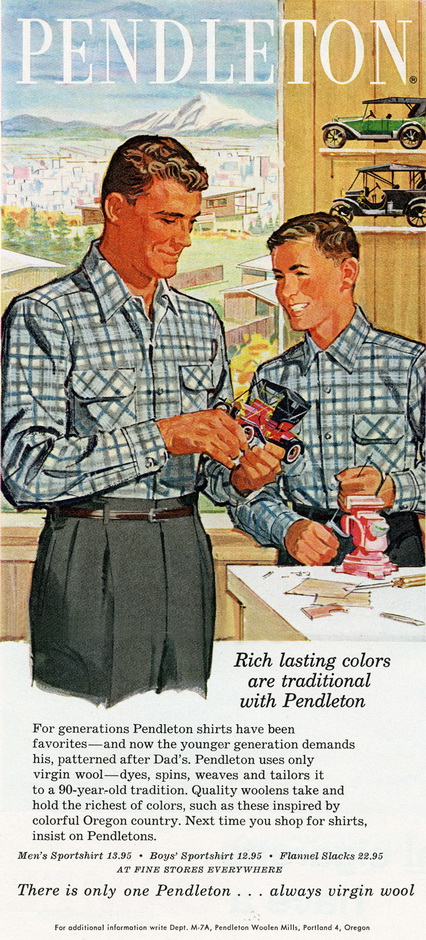
Pendleton Sport Shirt (1952)

Print advertisement, 1952

Pendleton, Oregon is a small (population is currently just over 15,000 people) city located about mid-way between Portland, Oregon and Boise, Idaho. U.S. Route 30, which has stretched all the way from Atlantic City, New Jersey to Astoria, Oregon since 1926 runs directly through town. Before that it was served by the Union Pacific railway line. The Pendleton Round-Up, a Nationally-known rodeo, was started in 1910 and now draws some 50,000 cowboys, cowgirls, and assorted others to the area every September. More recently, the Eastern Oregon Correctional Facility has drawn some attention to its host city on account of its Prison Blues line of clothing. But without the shadow of a doubt, Pendleton, is most well-known for the Pendleton Woolen Mills. 

Print advertisement, 1953

The mill existed before the 20th Century, but it was the acquisition of the facility and its subsequent rejuvenation by the Bishop family of Salem, Oregon in 1909 that is the real first chapter in this story. Eastern Oregon at the turn of the last Century was sheep country and more than a little rough and tumble. The Bishops made their living manufacturing Indian blankets, selling to both to the local tribes (Utatilla, Cayuse, and Walla Walla) as well as those the Southwest. But within fifteen years they expanded their product line to include their first men's shirts, which developed into a full line of men's clothing by 1929. Both were innovative at the time, mainly due to the rich colors and patterns that the company incorporated into its clothing, an anomaly particularly in the world of outdoor and work wear of the time.


Print advertisement, 1954

Pendleton shifted all of its production during the Second World War to supply the military and contribute to the war effort at home. At the conflict's end, production of consumer goods resumed and expanded in 1949 to include its first woman's line of clothing. There was also a tremendous shift after the war, that attempted to move away from it's workwear/outdoorsman image and court the mid-century spirit of leisure that was beginning to pervade so much of the United States. This only increased after the conclusion of the Korean War in 1953, both in terms of the types of items found in the men's line as well as in the spirit of the company's advertising campaigns. 


Print advertisement, 1955

Some time during this era in the company's history, they introduced their Sport Shirt, more commonly known today as the Board Shirt in deference to West Coast surf culture's adoption of the garment in the early-1960s (more on that in a moment). I have yet to pinpoint the exact time of introduction, but the earliest print ad I have seen making mention of the Sport Shirt is 1952. This makes sense from a stylistic perspective, in that the sport shirt clearly draws is main design inspiration from the men's casual shirt of the mid-to-late-1940s style widely manufactured throughout the United States but very often so referenced as "California Style" and frequently made in gabardine. Incidentally, Pendleton's older shirt design was re-christened as its Regular Shirt to differentiate the two. A third style, the Sir Pendleton was introduced a short while later in the middle of the decade.


Print advertisement, 1959

What sets the Pendleton Sport Shirt apart from any other manufacturer of this style of shirt is not only its use of its trademark bold woolen plaids but the fact that the Pendleton Sport Shirt stayed in fashion long after men's casual wear moved onto to other styles and trends. In fact, the shirt has pretty much remained in production by Pendleton since the early-1950s and can be bought new today in 2012 for pretty much the same price (adjusted for inflation, of course). Perhaps even more remarkable is that it has done so with only slight concessions to the changing times. One could of course detail the differences between this year's model and the inaugural version, but in a larger scheme of things, they are remarkably similar. Another small miracle is not only how the Sport Shirt has usurped all prior versions of the same style casual shirt, so much so that many for decades have equated this style shirt with Pendleton; but also how it has become known to nearly as many as simply "a Pendleton." 


Gerry Mulligan, Los Angeles, 1953, photo by Bob Willoughby

In addition to the typical man of leisure the shirt was marketed to, the Pendleton was quickly adopted by the West Coast Bohemian set. Jazz musicians as well as the emerging Beat Generation that they influenced can be seen in the soon-to-be ubiquitous Sport Shirt throughout the 1950s. The fact that Down Beat could be running a photo of Gerry Mulligan blowing his bari roughly around the same time that Pendleton was opening a retail shop in Disneyland, also speaks to the somewhat egalitarian status the shirt was reaching. A quick side note: the Pendleton shop located in Frontierland in the original Disneyland amusement park in Anaheim, California was open for nearly 35 years (July 1955 through April 1990)!


Brew Moore LP, 1956, Fantasy Records 

That the shirt was at both ubiquitous and hip is what I suspect is behind its appropriation by Southern California surf culture in the early-1960s. Much of that youth culture was a mix of the suburban and Bohemian, drawing inspiration from equal parts Venice Beach boho and Hawthorne prefab. Of course much has been made of the early-Beach Boys moniker The Pendletones, as well as the photos of the group in Pendleton Sport Shirts on 2 of its first 3 LPs from 1962 to 1963. But it was truly part of the West Coast surfer uniform at the time. But why would a wool shirt be worn in a region known for the warmth of the sun? Well, as anyone on a coast will tell you, the ocean breeze blows cool and getting out of the water can be a bit of a shock to the system. And as noted surf culture historian, Domenic Priore, pointed out to me, surfers are up at 5 AM and in the water by 6 AM. The beach is cold that time of day! And let's not forget that good virgin wool breathes with the wearer making it fairly versatile and suitable for all but really warm days.


Disneyland, 1959

Fast forward fifty years and the Pendleton Sport Shirt (or Board Shirt) is still part of the conversation on cool. It's consistent production and relatively low cost has made it a thrift store staple for decades, ensuring its perpetual inclusion in the wardrobe of hipsters both young and old. It's egalitarian nature has been preserved and folks ranging from bearded Brooklyn youths to web-posting connoisseurs of 20th Century Classics ensure that it's legacy lives on.

Thanks to the gang over at The Roll Call on Facebook for the inspiration. For further reading, I highly recommend checking out the archival entries in Pendleton's own weblog. For vintage Disneyland photos, one can do no better than Gorillas Don't Blog.

Tuesday, July 31, 2012

Alvin Lustig for JBL (1950)


Alvin Lustig, 1949

In a previous weblog entry, I quoted Charles Eames in saying "Eventually, everything connects." The concept is a favorite of mine and if you are a regular reader here, you will have seen that I often have been able to weave my various interests into the some sort of over-arching narrative. Today's entry is no exception, but designer Alvin Lustig makes such pursuits easy. Over the course of his brief 40 years on this planet, he was involved with books, magazines, interiors, architecture, furniture, industrial design, and company branding/identity. Born in Denver, Colorado he spent much of his early career in Los Angeles (with the exception of a brief spell as a student of Frank Lloyd Wright at Taliesin) before moving to New York City at age 29 to work as the Director of Visual Research for Look magazine, then in its ascension. A year later he began teaching. By the end of 1946 he returned to Los Angeles and opened up his own studio where he tried to eek out a living until he was forced to move back to New York in 1951. As a result of diabetes, Lustig lost his sight in 1954 and he died a year later due to complications around that disease.

Jim Lansing Signature Speakers brochure by Alvin Lustig, 1950 (front)

One of Lustig's clients during his second tenure in Los Angeles was the fledgling James B. Lansing Sound. The story of legendary amplified sound pioneer James Bullough Lansing (born James Martini, making him a suspected Italian-American. Cough.) is rather complicated, but in short he began to manufacture loudspeaker in LA in 1927 as the Lansing Manufacturing Company. After his business partner was killed in a plan crash, Lansing's company floundered was was purchased by Altec in 1941. Lansing was contracted with the company through 1946, but parted ways before that contract expired. James B. Lansing Sound, Inc. was founded in 1946, although Lansing again struggled to keep the company afloat and took his own life on his ranch in San Marcos, California just north of San Diego in the Autumn of 1949. Control of the company reverted to Vice President Bill Thomas who was able to parlay the company's sound innovations into a successful business. The company changed it's brand name to JBL in 1955 to settle its ongoing disputes with Altec Lansing. Fast forward fifty-seven years later and the name JBL is known the world-over.


Jim Lansing Model 375 label detail, early-1950s

As part of this chaotic transition, Thomas and James Lansing Sound, Inc. engaged Lustig to assist them with re-branding their company. Unfortunately, there is very little documented information about when Lustig was contracted for the work, but one may assume that it may very well have happened after Lansing's death. Similarly, little is known about the depth of his engagement and how much it increased in scope after his association. What is known, is that by mid-1950 Lustig had overhauled the company's brand identity. That year's brochure was a beautiful example of postwar California modernist graphic design and is a unique item in Lustig's portfolio. It also introduced a logo hallmark (the "Jim Lansing" sans serif font contrasted with the "L" script) that would grace most of Lansing's speakers through the 1955. 


Jim Lansing D-175 speaker driver decal detail, early-1950s


Jim Lansing by Ampex logo variation, early-1950s

In additional to the graphic design work, Lustig's scope of services included design consulting with their speaker enclosures, namely the C34 through C39 series. Again, details are illusive in terms of his exact contributions and the Internet is teeming with vintage-JBL enthusiasts who are more than happy to share their knowledge and educated guesses. But after taking one look at the speaker enclosures from this time period, it is easy to speculate about Lustig's input.


JBL C39 Harlan speaker enclosure, 1956

Lustig's association with the soon-to-be-JBL was obviously brief. The company introduced very little to  it's branding until the mid-1950s transition and Lustig's move to New York, followed by his death meant that there was little future for the partnership. What he did do is very successfully transition the branding of the company to something very cutting-edge and modern: a graphic representation of the products the company was becoming known for. By mid-decade, JBL was being mentioned in Life magazine and the rest, as it's been said, is history.


Jim Lansing Signature Speakers brochure by Alvin Lustig, 1950 (rear)

Tuesday, June 26, 2012

Fender Telecaster (1951)


2011 Fender 1951 reissue "Nocaster", made in Corona, California 

To say much has been written about the Fender Telecaster, would indeed be an understatement. Officially introduced in 1951 by Leo Fender's then small Los Angeles County-based musical instrument operation, it arguably the most-popular electric guitar ever, transcending genres and generations. There are plenty of excellent online resources from a musician's and guitar geek's perspective, including a message forum dedicated entirely to the guitar. But what interests me most from the perspective of this weblog is the Fender Telecaster as an icon of modern California design.


2011 LACMA Exhibit Book, available here

A few weeks ago, I caught the tail-end of the LACMA's California Design, 1930-1965 "Living in a Modern Way". It was an excellent exhibit that did a great job of not only presenting the classics, but also making a good case for the zeitgeist modern California design. For example, just a few feet from an amazing recreation of the living room of Charles and Ray Eames was a pair of surfboards designed by Hobart "Hobie" Alter and Greg Noll. This sparked an interesting conversation between my brother and I about the validity of presenting two disparate design pieces that socially, if not culturally, may or may not have little to do with one another. It also successfully got my brain thinking more about how cultural trends did influence various industries. And this, in turn, got me to thinking a bit more about Leo Fender's Telecaster.


Eames living room re-creation (left), Hobie and Noll surfboards (right), LACMA, 2012

While conspicuously absent in the LACMA exhibit, the first commercially successful solid-body electric Spanish or standard (as opposed to Hawaiian or lap steel) guitar meets much of the criteria of California modernism. It can trace it's design heritage back to 1948 with the first prototype being produced in 1949. Leo Fender had a small operation at the time based in Santa Ana, California (40 miles West of the Eames home in the Pacific Palisades and the Coast). The big band era was in its last few bars and small combos were becoming the new economic reality in modern jazz, rhythm and blues, and western swing music. As the standard guitar gained became more prevalent as a front-line instrument (not just a part of the rhythm section), so the need arose for a cost-effective amplified instrument. Leo was keenly aware of this. 


 Leo Fender, early-1950s

Fender's axiom was that this new guitar had to be cost-effective to both make and sell. It also had to be simple and easy to service. Furthermore it needed to address the musical concerns of being easy to play as a lead instrument and able to be amplified at loud volumes without causing the loud, offensive sound known as "feedback" - that howling sound everyone panics about that you've heard come from the PA system at street fairs. You know the sound.


1951 advertising insert

What follows next is a textbook example of "form follows function", the modern design principle introduced by Louis Sullivan at the end of the 19th Century. The guitar Fender created addressed all of those needs remarkably well and was soon available commercially for $189 (approximately $1,500 in today's dollars). This was an affordable, versatile tool that reflected the times and has since proven to be timeless. From a strict design perspective the Telecaster sits comfortably alongside the wooden Eames Lounge Chair (1946) and molded plastic Side Chair (1948), as well as the surfboard designs mentioned earlier. One could almost believe that they all came from the same design firm. Well, almost. Fender was being self-consciously modern to some extent. He did desire to break from the traditional guitar shape, again very much following the functional needs of the burgeoning lead guitarist. Early advertising was very much aware of this and, in fact, used the term "modern" freely.


Heywood-Wakefield M308 Side Table(s), c.1950

Lines and shapes aside, the color and finish was meant to emulate contemporary "blonde" furniture, still a relatively new trend in the early-1950s. More than any other single firm, this was popularized by Massachusetts-based Heywood-Wakefield starting with their mid-1930s "Modern Series", itself influenced heavily by European (primarily French) Deco designs and styles. The look was particularly popular in affluent Southern California and did reflect some degree of the aspiration of the time. Long-before collectors started talking about butterscotch finishes, Fender Telecasters were blondes. 


1952 magazine advertisement


After a rocky start which saw 2 name changes, some minor legal squabbles, and a bit of tweaking; the Fender Telecaster as we pretty much know it today was available for purchase in local music stores in 1951. Fender was smart in that he got it the hands of everyone from Jimmy Bryant to Les Paul to Barney Kessel. Not only did it become tremendously popular with the working-class western swing and country bands playing throughout the State, but with the rise of rock & roll, it became standard Hollywood studio issue. By the end of the decade it was everywhere, from TV (NBC's legendary Peter Gunn theme featuring Bob Bain) to radio (James Burton on nearly every Ricky Nelson hit from 1958 onwards to name just one player) and beyond.


Barney Kessel, Fender Telecaster, c.1958

Was Leo Fender a modernist? Of course, although I doubt very highly he thought of himself as such or even would care about being mentioned in the same breath as Charles Eames. As proud of his achievements as he was over the years, I am sure he thought of himself as a pragmatist first and foremost. But for our discussion's sake, he was a modern man, to be sure.

Postscript - Although Fender sold the company a long time ago, you can still buy a brand new made in California Fender Telecaster today which has truly changed very little in the past 61 years.

Tuesday, May 22, 2012

Allen Edmonds Kenwood (2011)

Let's talk about Allen Edmonds. More specifically, their current version of the classic beefroll loafer, named the Kenwood. They introduced the production model, made in their Port Washington, Wisconsin factory, a few years back. Initially, I was a real fence-sitter. The burgundy and black versions were only available in gentry (aka brush-off aka plasticized) leather and the shell cordovan was a bit out of reach for me. And the tan saddle version shown above? Well, let's just say that the online catalog photo was a bit underwhelming.

But as I so often I do: I kept circling back around the Kenwood. Why? Well so often is the case a musician is involved. You see, when I was 14 (more specifically the Summer of 1985) I made a very important connection between music and clothing. I not only wanted to play music like my emerging heroes, but I wanted to dress like them as well. Of course it helped that Los Angeles (the closest metropolis to my suburban digs) was experiencing the Paisley Underground and a good friend fell in a group of kids he referred to as mods. In short, it was the first step on a lifelong path of the shoes matching the sound, as it well.

But let me get back to the Kenwood. You see, I never really dug beefroll loafers. Sure sure, I knew they had their admirers and their place - my English friends seemed particularly fond of them - but they just did not do it for me. And then I saw this...


That's West Coast jazz and pop master guitarist Howard Roberts circa 1955 or so in the recording studio in Los Angeles. For my eyes this shot (photographer, unfortunately, unknown) matches Francis Wolff's later celebrated Blue Note photographs in every way. It is just plain cool. But don't smoke, kids. Seriously. Most importantly with regards to this post, let's take a cue from my pal, Mod Male, and focus in on a detail...


Yes a beefroll loafer, probably black, replete with a rear seam detail that I had only seldom seen on examples of these shoes. OK, so maybe these shoes were alright after all. Fast forward to when I first saw the Kenwood, some of the details of the shoe appealed to me thanks to Mr. Roberts, namely the rear seam. But the Kenwood had another detail that appealed to me: the pinked edge of the tongue. And there was something about it that reminded me of another photo I had seen.


Miles Davis, photographed by the aforementioned Francis Wolff at Rudy Van Gelder's studio in Hackensack, New Jersey on March 6, 1954. Again, we can take a look at a detail up close...


While not as pronounced as the Allen Edmonds model, there is the pinked edge that had caught my eye. Very likely a tan saddle pair as well. And while we are at it, nice sock/trouser contrasts both in terms of color tone and fabrics. And while 1954 marked the beginning of Davis's adoption of Ivy League as part of his sartorial style (something I have written about a greater length elsewhere on this very same weblog), he was photographed 6 months earlier wearing what is most likely the same pair of shoes...


Chet Baker, Miles Davis, and Rolf Ericson photographed on September 13, 1953 at The Lighthouse Cafe in Hermosa Beach, California. Miles had kicked his habit and took a road trip to the Coast where he jammed with Baker and Ericson alongside his bandmate from the Charlie Parker Quintet days, Max Roach. By the way, a recording of this session was released decades later by Fantasy/OJC as At Last! And Miles's tan beefrolls were there...


So when I happened into the Allen Edmonds shop in Union Square last year during one of their semi-annual sales and saw the Kenwoods up close and personal, my perception had shifted enough to encourage me to try on a pair of the tan saddles. No gentry leather, decent looking, USA-made. Perhaps I could warm to these. Admittedly the slightly burnished look still left me a bit cold, but I was in the mood for something different and the price was right so I gave them a shot.

The verdict? Well, I've had a uneasy 8 month relationship with the shoes. On the plus side, they are sharp as a tack. The color was much more versatile than I had suspected. In fact, a couple of trips to A Shine & Co. (don't tell my tailor that I get my shoes shined - it's a long story) and several coats of Meltonian goldenrod shoe cream and the richness of the leather has really come to life. On the flip side, I broke a heel within a few weeks of owning the shoes. A simple repair for sure, but not terribly encouraging for my first Allen Edmonds experience. I should also say that they stretched rather quickly resulting in a not too pleasant fit for my 10.5 E feet. I've since solved that issue by wearing a pair of thick Wigwams or a cotton liner sock, but again somewhat rough seas for my maiden voyage with the shoemaker. Still, my Father swears by Allen Edmonds, so I will give them some more time. As for a recommendation? Well, I can only give a highly qualified one and I would love to hear about your Allen Edmonds experiences in the comments section below.

Friday, November 11, 2011

Detour (1945)


Directed by Edgar G. Ulmer
Written by Martin Goldsmith and Martin Mooney
Cinematography by Benjamin H. Kline
Music by Leo Erdody

Full details here and here.

First a commercial. If you have a good, local video rental shop - such as mine, Lost Weekend Video - get out there and see if you can rent a copy of this movie (or any movie for that matter). They need your patronage, your legs need the exercise, and the film is going to be more enjoyable on something other than a computer. Now on to today's feature...

Some time ago, local film critic Mick LaSalle, published his short-list of essential Film Noir titles. More recently, I have been dutifully working my way through the movies I have yet to see. Detour is on that list. Seeing that it was not available at my local and that I didn't want to shill out the cash/waste resources for a copy on the 'Bay (nor has it been featured recently in San Francisco's EXCELLENT Noir City Film Festival), I hit the 'net looking for some options. 

Much to my surprise, the entire film (and a decent print at that) is available for viewing on YouTube. Yes, YouTube home to a million low-res time wasters. I feel as if some corner has been turned. 

All that aside, sit back and get comfortable. Released by PRC in November of 1945, you can enjoy the film right here or click over to the 'Tube if you want a little more control over your screen.


Sunday, May 22, 2011

White Oak Denim (1905-?)

A few days ago, on on May 20, 2011, Levi Strauss & Company celebrated the 138 anniversary of being awarded United States Patent Number 139, 121. This "Improvement in Fastening Pocket-Openings" is widely heralded as the birth of blue jeans, not only an American classic if there ever was one, but also a clothing icon.Contrary to latter-day publicity materials, San Francisco-based Strauss missed the California Gold Rush, but he most certainly sold garments to prospectors and beyond once production was active in the 1870s. For several decades, "Levis" (as we tend to call them now) were the provenance of West Coast workers from ranches to factories. But gradually, exposure to the garment grew. For example, the 1915 Panama Pacific International Exposition featured a hall where Levi's employees actively created garments.


In the 1930s, with Westerns riding high in the box office, the Dude Ranch fad/craze brought many Easterners in direct contact with genuine cowboys. What could be a better souvenir than a pair of the denim trousers that nearly every ranch-hand worth his boots could be seen wearing? The 1940s then saw an influx of folks of all classes, creeds, and colors into San Francisco, the greater Bay Area, and California thanks to both the armed forces as well as the war production effort. By the end of the Second World War, it is safe to say that Levi's were fairly well-known, if not well on their way to becoming ensconced in the cultural consciousness.


I celebrated Levi's achievement early this year by purchasing a brand new pair of Levi's Vintage Clothing line's 1947 501XX Selvedge Jeans at one of my favorite local merchants, Unionmade. Perhaps somewhat prohibitively pricey, they are impeccably and accurately fashioned after the surprisingly slim and modern cut of the 1947 501s. It would seem, by any measure, that Levi's Strauss & Company have firmly re-established themselves on the competitive (if not slightly overcrowded) premium denim scene.


Apart from what the attention to detail, two major things struck me about these particular reissues. First, they are made in the United States. And by made I mean: milled, cut, and sewn here in the United States. In fact, with a little research it turns out the cutting and sewing for these as well as some less pricey items from their regular line (such as 501s and 505s) are being cut and sewn in Los Angeles. Yes, that's right. Back in California after several decades in other states and countries!

But most impressive is the quality of the denim. It's quite simply some of the nicest I have ever come in contact with. It looks right. It feels right. And that's because it IS right! It turns out Levi's has been using Cone Denim from North Carolina. And not just any denim from Cone, but their premium White Oak denim that features unmistakeable narrow selvedge courtesy of original vintage shuttle looms. What more is that the White Oak Plant has been producing denim since 1905, which surely must be some sort of record. Compound this with the fact that the White Oak Mill has been supplying Levi's with denim since 1915 results in a pair of jeans that really are something special.

Herein lies a huge appeal to me. In so many ways a historic reissue is, by design, a period piece. But considering the source of the fabric and the continuum of its history, this is transcended in a no small way. And at the end of the day, the garment is still a piece of work wear more akin to other modern functional classics such as an Eames molded plastic chair rather than a museum treasure or mantlepiece.

Here's a brief video that focuses on another one of White Oak's customers, Raleigh Denim, but it does have some very cool images of the plants and the looms in action. Here's hoping those looms keep moving another 106 years!

Raleigh Denim: Handcrafted in North Carolina | UNC-TV from David Huppert on Vimeo.

Thursday, April 21, 2011

American Optical Flight Goggle 58 (1958)


American Optical Eyewear, Inc. has been making eyewear right here in the US of A since 1833. It can trace its origins back to William Beecher in 1826 and you can read their full story here. Other interesting date-related facts worth reading about include their first sunglasses (1876), their introduction of Ulta-Violet protection (1913), and polarized lenses (1940). But perhaps AO, Inc. is most well-known for their association with the US military.

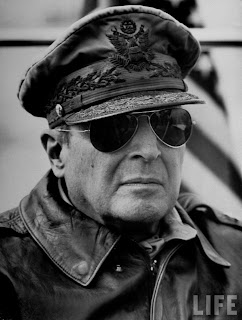
The design of the ubiquitous "aviator" sunglass generally credited to Ray Ban is, its classic egg-shaped glass favored by pilots around the time of the Second World War. Interestingly, pilots did not wear sunglasses while flying at this time, so their popularity had to have been reserved out of the cockpit. The most well-known Ray Ban man at the time? General Douglas MacArthur, of course.


A quick sidenote: the earliest hipsters (and I mean that in the true sense of the word), I have seen sporting aviators are in this photo of Afro-Cuban musicians in NYC from the late 1940s. By the way, that is Arsenio Rodriguez in the dark suit and tie in the center and Machito on the far right. Legendary bandleaders both.


But I digress.

American Optical, too, was producing and supplying aviator sunglasses to the military during World War II. In fact, they had been supplying sunglasses to the military as far back as the First World War, long before Ray Ban existed as a company. It was a fairly common practice for the quartermaster of any given branch of the military to source common goods such as these from multiple suppliers - take a look at the history of military watches some time for ample examples.

1958 saw the introduction of a newly-designed aviator sunglass courtesy of American Optical. And for my money, it is a design classic that surpasses the Ray Ban aviator. Its semi-rectangluar lenses have become almost as iconic as its egg-shaped predecessor. Living up to the modernist axiom of form following function, Flight Goggle 58 (as it was initially known) was/is streamlined and to the point. Their popularity quickly eclipsed that of the other aviator style for much of the subsequent decade, perhaps reaching a figurative and literal high point when they were the first sunglasses on the moon in 1969.

Jim Irwin (in blue) with fellow astronauts Alan Bean, Charlie Duke and Bruce McCandless before the July 1969 Apollo 11 launch.

Over the years, the popularity of the 58s has waxed and waned, but they have definitely seen an upsurge in popularity, again as an alternative to the egg-shaped aviators that ever Tom, Dick, and Supermodel seems to be sporting these days, irregardless of social status, political views, or face shape. But the 58s are around. Look for the discerning gentleman. And you can (in part) thank Don Draper while you are at it...


I will leave you with one piece of advice. If you get the itch for a pair, don't settle for any cheap (or expensive) imitations. You can purchase a pair of genuine American Optical Flight Goggle 58s (now called Original Pilot Sunglasses) direct form AO here. They are still made right here in the USA, with every customization option imaginable (within the confines of good taste of course). Be sure to order direct from them, it's worth the few extra dollars to know exactly what you are getting.