The Christmas Song, Nat "King" Cole, live on The Nat King Cole Show, December, 17, 1957
Showing posts with label capitol records. Show all posts
Tuesday, December 25, 2012
Tuesday, December 4, 2012
Oscar Moore and Fender (1951)
Oscar Moore was near the peak of his popularity in 1947. For over ten years, he had been a member of the King Cole Trio whose string of nationwide chart hits started in 1943, including in a number one pop record on the emerging independent Capitol Records, "(I Love You) For Sentimental Reasons" in the Autumn of 1946. The Down Beat readers voted Moore the top guitarist of 1945, 1946, and 1947. He appeared in print ads for Gibson guitars, had guitar transcriptions published, and appeared on all-star radio and recording dates. Moore also commanded a tremendous amount of respect among his peers and influenced guitar players ranging from his near-contemporay Barney Kessel to a then teenage Kenny Burrell.
The King Cole Trio up until the time had been more or less a collective, with Moore an equal partner in the enterprise. But the hits all prominently featured the vocals of pianist Nat "King" Cole. Buoyed by success and reportedly encouraged by his soon-to-be wife among others in his management, Cole made a power-play in the latter part of the Summer of '47 that would regulate Moore to the financial role of a sideman. Moore called his bluff and walked. And why not? Moore had already released a handful of "solo" discs on Atlas Records (onetime home to the King Cole Trio) featuring the Los Angeles based combo, Johnny Moore's Three Blazers. Johnny (Oscar's older brother) and the group were experiencing their own run of popular chart hits that betrayed their blues-baked Texas roots. So it seemed not only natural but something of a lateral career move when Oscar walked away from Nat and into the Three Blazers.
Unfortunately, the Three Blazers combo had vocalist issues of their own. Charles Brown, the trio's popular pianist and vocalist, decided to sign a solo recording contract in 1948 leaving the Three Blazers in the lurch. The age of the singer was in full swing, thanks in no small part to the extraordinary popularity of Frank Sinatra. The group struggled for years to find an adequate replacement but Oscar drifted further and further afield. At the dawn of the studio session era in Los Angeles, Moore found some work backing people such as Illinois Jacquet (Clef Records) and Billy Hadnott (Federal Records), as well as eventually cutting some discs on his own starting in 1954.
As I discussed on this weblog before, it was around this time that Leo Fender was perfecting his first great contribution to musical instruments, the Fender Telecaster, just a few miles from Moore. Leo was known to be a fan of Western Swing and quite famously made sure his guitar got in the hands of top players like Jimmy Bryant. What is not as well known is the fact that he got one in the hands of Moore. To add to the obscurity, Oscar Moore's "Nocaster" (so named as it was produced in the early to middle of 1951 just before the Broadcaster was renamed the Telecaster) was one of the most unique examples of the guitar in terms of finish and hardware that is know to have existed.
What makes Moore's Fender so unique? The biggest aspect is it's gold hardware. Based on other examples of these guitars from the same era, this is the first as well as the only for several years to sport gold metal hardware. Gold metal hardware was commonplace on higher-end archtops at the time, which most jazz guitarists preferred. But Leo's guitar was a working man's instrument seemingly fairly devoid of any such loft aspirations. This shows that maybe this is not the entire story. The guitar is also finished in white. A simple enough characteristic and certainly a color that would become fairly commonplace on Fenders by the end of the decade, but in the nascent days of the company nearly all of instruments produced blond(e). The gold pickguard, again, seems to be a complete one-off and unlike anything Fender would produce for years to come. If Guitar Geekery is your thing, you can read more about the actual instrument here.
Nat "King" Cole and Oscar Moore (possibly Jack Costanzo in foreground), 1951. Photo by Leo Fender.
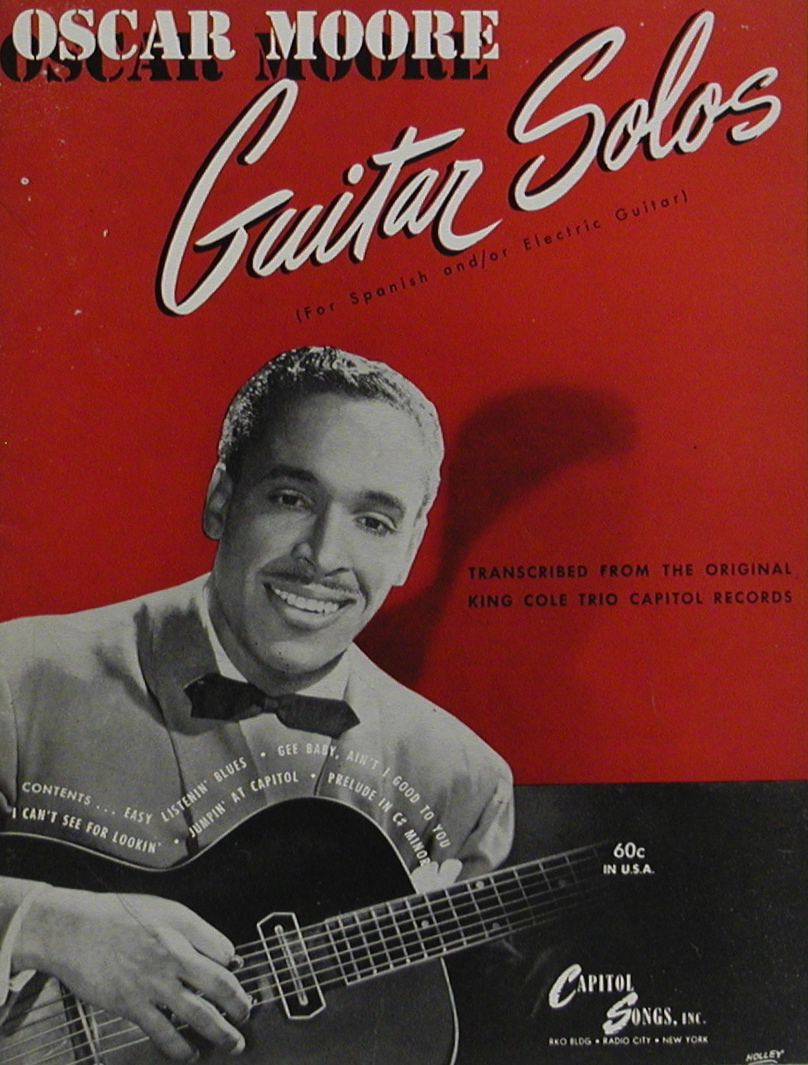
Oscar Moore Guitar Solos, published by Capitol Songs, 1946
Atlas Records, 1945
Ooh Chica, Billy Hadnott And His Orchestra (featuring an uncredited Oscar Moore), 1952, Federal Records
As I discussed on this weblog before, it was around this time that Leo Fender was perfecting his first great contribution to musical instruments, the Fender Telecaster, just a few miles from Moore. Leo was known to be a fan of Western Swing and quite famously made sure his guitar got in the hands of top players like Jimmy Bryant. What is not as well known is the fact that he got one in the hands of Moore. To add to the obscurity, Oscar Moore's "Nocaster" (so named as it was produced in the early to middle of 1951 just before the Broadcaster was renamed the Telecaster) was one of the most unique examples of the guitar in terms of finish and hardware that is know to have existed.
Fender "Nocaster" electric guitar, 1951, previously owned by Oscar Moore
Telephone Blues, Aladdin Records 78, 1951 (#4 R&B chart hit)
There seem to be as many questions about Moore and Fender as there are answers. It almost certainly was a custom guitar produced specifically for Moore. But why a jazz man like Oscar who seemed to be on the lee-side of success? It turns out that Fender was fairly aggressive in their efforts to get the Broadcaster/Nocaster/Telecaster into the hands of top players regardless of their primary field of music, which explains why everyone from Jimmy Wyble to Les Paul ended up with guitars from the company around this time. Moore, only 3 years since his last Down Beat honor was still a celebrity of some note particularly in Los Angeles thanks to rhythm and blues hits like Floyd Dixon's "Telephone Blues". Plus, Cole's continued success certainly must have helped rather than hindered Moore, even though he no longer performed with the now successful pop star. Or did he?
Curiously, the only evidence that Moore ever used his Fender in public comes from a photo snapped by Leo himself according to Richard Smith's Fender: The Sound Heard 'Round The World. It shows Moore in 1951 performing with Nat Cole! Moore was never known to rejoin Cole's group after his 1947 departure. In fact, the two were known to have been estranged for years, a situation which was not remedied until Moore's appearance on the June 1960 episode of TV's This is Your Life which spotlighted Cole. But 1951 was a transition year for Cole's working group. Moore's replacement, Irving Ashby, made his final appearances with Cole in the studio of March of 1951. One can suspect that his live appearances ceased soon after. In the studio, Cole was aided by the talents of guitarists Barney Kessel and Bob Bain until he found a permanent replacement in John Collins who joined at the end of the year. In fact, 1951 was the year the King Cole Trio was officially disbanded and Cole begin appearing solely as a single. As there is little to no other known documentation of Moore and Cole working together in 1951, one can reasonably assume that Moore was temporarily filling the guitar chair, perhaps even for the night.
Letter to Syd Heller from Don Randall, 1953
One final Fender connection is worth talking about. Jon Raney on his EXCELLENT website devoted to his father, the legendary jazz guitarist Jimmy Raney, published a letter from his archives that will serve as something of a final chapter to this story. Don Randall had been a key part of Fender's early success from the first days of the company. By 1953 he was the President of Sales and responsible for bridging Leo's innovations with both musicians and the public. Syd Heller was the owner of the Columbia Music Company in San Francisco, which had no relation to the record company, but rather was a retail shop and point of connection for many of the West Coast musicians of the time. Through Heller, Randall actively pursued Raney and tried to get a Telecaster into his hands. His selling point? Oscar Moore's endorsement! You can read two of the letters in the correspondence here.
Oddly enough, there is very little aural evidence to support today's story. Moore's record appearances were sporadic in 1951 and it is difficult to tell for sure how much use his Fender got at the time. He continued to make records until 1957 (with one more 1965 session providing an epilogue to his discography), but nearly every photo of Moore in the 1950s shows him playing a Gibson archtop guitar. Perhaps some time in this great digital age, someone will compile all of Moore's 1950s sessions as a sideman. It would be more than appropriate for an artist who truly was both an innovator and one of the most popular of his time, but who is now sadly in danger of falling in between the cracks of time.
Thank you to Jon Raney for allowing me to reproduce the Randall/Heller letter.
Presenting Oscar Moore, Five Star Recordings, reel-to-reel release, 1957
Thank you to Jon Raney for allowing me to reproduce the Randall/Heller letter.
Labels:
Bebop,
capitol records,
Gibson,
guitar,
jazz,
Jimmy Raney,
los angeles,
rhythm and blues,
San Francisco,
west coast
Tuesday, June 12, 2012
Father's Day (2012)
One of the things that Jimmy Frost Mellor's guest post here a few weeks back got me thinking about was my first exposure to Ivy League style. And from madras cotton to loafers to Brooks Brothers clothes, much of this exposure was via my father. Much like the prevalent Mid-Century modern architecture of my native Southern California that did much to shape my design aesthetic, my father's own tastes in clothing and fond memories of his earlier years in San Diego provided some basis to my lasting affection for the style.
My first conscious memory relevant to this topic was some time in the mid-1980s when I was developing an interest in vintage clothes. We lived in suburban Los Angeles at the time and my father, a banker who wore a suit and tie to work everyday, spent a good portion of his work week traversing LA's serpentine freeway system in a company car going from branch to branch doing the sort of thing an area manager does. I recall him coming home one evening and telling me he had some seen some "bleeding Madras" shirts in a shop window on Melrose that were "very 60s". Truth be told, I was a little more interested in dressing like Cream-era Eric Clapton at the time, but obviously it made a lasting impression on me. From that point, we casually talked clothes frequently: he laying knowledge and predilections on me; me sifting through it all for what was important in the immediate and filing away the rest for later. Often times over the years we would compare notes, such as the time he extolled the virtues of his tasseled Allen Edmonds loafers (always meticulously polished) over my vintage Italian pointed numbers (which hurt my wide, flat feet). Much of what interested him most was Ivy League style, although he rarely referred to it as much beyond "very traditional". Recently, I took it upon myself to ask him a few questions about his early interests and inspirations when it came to clothing and style.
I asked my father, Laurence "Larry" Rossi (born in San Diego, California, U.S.A. in 1947) about his early memories and experiences with Ivy League style. Among his first dates back to 1959 or 1960 when he was in the 7th grade and starting experiencing migraine headaches (one of many traits we share). When the doctor's suspected an enlarged optic nerve, glasses were duly subscribed and the style my father chose were "horn rims which were inspired by friend Joe Ledesma who was in turn inspired by jazz artists" adding that "those styles were not limited to Ivy Leaguers, but also lower income whites/hispanics who followed jazz greats". Dave Brubeck being name-checked and the probably most popular choice at the time. Ledesma stories are something close to my heart as my father speaks of his best friend Joe's older brother's record collection which included LPs by Brubeck and other popular West Coast jazzmen like Cal Tjader. Every so often my father blows my mind by mentioning another disc he discovered during these years thanks to his pal Joe. (Side note: years later my Dad was the first person I would ever hear use the term "Poor Boys" to describe a particular style of eyeglasses, but that is a topic for another post.)
If I were to name the most important musical artist of the Rossi household growing up, it would have to be The Kingston Trio. My father owned all of their LPs and loved them dearly. Well. All of their early LPs that featuring the original trio with Dave Guard (and often the VERY intriguing and important David "Buck" Wheat on upright bass, again a topic himself who deserves his own entry). At any rate, as I have mentioned before, I can recall pouring over the sleeves of these discs myself for years, with their distinctive striped short-sleeve button-down shirts. Correction. Make that HALF-sleeves! As my Dad told me, "They were half-sleeve shirts, NOT short sleeve. You had to make that distinction otherwise you didn't get the right style." But he did confirm the the "other inspiration was indeed the Kingston Trio whose album covers were always showing them in button-down shirts. Having gone to Catholic school we had to wear white shirts and I was alway begging mom to buy me one with a button-down. There was a kid school who wore it and was just so cool. Incidentally, the premier shirt maker of button downs was Gant, especially because it had the back collar button plus the locker loop." Incidentally, the Northern California-based Kingston Trio purchased many of their shirts from Johnson & Gray in Sausalito just over the Golden Gate Bridge from San Francisco in Marin County - although a Kingston Trio insider tells me that their first ones were purchased by a Bay Area department store (probably Roos Brothers) and were tailored to half-sleeves (again note the distinction!).
Speaking of which, I asked him where one could find these styles in a some-what sleep military town like San Diego back in the day. He replied:
"4 stores in San Diego, Roberts and The Highlander (which is still alive). The third, The Ascot Shop in La Jolla, is still there as well, but we were too poor to even drive to La Jolla. The last was Lion Clothing. Right on Broadway downtown. Long since gone. They sold the absolute best traditional clothing. This is where I bought my suit when I got married. Funny story here. Dad [his father Ugo Rossi, ed.] bought all of his Ivy League suits at Roberts usually during the January sales and from his high school friend, David Reed. I remember because their connection beyond high school was that David went to Reed College and my uncle went to Portland. David had a son, also a David, who also went to Reed is a famous artist. I have to say that my dad was the style guy with his cuffed pants, vented-jackets, and, of course, wingtips, which I had to shine for him weekly."
I pressed him a bit further on details. What were the hallmarks? Were there any particular regional favorites within the style? He was happy to oblige:
"Hickey-Freeman suits: all wool. English Walkers wingtips. My dad wore them all the time. Don't confuse with British Walkers. They are not the same. Other popular shoes were saddles and Bass Weejun penny loafers. Black and white saddles were the rage worn with powder blue slacks and with button-downs. Everyone in high school wore these kinds of clothes because we also had to wear blazers every day which were bought at only one place...Roberts! As a senior you could choose another color and we chose olive drab. All underclassmen had to wear black. Fridays you had to wear a tie, so getting dressed up was the thing. Add a skinny tie and you were good to go. It was also the beginning of the "dry" look. No more Brylcream or Wildroot Hair Tonic. The greasy look was dead to coincide with the clothes. Grease started leave in the late 50's. Again, Kingston Trio influence as well as surfer influence."
When I asked him why he thought we were even talking about the style, he remarked, "In the end, this style has lasted through the times. It never goes out of style and tends to label you as one who won't compromise and chase after fads." Well, far be it from me to argue with my father.
One final story. When I finally purchased my first new Brooks Brothers oxford cloth button-down shirt from their Century City shop in 1996, I immediately called my father with the news. I was immensely proud of myself and felt like I had attained some degree of maturity and success. And indeed I had.
Happy Father's Day Pops!
Interchange by Ansel Adams, Los Angeles, 1967
"Guaranteed to Bleed", real deal bleeding Indian Madras cotton garments available from this Etsy seller and select few other vintage resellers
Dave Brubeck (ready for his close-up), UK EP, 1960
The Kingston Trio...from the "Hungry i", recorded live in North Beach, San Francisco, released on Capitol Records in 1959...I remember pouring over the line drawing in the background for ages as a kid!
Speaking of which, I asked him where one could find these styles in a some-what sleep military town like San Diego back in the day. He replied:
"4 stores in San Diego, Roberts and The Highlander (which is still alive). The third, The Ascot Shop in La Jolla, is still there as well, but we were too poor to even drive to La Jolla. The last was Lion Clothing. Right on Broadway downtown. Long since gone. They sold the absolute best traditional clothing. This is where I bought my suit when I got married. Funny story here. Dad [his father Ugo Rossi, ed.] bought all of his Ivy League suits at Roberts usually during the January sales and from his high school friend, David Reed. I remember because their connection beyond high school was that David went to Reed College and my uncle went to Portland. David had a son, also a David, who also went to Reed is a famous artist. I have to say that my dad was the style guy with his cuffed pants, vented-jackets, and, of course, wingtips, which I had to shine for him weekly."
Early-1900s newspaper advertisement for Lion Clothing
I pressed him a bit further on details. What were the hallmarks? Were there any particular regional favorites within the style? He was happy to oblige:
"Hickey-Freeman suits: all wool. English Walkers wingtips. My dad wore them all the time. Don't confuse with British Walkers. They are not the same. Other popular shoes were saddles and Bass Weejun penny loafers. Black and white saddles were the rage worn with powder blue slacks and with button-downs. Everyone in high school wore these kinds of clothes because we also had to wear blazers every day which were bought at only one place...Roberts! As a senior you could choose another color and we chose olive drab. All underclassmen had to wear black. Fridays you had to wear a tie, so getting dressed up was the thing. Add a skinny tie and you were good to go. It was also the beginning of the "dry" look. No more Brylcream or Wildroot Hair Tonic. The greasy look was dead to coincide with the clothes. Grease started leave in the late 50's. Again, Kingston Trio influence as well as surfer influence."
Manufacturer stamp from the extremely illusive English Walkers brand shoe
One final story. When I finally purchased my first new Brooks Brothers oxford cloth button-down shirt from their Century City shop in 1996, I immediately called my father with the news. I was immensely proud of myself and felt like I had attained some degree of maturity and success. And indeed I had.
Happy Father's Day Pops!
Tuesday, May 29, 2012
Sonata for Flute, Viola, and Harp by Claude Debussy (1915)
The Jimmy Giuffre 3 photographed by William Claxton, an alternate shot of what was used on his first Atlantic LP
I've only recently (read as: last week) learned that Memorial Day here in the United States is also known as the unofficial start of Summer. Equinoxes aside, I guess I can accept this as it does make a certain amount sense. But what that means to me is not that I can start wearing white again, but rather that it is time to dig out the debut LP by the Jimmy Giuffre 3 on Atlantic Records. Recorded over the course of 2 sessions at Capitol Records Studios (possibly the Tower then in its first year of operation, but perhaps on December 3rd and 4th, 1956 in Los Angeles by reed player (and fellow Italian-American) Giuffre, Jim Hall (guitar) and Ralph Pena (bass), the LP gained its seasonal association for me due to my first exposure to "The Train and the River" as featured in Jazz on a Summer's Day (more on that one some other time). That aside, there is a warm breeze to the music that provides some aural hint of long sunny days. Something Los Angeles experiences more than many of us during the year perhaps, but at the very least there is vaguely something...well...Summery about the music.
For those of you who have not heard the original studio recording of the above mentioned classic, have a listen:
Every time I listen to this disc, I hear something more. Not only is it deep music but it swings like heck - even in the absence of a pianist or drummer. As I am want to do, I ended up spending a little time digging deeper into this topic. After retreading much of the same virtual ground online, I went to my bookshelf and reached for Ted Gioia's excellent West Coast Jazz: Modern Jazz in California, 1945-1960 from 1992. If you are a jazz head, dig those great West Coast sounds, and are looking to add to your Summer reading list, I cannot recommend this book enough. It's easily one of my favorite books written about jazz music. But (as usual) I digress. I recalled that Gioia devoted a chapter to Giuffre, which I re-read Monday morning.
As well worn as my copy of West Coast Jazz is, it too is a work of art that always reveals a little something more every time I return to it. This time around concerned the origins Jimmy Giuffre 3. Giuffre is quoted by Gioia as having been inspired by Claude Debussy's Sonata for Flute, Viola, and Harp in putting together this particular combo with himself, Pena, and Hall in the respective flute, viola, and harp roles. Debussy! Of course the great French Romantic composer's name is familiar to those who have dug a little deeper into modern jazz, everyone from Duke Ellington to Gil Evans to Charlie Parker expressed admiration or showed some influence. But what is unique in this instance is how a single piece of music - and a piece of chamber music at that - influenced the concept of an entire combo, and across genres at that.
Debussy and his daughter near the end of his life (and her's) enjoying a picnic.
This particular piece is one of Debussy's later works: he would die of rectal cancer only 3 years after completing this sonata. As a composer and artist, Debussy is fascinating, not only for his music and for the time he emerged from, but for his deep appreciation of and influences by the visual arts. He was remarkably modern, employing musical devices that many of us still have not caught up with. Dissonance and whole-tone scales aside, he composed beautiful and challenging music which fortunately has experienced a fair amount of appreciation over the years and is accessible both via recorded works and usually wherever large symphony orchestras perform regularly.
I will in no way claim to be an expert on his music - I am a casual admirer - but I must say that it is one of his more interesting and appealing pieces. I've probably listened to it half a dozen times today and it, too, continues to reveal its layers with each subsequent listen. I suspect this will continue to be the case for years to come. But for now I am content with the perfect soundtrack for an early-Summer morning. Sit back, put on a pair of headphones, or stream this through your home hi-fi and enjoy!
Labels:
art,
capitol records,
Charlie Parker,
Italian-Americans,
jazz,
music,
swing,
west coast,
William Claxton
Thursday, May 27, 2010
Daphnis et Chloé (1912) and Artistry in Rhythm (1943)
Messrs. Merriam and Webster define serendipity as "the phenomenon of finding valuable or agreeable things not sought for." So, how does this grab ya? I made a fairly last-minute decision to attend the San Francisco's Symphony performance this past Sunday afternoon. Stravinsky, Bernstein and Ravel were on the bill and the sound of modern classical music performed live by a symphony orchestra never fails to really thrill me. Seriously. At any rate, I set out by foot to the symphony hall early in the afternoon with the intention of buying whatever ticket I could get my hands on. Arriving at the box office I was told that "rush" tickets were available for a mere $20. What more, I could sit front row center, if I so chose. Yes, I did choose. Once I was settled in my seat, the program notes informed me that the Stravinsky piece would not be performed due to performer visa/immigration problems. Well OK, I thought, Lenny and Maurice would have to see me through.
Michael Tilson Thomas (or MTT if you are into the brevity thing) made his typical grand entrance at the appointed time and promptly informed us that while the Stravinsky chorale would not be performed that he would be treating us all to a 3-movement "Ode." Yes, a treat indeed. What more, this particular piece featured a middle section originally written for the Sir Laurence Olivier film version of Jane Eyre. It would seem Igor yearned to break into the film composing game, something I never knew about the Russian genius. It was an excellent, if brief, piece of music which was followed by Leonard Bernstein's ...
The second half of the program held the biggest surprise though. Maurice Ravel's Daphnis et Chloé was originally written as a ballet and was the longest piece of music the composer wrote. Its dynamics really need to be heard to believe, while it ran the whole gamut of musical emotion. I am being serious here people. I will 'fess up to nodding off at one brief moment, when the clarinets and harps lulled me into a beautiful deep submission. In fact, I found myself daydreaming - wondering what it would be like to have "lounge seats" at the symphony where an afternoon lie down would not be frowned upon. But I snapped to, made sure the conductor did not notice my transgression and focused back on the music. Yes, I could almost read the music of the first violinist who sat a few feet from me.
And then I made a connection.
What was that riff? OK, motif as the long-hairs would call it. But where had I heard that before?
Hear it? Listen closely. I did. And then it hit me.
OK, so the above may not be the best performances of the pieces in question, but you get the idea. Of course, once I got home I hit the Google machine and several pages made mention of the relationship between the two pieces of music. I just love the serendipity of it though. Perhaps it is time to go back and give Stan Kenton's Orchestra a little more ear time? Perhaps.
Wednesday, April 22, 2009
Birth of The Cool (1949)
Today in 1949, the Miles Davis Nonet recorded the second of three sessions which would later be repacked and marketed by Capitol Records as "The Birth of the Cool" at WOR Studios in New York City. The first session was in January of 1949 and the final session was almost a year later. Most of the sides were released as 78 rpm 10-inch shellac singles and then subsequently compiled on 10-inch (1953) and 12-inch (1957) LPs. It's this last reissue that gave the group the moniker it is known as, albeit posthumously.
Much has been written about Davis, Gil Evans's "salon", the band, and the studio. Some like to paint it out to be a pivot point in Modern Jazz away from a populist form of entertainment and in the direction of the "America's Classical Music" that many consider it to be today. Some like to "blame" it for the cool school of jazz - which has been unjustly derided in recent history in an effort to prop up a mythos based on East Coast Hard Bop and Jazz-Funk traditions. But taken at face value the recordings are very interesting and quite musically satisfying, neatly encapsulating many ideas which were obviously floating around at the time. Add a little bit of history to the mix and it clearly was a crossroads of sorts - or perhaps more appropriately a point of departure.

Photo by Marcel Fleiss; Bud Powell, Miles Davis, Lee Konitz, Kenny Clarke on stage at Birdland, NYC c. 1950 or 1951. The "Birth of the Cool" band only performed one engagement, in August or September 1948 at the Royal Roost as the Miles Davis Band. Broadcast recordings from that engagement do survive and were officially released as part of the 1998 CD reissue of the studio recordings.
Sartorial Sidebar: Davis had already made the transition to a more ivy league style and it was just the beginning of the decade. This somewhat detracts from this article in which the Andover Shop hints at having a larger role in his image closer to the middle of the decade. Still worth the read though and an interesting perspective.
Subscribe to:
Posts (Atom)