Showing posts with label Jimmy Raney. Show all posts

Tuesday, February 12, 2013

The Street Swingers (1958)


The Street Swingers, Brookmeyer/Hall/Raney, World Pacific Records 1239, 1958

A true anomaly in both image and recording locale of the Pacific Jazz/World Pacific record catalogue is 1958's The Street Swingers LP. Credited to Brookmeyer/Hall/Raney with Osie Johnson and Bill Crow, it is a session nominally led by valve trombonist Bob Brookmeyer (who also provided the liner notes), but featuring compositions by all 3 of the principles - the other 2 being Jim Hall and Jimmy Raney. It was recorded in New York City on December 13 and 16, 1957 at Coastal Studios with production credited to label-owner Richard Bock. The cover photo was shot by Lee Friedlander. It's all very interesting enough, but is why does this warrant our time today?


Jazz on a Summer's Day opening sequence, filmed July 3, 1958, directed by Bert Stern

For me, the image Bob Brookmeyer is a very primary jazz image. Any time I see a photograph of him or hear his name, something in me recalls seeing him in the opening minutes of Bert Stern's beautiful color celluloid document of the 1958 Newport Jazz Festival. Even if for a moment, I remember being an impressionable 19 or 20 year old kid, eager to learn more about jazz and being captivated and confused by Jimmy Giuffre's trio - which seemed to be both hip and square at the same time. Brookmeyer looked more like a U.S. Naval officer with his cropped haircut and aviator glasses - but filtered through an Ivy League lens and playing challenging but funky (yeah that's right, I called him funky) modern jazz. At the time my modest jazz record collection consisted of the basics - Miles, Monk, Coltrane, and a smattering of organ-centric Blue Notes - but here was this lanky, kind-of-goofy-looking white cat ushering me down a whole new path.


Bob Brookmeyer, unknown (possibly Lee Konitz), Bill Crow, Jim Hall, Jimmy Raney, c.1957, photo by W. Eugene Smith

So needless to say, when I spied Brookmeyer in the corner of a W. Eugene Smith photo featured in Sam Stephenson's The Jazz Loft Project book (which I mentioned a couple of weeks ago), it resonated in some subtle way. And of course, seeing Bob engaged in a jam session with two guitarists that I have been paying more and more attention to over the past year and a legendary bass player with whom I have had the pleasure to exchange a few emails, I became more and more intrigued by the candid photograph. There is certainly a feel to The Street Swingers that could only come about due to the collaborative musical experimentation that can result in the best of casual jam sessions. The LP doesn't feel like a Prestige-styled blowing session or a over-formal presentation of compositions that one might find on a Capitol Records disc. The music exists somewhere between those extremes. I began to suspect that the two recording sessions perhaps may have come as a result of the Sixth Avenue sessions.


Brookmeyer, Hall, Raney, 1957, photo by Lee Friedlander taken from the rear of the LP sleeve 

After doing my basic due diligence and re-aquainting myself with the LP, I reached out to bass player Bill Crow. Bill is not only featured in the Smith photo but also on the World Pacific LP. As I did not know the exact date of the photo, I was curious how the Sixth Avenue loft fit into the story. Crow was kind enough to respond to me:

Raney and Hall played together at the loft several times, and Brookmeyer and I were there a lot, too. The two Jims would often be plugged into the same amplifier, since there was only one at the loft. Jim Hall had come to NYC with the Giuffre trio, with Jim Atlas on bass. When Giuffre found that Bob was available, he replaced Atlas with Brookmeyer.

Bill went on to tell me, "We were all living in Greenwich Village at the time, and hung out a lot together. The album was probably Bob's idea." Brookmeyer had an existing relationship with label-owner Dick Bock having had appeared on a number of Pacific Jazz sessions as both a sideman and leader before December 1957. Hall, too, had done a similar number of sessions for Bock in both roles, perhaps most notably the first Chico Hamilton Quintet LPs as well as Hall's debut disc under his own name. Brookmeyer and Raney had a history of collaboration stretching back over several years and several sessions. And Crow, of course, was a big part of the New York scene at the time. 


Lee Friedlander, 1960, photo by William Claxton

One final curious detail is that of the cover photograph. I suspect most who are in interested in 20th Century photography are familiar with Lee Friedlander. And while the cover has a great Winter in New York City feel, it is far from typical Friedlander, as it is not only in color but very much a posed portrait. At the time he was still 6 years away from his first solo museum show and the notoriety that came with it. At the time, he was a commercial photographer who shot a fair number of musicians particularly due to his association with New York's Atlantic Records as a house photographer starting in 1956. The World Pacific one-off gig very likely came about as the result of his friendship with Bock's main-man behind the camera William Claxton. Clax and Lee were good friends, the latter even served as the former's best man at his 1959 wedding to Peggy Moffitt that took place in NYC. As a footnote, when I mentioned how evocative the "street scene" of the cover photo was, Bill Crow corrected me, "Actually, the photo was taken on the roof of the recording studio. Lee wanted more light."

Editor's Note: if anyone knows where Coastal Studios was/is located, drop me a line. I could find only passing references to the facility.

Tuesday, January 29, 2013

David X. Young (1954)

Sam Stephenson's 2009 book, The Jazz Loft Project, was a recent holiday gift from my brother. Inspired by an upcoming trip to New York, I finally peeled off the plastic-wrap and and have started digging into it. The photos and text are just fascinating. Of course, it received a respectable amount of attention upon its initial publication, which is always a pleasant surprise for any jazz-related item. It also has an impressive web presence, thanks in no small part to a website dedicated to the project. Be sure to click through the links to access the 10-part radio series.


The Jazz Loft Project, Sam Stephenson, 2009

While Stephenson's book centers around the archives of and the era of photographer W. Eugene Smith, his neighbor and sublettor David X. Young piqued my curiosity. Young was the true start of the 'Sixth Avenue Loft' scene, having moved (illegally) into the space some time in 1953 or 1954. That part of Manhattan was years off from being zoned for residential use, but Young could not pass up the rent of $120 a month for 3 floors of the Mid-town building. Adjusted for inflation, that is less that a grand in today's money. So with a lot of determination, a little ingenuity, and a few well placed bribes, the painter Young innovated the work/live space concept right in the middle of Manhattan. 


Jimmy Raney Plays, Jimmy Raney, Prestige LP 156, 1954

Although he initially spent much his time with fellow abstract expressionist painters as Franz Kline and William de Kooning at The Cedar Tavern in Greenwich Village, Young was even more of a jazz fan than his contemporaries and preferred the company of jazz musicians. To that end, he moved an affordable, playable piano into his loft space and began hosting late- night jazz jam sessions.


The Modern Jazz Quartet, The Modern Jazz Quartet, Prestige LP 160, 1954

The sessions began to draw nearly every notable name on the New York scene, spanning several generations of musicians. Recollections by those who were there at the time, name not only the heavy hitters to whom history has been kind, but also many unknowns familiar to only the most fanatical discographers if at all. Miles Davis was there. As was Charlie Mingus, Jimmy Raney, Eric Dolphy, Jim Hall, Bill Crow, and Lee Konitz. In fact the list goes on and on into the hundreds. And while Bird was rumored to have made an appearance (once), it is known that Mingus was there in March 1955 when he learned that Parker had died.


Miles Davis Quartet, Miles Davis, Prestige LP 161, 1954

Although he did regular exhibit in galleries throughout New York and the East Coast, starting with his 1951 show at the Mortimer Levitt Gallery, Young took commercial art jobs to cover rent and keep food on his table. Through his increasing music connections he began doing sleeve design work for Bob Weinstock's Prestige Records, also based in New York City at the time. 


Art Farmer Quintet, Prestige 177, 1954

What is interesting and notable about Young's work compared to contemporaneous LP graphic designers such as John Hermansader or even Reid Miles, was Young's direct connection to the musicians. Young was not only a fan of modern jazz, but he spend a great deal of time in their company. To take it even further, it can be argued that in providing the venue for the laboratory-work that is the jam session, he had a deeper understanding of the music than even some of the most dyed-in-the-wool fans.


Leonard Feather Presents Jazz Club U.S.A. in Sweden, Jimmy Raney All Stars, Prestige LP 179, 1955

Also of note is the period of time when Young was doing his work for Prestige. The 10-inch Long Playing (LP) record was still relatively new, having been introduced to the record-buying public in 1948, but not catching on with jazz labels such as Blue Note until 1951. Of course, by the middle of the decade, the 10-inch LP was all but supplanted by the 12-inch LP, which not only provided higher-fidelity and more playing time, but also a larger canvas for commercial designers to work with. 


Encores, Phil Woods New Jazz Quintet featuring Jon Eardley, Prestige LP 191, 1955

Young was finally evicted from the space in 1964 and so ended the first chapter in New York's jazz loft scene story - although those familiar with the history of the music know it was just the beginning of that particular narrative. He managed to stay in Manhattan and continued to work up until his death in 2001. The address 821 Sixth Avenue (or Avenue of the Americas if you must) is now a legendary one and David X. Young's contribution to the music of the era can not only be seen on these 10 inch LP sleeves, but also in the music contained therein - as many of these combos first played together up in Young's loft.


Teddy Charles featuring Bobby Brookmeyer, Prestige LP 178, 1955

Editor's Note: as I continue to "discover"more LP cover art by Young, I will post them here. Please check back.

To view a gallery of Young's paintings, click through to his official site here.

For more Prestige Records 10" and 12" LP sleeves, check out this excellent site.


The Informer, David X. Young, 1961


Tuesday, December 4, 2012

Oscar Moore and Fender (1951)

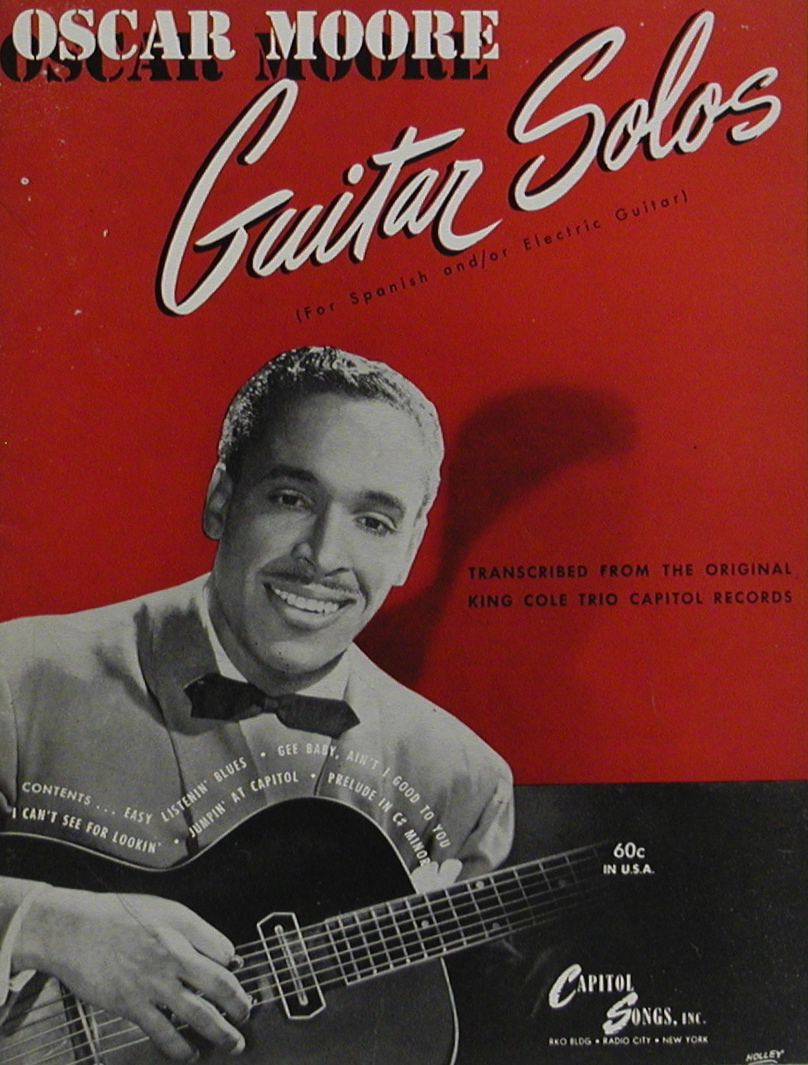
Oscar Moore was near the peak of his popularity in 1947. For over ten years, he had been a member of the King Cole Trio whose string of nationwide chart hits started in 1943, including in a number one pop record on the emerging independent Capitol Records, "(I Love You) For Sentimental Reasons" in the Autumn of 1946. The Down Beat readers voted Moore the top guitarist of 1945, 1946, and 1947. He appeared in print ads for Gibson guitars, had guitar transcriptions published, and appeared on all-star radio and recording dates. Moore also commanded a tremendous amount of respect among his peers and influenced guitar players ranging from his near-contemporay Barney Kessel to a then teenage Kenny Burrell.


Oscar Moore Guitar Solos, published by Capitol Songs, 1946

The King Cole Trio up until the time had been more or less a collective, with Moore an equal partner in the enterprise. But the hits all prominently featured the vocals of pianist Nat "King" Cole. Buoyed by success and reportedly encouraged by his soon-to-be wife among others in his management, Cole made a power-play in the latter part of the Summer of '47 that would regulate Moore to the financial role of a sideman. Moore called his bluff and walked. And why not? Moore had already released a handful of "solo" discs on Atlas Records (onetime home to the King Cole Trio) featuring the Los Angeles based combo, Johnny Moore's Three Blazers. Johnny (Oscar's older brother) and the group were experiencing their own run of popular chart hits that betrayed their blues-baked Texas roots. So it seemed not only natural but something of a lateral career move when Oscar walked away from Nat and into the Three Blazers.


Atlas Records, 1945

Unfortunately, the Three Blazers combo had vocalist issues of their own. Charles Brown, the trio's popular pianist and vocalist, decided to sign a solo recording contract in 1948 leaving the Three Blazers in the lurch. The age of the singer was in full swing, thanks in no small part to the extraordinary popularity of Frank Sinatra. The group struggled for years to find an adequate replacement but Oscar drifted further and further afield. At the dawn of the studio session era in Los Angeles, Moore found some work backing people such as Illinois Jacquet (Clef Records) and Billy Hadnott (Federal Records), as well as eventually cutting some discs on his own starting in 1954.


 Ooh Chica, Billy Hadnott And His Orchestra (featuring an uncredited Oscar Moore), 1952, Federal Records

As I discussed on this weblog before, it was around this time that Leo Fender was perfecting his first great contribution to musical instruments, the Fender Telecaster, just a few miles from Moore. Leo was known to be a fan of Western Swing and quite famously made sure his guitar got in the hands of top players like Jimmy Bryant. What is not as well known is the fact that he got one in the hands of Moore. To add to the obscurity, Oscar Moore's "Nocaster" (so named as it was produced in the early to middle of 1951 just before the Broadcaster was renamed the Telecaster) was one of the most unique examples of the guitar in terms of finish and hardware that is know to have existed.


   Fender "Nocaster" electric guitar, 1951, previously owned by Oscar Moore

What makes Moore's Fender so unique? The biggest aspect is it's gold hardware. Based on other examples of these guitars from the same era, this is the first as well as the only for several years to sport gold metal hardware. Gold metal hardware was commonplace on higher-end archtops at the time, which most jazz guitarists preferred. But Leo's guitar was a working man's instrument seemingly fairly devoid of any such loft aspirations. This shows that maybe this is not the entire story. The guitar is also finished in white. A simple enough characteristic and certainly a color that would become fairly commonplace on Fenders by the end of the decade, but in the nascent days of the company nearly all of instruments produced blond(e). The gold pickguard, again, seems to be a complete one-off and unlike anything Fender would produce for years to come. If Guitar Geekery is your thing, you can read more about the actual instrument here.


Telephone Blues, Aladdin Records 78, 1951 (#4 R&B chart hit)

There seem to be as many questions about Moore and Fender as there are answers. It almost certainly was a custom guitar produced specifically for Moore. But why a jazz man like Oscar who seemed to be on the lee-side of success? It turns out that Fender was fairly aggressive in their efforts to get the Broadcaster/Nocaster/Telecaster into the hands of top players regardless of their primary field of music, which explains why everyone from Jimmy Wyble to Les Paul ended up with guitars from the company around this time. Moore, only 3 years since his last Down Beat honor was still a celebrity of some note particularly in Los Angeles thanks to rhythm and blues hits like Floyd Dixon's "Telephone Blues". Plus, Cole's continued success certainly must have helped rather than hindered Moore, even though he no longer performed with the now successful pop star. Or did he?


Nat "King" Cole and Oscar Moore (possibly Jack Costanzo in foreground), 1951. Photo by Leo Fender.

Curiously, the only evidence that Moore ever used his Fender in public comes from a photo snapped by Leo himself according to Richard Smith's Fender: The Sound Heard 'Round The World. It shows Moore in 1951 performing with Nat Cole! Moore was never known to rejoin Cole's group after his 1947 departure. In fact, the two were known to have been estranged for years, a situation which was not remedied until Moore's appearance on the June 1960 episode of TV's This is Your Life which spotlighted Cole. But 1951 was a transition year for Cole's working group. Moore's replacement, Irving Ashby, made his final appearances with Cole in the studio of March of 1951. One can suspect that his live appearances ceased soon after. In the studio, Cole was aided by the talents of guitarists Barney Kessel and Bob Bain until he found a permanent replacement in John Collins who joined at the end of the year. In fact, 1951 was the year the King Cole Trio was officially disbanded and Cole begin appearing solely as a single. As there is little to no other known documentation of Moore and Cole working together in 1951, one can reasonably assume that Moore was temporarily filling the guitar chair, perhaps even for the night.


Letter to Syd Heller from Don Randall, 1953

One final Fender connection is worth talking about. Jon Raney on his EXCELLENT website devoted to his father, the legendary jazz guitarist Jimmy Raney, published a letter from his archives that will serve as something of a final chapter to this story. Don Randall had been a key part of Fender's early success from the first days of the company. By 1953 he was the President of Sales and responsible for bridging Leo's innovations with both musicians and the public. Syd Heller was the owner of the Columbia Music Company in San Francisco, which had no relation to the record company, but rather was a retail shop and point of connection for many of the West Coast musicians of the time. Through Heller, Randall actively pursued Raney and tried to get a Telecaster into his hands. His selling point? Oscar Moore's endorsement! You can read two of the letters in the correspondence here.


Presenting Oscar Moore, Five Star Recordings, reel-to-reel release, 1957

Oddly enough, there is very little aural evidence to support today's story. Moore's record appearances were sporadic in 1951 and it is difficult to tell for sure how much use his Fender got at the time. He continued to make records until 1957 (with one more 1965 session providing an epilogue to his discography), but nearly every photo of Moore in the 1950s shows him playing a Gibson archtop guitar. Perhaps some time in this great digital age, someone will compile all of Moore's 1950s sessions as a sideman. It would be more than appropriate for an artist who truly was both an innovator and one of the most popular of his time, but who is now sadly in danger of falling in between the cracks of time.

Thank you to Jon Raney for allowing me to reproduce the Randall/Heller letter.