Showing posts with label abstract expressionism. Show all posts

Wednesday, June 18, 2014

Portrait of a Spanish Poet (1959)

Portrait of a Spanish Poet by John Altoon, completed 1959

Los Angeles born artist John Altoon, spent nearly 5 years working on the painting he titled Portrait of a Spanish Poet. Often subtitled (Lorca), the piece is ostensibly a portrait of Spanish writer Federico García Lorca. It was completed in 1959 (the same year Altoon married B movie and television actress Fay Spain) and was included in Altoon's second solo show at the Ferus Gallery in 1961. By the time of that show Ferus had moved to its second location at 723 North La Cienega in West Los Angeles and had been under the direction of Irvin Blum for 3 years. Altoon's relationship with the gallery was firmly established by the late-'50s, being represented by Ferus. The painter had yet to fully transition to the more figurative approach he adopted in the 1960s, with the work being very much a product of his exposure to Abstract Expressionism due to his time spent in New York City as well as the Bay Area  School with exerted a strong influence on the LA art scene during the 1950s. 

John Altoon, Tony Lanreau, and Maggie Ryan, Venice, California, photo by William Claxton, 1959

The painting and Altoon made a cameo appearance on the dust jacket of the original 1959 edition of Laurence Lipton's The Holy Barbarians, the writer's survey of Beat Culture at the turn of the decade. Many (most?) had no idea that that giddy, shirtless beatnik in William Claxton's photo had painted the work of art hanging on the wall behind him, much less that he was the heart and soul of the burgeoning Ferus Gallery scene in West Los Angeles and Venice Beach. The connection was likely more due to Claxton, rather than Altoon laying any Beat Generation claims as the modern art circles on both Coasts tended to distance themselves from the Beat poets in spite of any lifestyle similarities.


Jazz Guitar: Jim Hall, Pacific Jazz 1227 12" LP, 1957, cover photo by William Claxton featuring John Altoon

Clax also played a role in Altoon's slightly earlier entree to mainstream exposure. As the staff photographer and cover art director for Dick Bock's Pacific Jazz Records, Claxton played a major role in the label's West Coast Artist Series that was begun some time in early 1956 as this excellent, highly recommended article outlines in detail. By the time it came to release guitarist Jim Hall's debut LP on the label, Bock and Claxton took a slightly different approach to the series by not only featuring the work or an emerging West Coast artist, but also by including a photo of the artist at work. The artist in question was John Altoon who was featured in the shot (albeit with his back to the camera). The device had already been used once the previously year for a Chico Hamilton Quintet release (also featuring Hall), but the Jim Hall/John Altoon/William Claxton image seems to capture the zeitgeist with slightly more authenticity. 

 Dick Bock, Jim Hall, John Altoon, and William Claxton, 1957

Altoon's career - and life - was short. He battled what some called true demons throughout his lifetime - but, in spite of his concerted efforts to manage his struggles, he died of a heart attack at the age of 44 in 1969. 

For more information about Altoon and the Ferus Gallery scene, I highly recommend Morgan Neville's 2008 documentary film The Cool School

If you live in or are going to be in the Los Angeles area before September 14, 2014, I strongly encourage you to visit the first major John Altoon retrospective, currently on exhibit at LACMA.


Tuesday, March 4, 2014

Bird Lives! (1958)

Bird Lives! oil on canvas board painting by Ted Joans, 1958, courtesy of the de Young Museum, currently on exhibit through January 2015

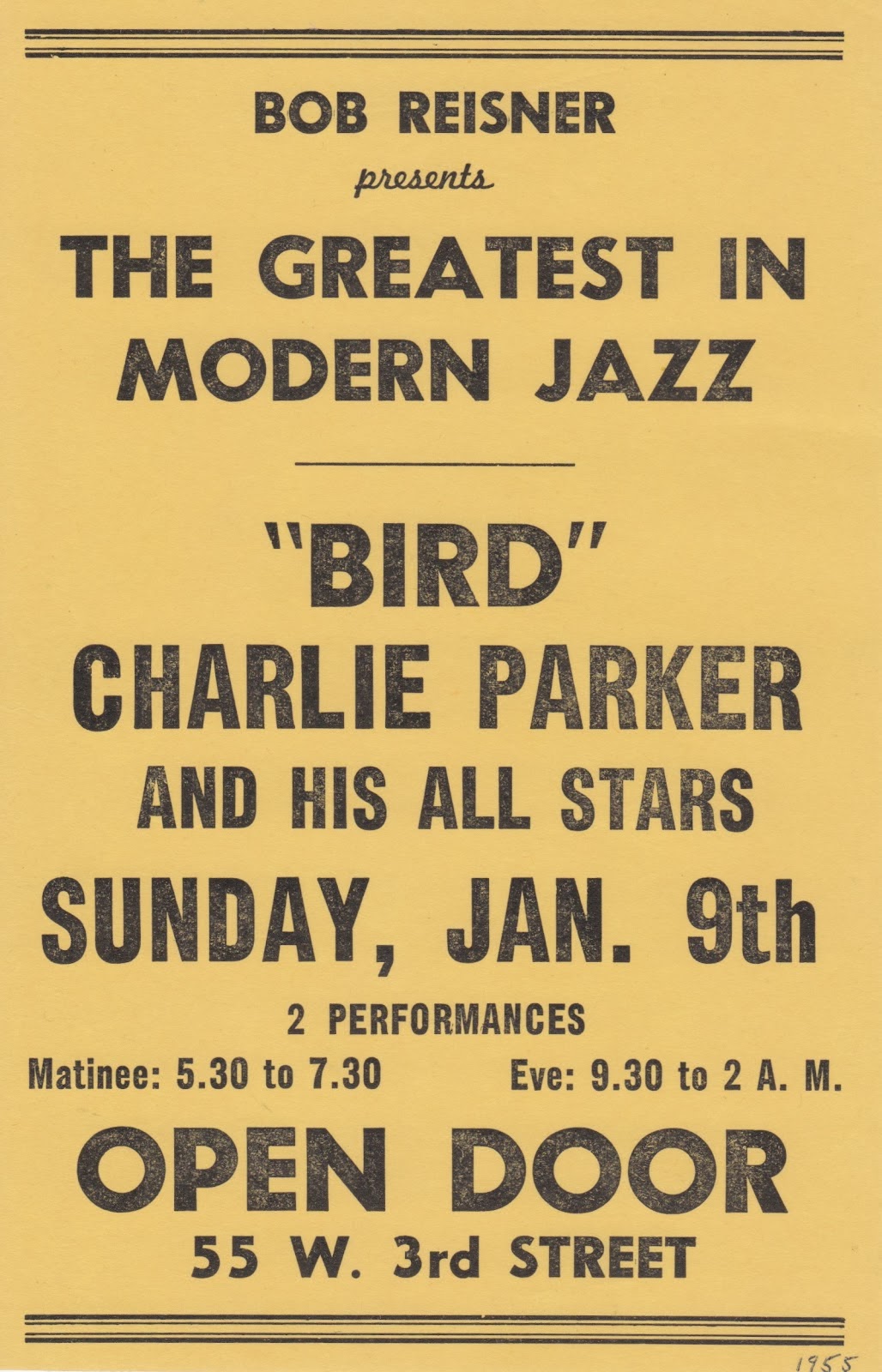
The death of Charlie Parker on March 12, 1955 had both an immediate and lasting impact on the New York art community. It wasn't just the musicians who grieved and grappled with the truth that Bird was dead, the painters and poets too strongly felt the loss of one of their idols. He was a hero made flesh: many of them knew Parker as much from seeing him around their Greenwich Village and Lower East Side (there wasn't an East Village yet) neighborhoods as much as they did from his stage appearances. Of course, they knew his records and would check him out at The Open Door on West 3rd Street when they could afford to do so, but the notion of the starving artist wasn't a punchline once upon a time.

Poster, The Open Door, Greenwich Village, New York City, 1955

According to the somewhat controversial record producer and writer Ross Russell, who owned Dial Records and who recorded some of Parker's most critically acclaimed music, within "a few days of the alto player's death there appeared among the graffiti on the walls in the Village and in subways, scrawled in black crayon or squirted out of pressurized paint canisters, the legend 'Bird Lives!" (Bird Lives: The High Life and Hard Times of Charlie (Yardbird) Parker by Ross Russell, New York; Charterhouse, 1973). Years later it was poet Ted Joans who was credited as the instigator of the graffiti. 

1955 newspaper obituary, source unknown

Ted Joans knew Charlie Parker and knew him somewhat well. Not too long after Joans arrival on the scene, he become known for his elaborate parties often costumed affairs. Author and promoter of the 1950s jazz sessions Robert Reisner claims that Bird turned up for one of these parties dressed as a Mau Mau and supposedly the January 1955 issue of John Preston Davis' groundbreaking African-American journal Our World featured one such party with Parker visible in the background. After returning from an extended engagement in Chicago in that same month, Bird was more or less a transient who relied upon the goodwill and couch space of others for shelter. At the time Joans shared a small apartment at 4 Barrow Street in the Village (don't go looking for it, it has been razed) just off of Sheridan Square and across the street from the Cafe Bohemia (that building is still there, occupied by the Barrow Street Ale House) and his roommate Ahmed Basheer brought a sick Parker home one night after finding Bird sprawled out on the sidewalk near their front door. As a result, Parker and Joans were de facto roommates off and on during last 2 months of the saxophonist's life.

Ted Joans at the Cafe Bizarre, Greenwich Village, New York, 1958

But just calling Ted Joans a poet is doing his legacy a disservice. Yes he was indeed a poet. In fact, he is now often referred to as one of of the original beat poets. Joans moved to Greenwich Village in 1951 around the age of 23 having moved to the big city from Illinois by way of Indiana University. Sadly, the history of the Beat Generation seems to have suffered from some degree of whitewashing as Joans seldom appears as more than a mere footnote. But he was clearly one of the first on the scene, connecting Gregory Corso not long after his arrival. He would later cite his biggest influences as Langston Hughes and André Breton. For his part, he thought himself as much as surrealist as he did a beatnik, although he certainly took advantage of the public interest in the latter as a way to have a forum for his art. By the time of his death in 2003, Joans had authored well over 30 books a remarkable body of work for any poet by anyone's standards.


The Hipsters by Ted Joans, Corinth Books, 1959

Joans creativity did not end with the printed word. At one point of time he was a trumpeter, although he reportedly threw his horn off a bridge as he felt the need to focus on other aspects of his life (this again according to Russell). He was a visual artist as well. Although largely known as a recluse, Joans befriended the Jackson Pollock and got to know the painter before Pollock died in the Summer of 1956. Joans most certainly was a painter, although examples of his work are relatively scarce both online and in the real world. However, one of his surviving works is from 1958 and is fittingly (for our story at least) titled Bird Lives!

The is only the tip of the iceberg that is the fascinating story of Ted Joans. I highly recommend digging deeper. 

Bird Lives! the painting is featured in San Francisco's de Young Museum Shaping Abstraction exhibit now through January 4, 2015.

As a teaser, here are a couple of short films that feature Joans a few years after the death of Charlie Parker. Bird Lives indeed!


Village Sunday by Stewart Wilensky, USA, 1960
(click on image above for fullscreen view)


Jazz and Poetry by Louis van Gasteren, Holland, 1964
(click through for a better screen view)

Monday, August 5, 2013

The Tune is Red (1960)


The Tune is Red, oil on canvas, Hassel Smith, 1960 (full painting) 

I have often been asked why I like 20th Century abstract art. The phrasing of the questions have ranged from speculation on whether or not the questioner's child or grandchild could have easily done the same thing to something along the lines of I just don't get it. In truth, I cannot simply explain my attraction to abstract art both of and influenced by this period, so I thought I would muse on that notion a bit. 

My first art appreciation course was not until my second or third semester of college here in San Francisco. It was a fairly pedestrian course, one which covered all of the hits and a handful of misses. As a side note: I recall the end of term project that I created for this class: a piece of assemblage, which I white-washed with tempura paint, so I was already showing my colors so to speak. By this time, I had already been exposed to a few minor abstract works via 12-inch LP covers, having got hip to jazz records in high school. Another influence, no doubt, was psychedelic art of the 1960s, something that I spent no meager amount of time digging deep into during my high school and college years. The sum total was that abstract works just captured my interest and imagination more than any other form of visual art - save perhaps architecture and design. So I did which I so often do when something piques my interest, I dug deeper and deeper until I found the good stuff. 


The Tune is Red, oil on canvas, Hassel Smith, 1960 (detail 1)

Of course, no exploration of abstract art tunnels too far away from the New York School of the 1940s and 1950s, but living here in San Francisco, I am fortunate to have access to many of the fruits of the Bay Area School from roughly the same time period. Between the local works and visit to the Guggenheim and MOMA on East Coast trips, I have managed to see a fairly broad survey of modernist art from the last Century. I have my favorites, such as Franz Kline, but it's always exciting to be exposed to an exhibition such as the recent Richard Diebenkorn exhibit that I mentioned a few weeks ago.


The Tune is Red, oil on canvas, Hassel Smith, 1960 (detail 2) 

Back to the question of why. From an intellectual point of view, I have come to the opinion that figurative painting - for the most part - became less and less relevant as media such as photography, film, and video gained more and more traction. Surely the skill of the great masters is something to still admire, but I think it is important to note that those paintings are often the only visual records of those times. As the means to visually document the world around us have become more and more accessible and prevalent, it seems only natural to me that and older medium such as painting be used in a different manner. Of course that I have long been interested in some many other aspects of post-World War II culture certainly has resulted in a certain predisposition. Most certainly. But I think this has been a case where bias has been a virtue, in that I don't seem to have the aversion to this style of art that a lot of people exhibit.


The Tune is Red, oil on canvas, Hassel Smith, 1960 (detail 3) 

From a emotional point of view, I find abstract art captivating on a many levels - particularly when I am able to see a painting in person. In the works that have captivated me most, I have typically found a depth - in the colors, in the textures, in the movement - that just stimulates something in my brain and emotions. I don't look at them as Rorschach tests. I've ceased to look at them for meaning. But rather I have come to just experience them for what they are. And, yes, a good abstract painting can be similar in some ways to a good jazz performance in that it is a mix of skilled tradition and personal improvisation. So as my life as a jazz musician has been become more and more important, perhaps my affinity to abstract art and abstract expressionism in particular has achieved parallel importance.

Note: the painting featured on this page is currently residing at the Cantor Arts Center on the Stanford University campus. Admission is free, so all you need to do it get your self there to see this one. The artist, Hassel Smith, is one of the many of that era whose love for jazz music was reflected in his work. Smith spent a significant amount of time in the San Francisco-Bay Area and was also an important early part of the Ferus Gallery scene in Los Angeles. His remarkable timeline can be found here.