Thursday, April 21, 2011

American Optical Flight Goggle 58 (1958)


American Optical Eyewear, Inc. has been making eyewear right here in the US of A since 1833. It can trace its origins back to William Beecher in 1826 and you can read their full story here. Other interesting date-related facts worth reading about include their first sunglasses (1876), their introduction of Ulta-Violet protection (1913), and polarized lenses (1940). But perhaps AO, Inc. is most well-known for their association with the US military.

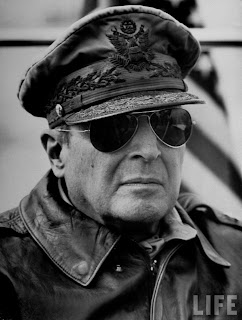
The design of the ubiquitous "aviator" sunglass generally credited to Ray Ban is, its classic egg-shaped glass favored by pilots around the time of the Second World War. Interestingly, pilots did not wear sunglasses while flying at this time, so their popularity had to have been reserved out of the cockpit. The most well-known Ray Ban man at the time? General Douglas MacArthur, of course.

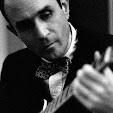
A quick sidenote: the earliest hipsters (and I mean that in the true sense of the word), I have seen sporting aviators are in this photo of Afro-Cuban musicians in NYC from the late 1940s. By the way, that is Arsenio Rodriguez in the dark suit and tie in the center and Machito on the far right. Legendary bandleaders both.


But I digress.

American Optical, too, was producing and supplying aviator sunglasses to the military during World War II. In fact, they had been supplying sunglasses to the military as far back as the First World War, long before Ray Ban existed as a company. It was a fairly common practice for the quartermaster of any given branch of the military to source common goods such as these from multiple suppliers - take a look at the history of military watches some time for ample examples.

1958 saw the introduction of a newly-designed aviator sunglass courtesy of American Optical. And for my money, it is a design classic that surpasses the Ray Ban aviator. Its semi-rectangluar lenses have become almost as iconic as its egg-shaped predecessor. Living up to the modernist axiom of form following function, Flight Goggle 58 (as it was initially known) was/is streamlined and to the point. Their popularity quickly eclipsed that of the other aviator style for much of the subsequent decade, perhaps reaching a figurative and literal high point when they were the first sunglasses on the moon in 1969.

Jim Irwin (in blue) with fellow astronauts Alan Bean, Charlie Duke and Bruce McCandless before the July 1969 Apollo 11 launch.

Over the years, the popularity of the 58s has waxed and waned, but they have definitely seen an upsurge in popularity, again as an alternative to the egg-shaped aviators that ever Tom, Dick, and Supermodel seems to be sporting these days, irregardless of social status, political views, or face shape. But the 58s are around. Look for the discerning gentleman. And you can (in part) thank Don Draper while you are at it...


I will leave you with one piece of advice. If you get the itch for a pair, don't settle for any cheap (or expensive) imitations. You can purchase a pair of genuine American Optical Flight Goggle 58s (now called Original Pilot Sunglasses) direct form AO here. They are still made right here in the USA, with every customization option imaginable (within the confines of good taste of course). Be sure to order direct from them, it's worth the few extra dollars to know exactly what you are getting.

Thursday, April 14, 2011

Brooklyn Goes To San Francisco (1956)

Cool, short featurette (ask Grandma about that one) from 1956 featuring plenty of San Francisco scenic shots. This was part of a series of short films written and directed throughout the 1950s by Arthur Cohen. Other destinations in the series included Las Vegas, Detroit, Cleveland, and Rome. But who is Arthur Cohen you might ask?

Well, most of you know Arthur Cohen. Born in Brooklyn in 1913 as Fivel Feldman. Feldman took the surname Foster from Foster Avenue in Brooklyn, Phil Foster in fact - but was seemingly also known as Arthur Cohen throughout his early career. Although he started off as an actor, for the most part he was a standup comedian and eventually made his way into film and television. However, he is most widely known for his portrayal of Frank De Fazio on Laverne & Shirley. You know, as in Laverne's dad!

Friday, April 8, 2011

Bird at The Three Deuces (1948)

Recently, the wonderful Phil Schaap has posted several more installments of his (almost) daily radio show, Bird Flight on WKCR, to his online radio pagehere. Now if you are a fan of Charlie Parker and you are not familiar with Phil, I cannot urge you strong enough to give him some ear time. There are few people on the face of this earth that are able to marry such enthusiasm and scholarly knowledge of The Great One (Bird, with apologies to Wayne Gretzky).

The episode in particular that has caught my attention is from February 2, 2011 - incidentally his 41st Anniversary broadcast. You can listen to it here. Do note that you can download these for private use. In fact, I strongly suggest dropping it on your iPod/iPhone and taking a long walk outside. But I digress...

The gist of this particular installment is the argument offered that in March of 1948, Charlie Parker was at the peak of his musical prowess and his combo at that time - Charlie Parker and The All Stars - were never to be bettered. Highly subjective of course. But Schaap not only provides aural evidence by way of the Dean Benedetti recordings of the combo recorded at The 3 Deuces in NYC on 52nd Street. On top of that he has the written testimony of combo member Miles Davis, plus first-hand recollections from both Lennie Tristano and Tal Farlow, both of whom played interval combos opposite Parker's headlining combo at The Deuces. Bird at the top of his game? Perhaps. Give it a listen and give it some thought.

Subjective opinions aside, the most is compelling. Bird is easily in one of his most fluid and energetic modes and the excitement is still palpable - in spite of the low fidelity of the recordings (or computer speakers for that matter).

Here are a few images I trawled to give Schaap's narration some visual reference...

First, here is 52nd Street, in color, courtesy of photographer William Gottlieb in 1947 or 1948. We are looking East towards 5th Avenue. The 3 Deuces is on the South side of the street on our right...


Next, here is a close-up of the Deuces during the very engagement in question...


Next a somewhat familiar but still beautiful shot of Bird in flight, again courtesy of Gottlieb, quite likely shot during the same 1948 engagement...


Low res, I know, but here is a fairly rare shot of the All Stars on stage at the club. Nice bow tie, Miles. In fact, notice how everyone is wearing light-toned suits...


And finally, here is a shot of The Bill Harris-Charlie Ventura combo included only to show everyone just how damn small that stage was at The Deuces. Wow! I will never complain about a lack of square footage on a gig again...


Note: Schaap's broadcast does include the entire set of recordings from the March 31, 1948 date in question. Just be patient, he will get to them. It's just Phil's way of doing things.

Wednesday, March 30, 2011

Style File No.1

My 2010 year-end bonus was a gift card: a significant amount of money to shop at Sak's Fifth Avenue with. Downtown San Francisco features a 4-story Sak's men's shop with a wide variety of items, brands, etc. Unfortunately for me, I quickly learned two things. First, what I thought (and still think, frankly) was a significant amount of money really wasn't compared to the prices at the shop. And, second, SO much of these high-end goods were made offshore in countries well known for - let's just say, lesser quality goods. No, I have been not living under a rock. And, no, I am in no way a jingoist/nationalist/etc. But I do appreciate well crafted items, whether they be a pair of shoes or an archtop guitar. And I do like the notion of supporting businesses here in the USA (and California and San Francisco, for that matter) particularly in these days of The Great Recession. So, try as I might, I just couldn't bring myself to spending all of that money on an overpriced designer sweater made down the street from where my ragged Land's End cable-knit shawl collar sweater was hobbled together on the cheap. So after several visits, I finally used the money towards a pair of cool Oliver Peoples sunglasses. Of course, I had to pony up some cash to make up the difference. The model is called the Sheldrake.


Two things I should say about Oliver Peoples. First, they retail for WAY more money than I care to pay for sunglasses. But the aforementioned gift card eased that pain. Second, they are very well made (in Japan). My reading glasses which I have had for maybe 15 years or so are by the same maker and they have held up quite well. In fact, I can think of very little that I have had for that duration of time that has held up similarly.

The Sheldrake is supposedly "inspired by Andy Warhol" - although he was furthest from my mind when I saw them and tried them on. Well that's an exaggeration. Lady Gaga was perhaps further from my mind when I saw the pair of Sheldrakes and tried them on. More of an immediate connection was Miles Davis on the cover of his 'Round About Midnight LP or any number of musicians Francis Wolff photographed while recording for Blue Note. They have that later-1950s/early-1960s look down to the keyhole nose opening. Heck, they aren't even too far off from what President Kennedy was often photographed wearing.

Where am I going with this? Well, the whole experience above is one of the reasons I have been thrift shopping more and more as of late. There are some wonderful clothes being produced out there. I can even afford some of them these days. But I still don't feel right about dropping all that cash. Plus there is something intrinsically socially conscious about recycling clothing. I've started to think of what I use and refuse as "my pile." In other words, when I shuffle off this mortal coil, I am going to leave a pile of material possessions. How big is that pile going to be? Will people be able to use what's in that heap? Something to think about - or at least something that I think about.

Today's trawling was fairly rewarding. For a mere $23.98 total, I managed to pick up a couple items of note...


1960s Bass Weejuns. Size 10 1/2 B. The older brick red burgundy color, well before Bass switched to that kind of awful burnished brush-off finish. Made in the USA naturally, well before Bass started production of their shoes in Central America. OK, to be fair, they are too narrow for me, but I have already found a friend who wants them. With some basic cleaning and a "bullet" shine from my friends down at A. Shine & Co., they will be things of beauty.


Navy blue 3-button sack blazer. Tropical-weight wool, 3/4 lined. Tailored by Southwick for Lew Ritter. Ritter had his origins in 1936 in New York City, and eventually expanded to Los Angeles in the early-1950s. To the best of my knowledge the shops have all closed. But back to the jacket. It needs a few days airing outside, but Spring is indeed here and there is no rain in the forecast until the weekend. Add a new set of buttons and I will be ready for mocktails.

I might never need to step foot back into Sak's again.

Monday, March 21, 2011

Spring Is Here


Kim Novak, circa early-1950s
Photographer Unknown

Saturday, March 12, 2011

Joe Morello (1929-2011)


"Take Five" by the Dave Brubeck Quartet
Jazz Casual
Recorded & Produced for television by Ralph Gleason & KQED
San Francisco, Calif., U.S.A.

Rest in peace, Joe.

Monday, February 14, 2011

George Shearing (1919-2011)

At the age of 91, pianist Sir George Shearing has passed away. May he rest in peace. In addition to his formidable talents a modern jazz piano player, he was responsible for introducing such names as Don Elliott, Denzil Best, Cal Tjader, Toots Thielemans, and Armando Perazza to the record buying public at large due to his successful string of records on MGM and Capital during the 1940s and 1950s.

For a taste of the Shearing Sound, near the beginning of its life, dig these 1950 film recordings of his quintet featuring Chuck Wayne (guitar), Don Elliott (vibraphone), John Levy (bass), and Denzil Best (drums) just burning in the coolest manner possible through 4 tunes. Elliott recently had replaced original Quintet vibraphonist Marjie (aka "Margie") Hyams. Levy would soon leave to manage the group, to be replaced by Al McKibbon. Best, of course, was the composer of "Geneva's Move" (aka "Move") as well as numerous other early bop tunes. And what can one say about guitarist, Chuck Wayne? Nimble, inventive, and fluid. It's music like that that continues to inspire me to practice my craft!

Side Note: most references to these clips claim they are soundies made to be viewed in bars and nightclubs on Panorams, but the fact that they were filmed in 1950 dispute that claim. It is more likely that they were meant to be shown in movie houses in between feature length films. Regardless, the Jazz on Film site reports that there is a 5th song out there from the same session, "I'll Never Smile Again". Let's hope it surfaces some time soon.