Showing posts with label history. Show all posts

Monday, September 9, 2013

September Song (1938)


September Song, sheet music, 1938

It is quite easy to see why Kurt Weill and Maxwell Anderson's "September Song" from the 1938 Broadway production Knickerbocker Holiday has been front of mind as of late. While Summer still lingers (particularly for those experiencing Indian Summers), the days truly grow shorter and it is only a matter of weeks before Autumn will begin to show its colors.


Kurt Weill and Fritz Lang in Hollywood, April 1938

German-born Jewish composer Kurt Weill had been living in New York City for 3 years in 1938. His residence in the most American of American cities marked the end of the first phase of his career in which he contributed greatly to the Weimar Republic soundtrack thanks to his rightfully celebrated collaborations with Bertholt Brecht. While in Germany, Weill was not only an active in populist left-wing politics but his music was celebrated the world over by avant-garde modernist composers such as Stravinsky, Berg, and Milhaud. Fleeing the Nazi regime, Weill and his wife settled in New York after short stays in both London and Paris. Weill soon began to self-consciously reshape his music to fit the mold of his adopted country. To show just how far he had come, 1938 saw him not only his collaboration with Anderson premiering on Broadway, but he spent some time in Hollywood scoring a movie for the Austrian-expatriate, Fritz Lang.


Maxwell Anderson, Time, December 10, 1934

Maxwell Anderson was a somewhat odd pairing for Lang. Born in Pennsylvania in 1888, he was twelve years Weill's senior. A scholar and writer, Anderson was also an outspoken pacifist - something that jeopardized his professional career on more than one occasion. Bouncing between writing and teaching jobs from North Dakota to San Francisco, he eventually ended up in New York in 1918 working as a journalist and playwright. Before meeting Weill and working with the composer on Knickerbocker Holiday, Anderson had experienced several Broadway hits. But what was perhaps most interesting about this particular stage production was the sub-text of the play. With the memory of the executions of Sacco and Vanzetti only 11 years old in 1938, Anderson had more than a passing interest in leftist-influenced anarchism. In fact, Knickerbocker Holiday is most often characterized by critics as a thinly veiled attack on then-President Franklin Delano Roosevelt's New Deal, something Anderson felt veered to close to the fascism that was dominating Europe at the time. 


September Song, Walter Huston, Brunswick Records, 1938

One of the stars of Knickerbocker Holiday was 55-year old Walter Huston, who requested a song be written for his character of advanced age to help woo a younger love interest. Weill and Anderson obliged with 'September Song' reportedly written start-to-finish within the span of a day. With it's roots going back at least as far Geoffrey Chaucer's 14th Century 'Canterbury Tales' (see The Merchant's Tale), the symbolic use of months of the year to represent differing ages was certainly nothing new in the late-1930s. But Weill and Anderson managed to breathe some new life into a well-worn device as well as come up with a rather touching plea for love. It's not terribly sentimental, but rather sweet lyrically and the music manages to hint just enough at the inevitability of the protagonist's demise without being morbid. 
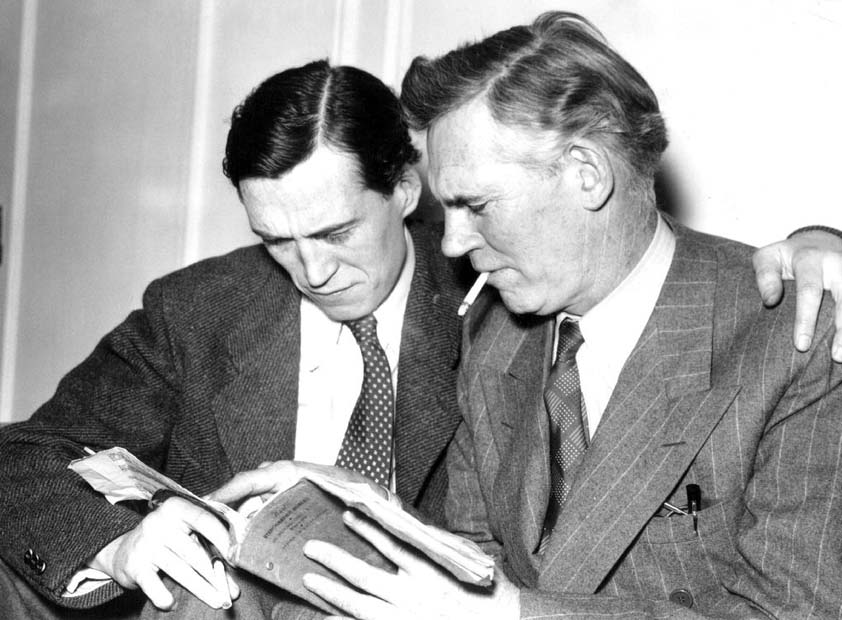

John Huston and his father Walter Huston, 1940

Irish-American Huston, the father of maverick film director and actor John Huston, and the grandfather of actors Angelica Huston and Danny Huston, had a minor chart hit with his original 1938 recording of 'September Song'. Huston's version was allegedly President John Kennedy's favorite song, with JFK performing the number for private affairs, intoning Huston's croon. Whether or not Jack was aware of the politic undercurrents of the song's source it not something that is documented. In addition to their other post-1938 achievements, all of the principals eventually found varying degrees of success in Hollywood: Huston won an Academy Award in 1948 for his supporting role in The Treasure of the Sierra Madre; Anderson wrote the screenplay to Alfred Hitchcock's The Wrong Man in 1956; and Weill scored a select few films. When Kurt Weill died in 1950, Maxwell Anderson delivered the eulogy. At the time of Weill's death 'September Song' experienced a resurgence of popularity, thanks in no small part to its use in that year's September Affair motion picture and by the end of the decade it was firmly established as a standard in what is now called the Great American Songbook.

Further reading: follow this link for a more musical look at the song.

Further listening: give this great 1946 version a listen by pianist/vibraharpist Dardanelle featuring Joe Sinacore on guitar which makes for an interesting comparison to Teddy Wilson's 1944 version featuring Sarah Vaughan on vocals, Remo Palmieri on guitar, and Charlie Ventura on tenor saxophone.

Wednesday, March 6, 2013

The Andover Shop (2013)


During my very first visit to Boston, Massachusetts last week, I finally had the opportunity to make a pilgrimage to the legendary Andover Shop across the river in Cambridge. What's the fuss, you ask? Well, The Andover Shop is the spot that directly links post-war modern jazz with Ivy League style. It has here that Roy Haynes had his suits custom made: the "slickest sh*t out"in his own words. It was here that a cleaned-up Miles Davis chose the threads that were to be part of his mid-1950s "comeback" image. And it was here that proprietor and acknowledged jazz-fan Charlie Davidson forged life-long friendships with customers such as Chet Baker.


The building itself is a simple unassuming modernist building located on a quaint (yes, I said quaint) New England side-street: 22 Holyoke to be specific. I have to admit, that I was taken a little a back upon arrival...and pleasantly surprised. I expected something along the lines of what Brooks Brothers on Madison Avenue is trying to be: more old club, old world. It is clear here that form followed function. The Cambridge shop is Charlie's second location, he opened the first on Main Street in Andover, Mass. back in 1949 after he left the employ of J. Press. But it was this place, the Cambridge address, which became the place.


I was greeted at the shop by Zach DeLuca who runs the excellent Newton Street Vintage shop on Etsy as well as The Suit Room weblog/Tumblr. Both are highly recommended if you are not familiar with them. I introduced myself formally (we had only met via the 'net) and set about exploring the store with Zach as my guide. I will admit to being slightly overwhelmed as I really wanted to soak it in. It is a dispensary in the best sense of the word: quite organized and well-stocked. The staff, who totaled four on this particular Monday morning, moved through the narrow aisles with knowing ease. 


Gerry Mulligan at The Andover Shop, photo by William Claxton (obscured), 1956

Meeting Charlie was exactly what I had hoped it would be. After some small talk about Roy Haynes and the Newport Jazz Festival, Charlie inquired if I was a musician. When I replied yes and that I played guitar, he responded with the jab, "That's not a real musician!" I expected nothing less. Ice broken, he proceeded to tell me some of his favorite six-stringers and I was very pleased to hear that Barney Kessel was near the top of his list - particularly since the neighboring Berklee School of Music seems to have it out for ol' Barney. Apart from some enjoyable jazz talk, I did pick up some basic, but essential clothier wisdom that the customer should be happy with the garment in the shop. It matters not what the clothier thinks, nor what the tailor may be able to do. This echoed a similar piece of advice that I picked up from Alden years ago (your shoes should feel good when you walk out of the shop...a "break-in" period is something of a myth). As I was paying for my American-made Hickey Freeman Hertling high-rise grey flannel trousers and saying my goodbyes, Charlie held out his hand and said, "I'm really glad you came into the shop today." Thank you Charlie. I am really glad that came into the shop too!

Tuesday, January 1, 2013

Happy New Year (2013)


New Year's Eve, Bimbo's 365 Club, San Francisco, California, c.1955, photo by N.R. Farbman for Life magazine

Tuesday, October 2, 2012

Chelsea Bridge (1940)


Nocturne: Blue and Gold - Old Battersea Bridge by James McNeill Whistler, c.1872-1875

In 1876, American-born James McNeill Whistler was living London and had been doing so for the better part of a decade. He had left the United States in 1855 and spent the first few years living the life of a Bohemian in the Latin Quarter of Paris. It was in Paris that he was deeply influenced by the notion of modern art, not only the visual arts such as Impressionism but by other trends in literature and music, as well as the relationships between all 3. He then moved to London, back to Paris, and then briefly to Chile, before settling back into London. While in Chile that he painted the first in a series of what he called moonlights later re-cast as nocturnes, copping a musical term from one of his patrons. In 1876 that he exhibited the above Nocturne: Blue and Gold - Old Battersea Bridge (currently in the collection of the Tate in London).


                                Moonlight on Ryogoku Bridge, by Utagawa Hiroshige, c.1830

The painting is notable for a couple of reasons. First, in addition to the French influence, art critics and historians have made the case that Whistler was influenced by Japanese woodblock artists during this time and more specifically by a Hiroshige work, Moonlight on Ryogoku Bridge, created forty-some-odd years earlier. Secondly, the Whistler work was the subject of a large degree of criticism at the time including that of well-known art critic John Ruskin who ended up in a court battle with Whistler under charges of libel. Whistler won the case, although his award amounted to 1 farthing. 


                                Billy Strayhorn and Duke Ellington, photo Dave Dexter, Jr., c.1943

Seventy years later and back in the United States, bandleader Duke Ellington was posed with a repertoire problem. ASCAP had substantially increased its license fees in 1939, which resulted in the creation of BMI in 1940 by the National Association of Broadcasters. Radio was key to the success of any band of the day and Ellington quickly surmised that if the major radio stations refused to play music published by ASCAP (which was the practical upshot of the situation), he would need a whole new band book of BMI-published material. To this end he brought his son Mercer and Billy Strayhorn, to Los Angeles for a massive effort to re-build the band book. Neither were affiliated with ASCAP, so were able to provide the clean slate material. This also coincided with what many critics consider to be his finest band, the so-called Blanton-Webster band. The issue was eventually resolved by the Federal court system in 1941, but not before Ellington's Famous Orchestra went through something of a musical transition. To make this time period even more tidy for historians, it signaled Duke's return to RCA Victor Records and the end of his longtime romantic and songwriting relationships. A new day indeed.


Victor 27740-B, 1941

The results of the songwriting sessions were staggering: Passion Flower, A Flower is a Lovesome Thing, Take The A Train, to name but 3. Chelsea Bridge was another. The Billy Strayhorn composition is just beautiful, it's age-old comparisons to the work of Claude Debussy not only accurate but apt. To call it an impressionistic piece might be a bit lazy, but certainly justified particularly with the chords Strayhorn uses on the A sections. To put it in simple terms, the slight dissonance gives the song a hazy and uncertain feel, particularly at the slower tempo. Not really unsettling, just a little ambiguous - but beautiful. As it turns out, the very erudite Strayhorn's inspiration turned out to be Whistler's Nocturne: Blue and Gold - Old Battersea Bridge (that's Chelsea Church on the left far shore in the painting).


Chelsea Bridge debuted with the orchestra some time in early 1941 as evidenced by Ellington's radio broadcasts from the swing-era stalwart Casa Manana, located in the LA suburb of Culver City. The number remained in the book throughout the year, with Ellington recording it in September both at a Standard Radio Transcription session and at a commerical Victor record session (again, both in LA). He returned to the piece on December 2nd when he took his orchestra into RCA's Hollywood Studios to record it along with another Strayhorn composition, Raincheck, plus 2 others. It was this recording, featuring Ben Webster on tenor sax, that was the released master recording.


The song found favor with hip ears and was recorded several times from the 1950s onward by the likes of Gerry Mulligan, the (original) Vince Guaraldi Trio, and Ella Fitzgerald. Webster kept is as part of his featured repertoire for the remainder of his life. But perhaps the most notable post-Ellington recording of the composition was made by its creator. Billy Strayhorn, almost 6 years before his untimely death at the age of 51, recorded a solo piano version in May of 1961 during a brief stay in Paris - where it arguably all began for Whistler a century earlier.


Tuesday, July 31, 2012

Alvin Lustig for JBL (1950)


Alvin Lustig, 1949

In a previous weblog entry, I quoted Charles Eames in saying "Eventually, everything connects." The concept is a favorite of mine and if you are a regular reader here, you will have seen that I often have been able to weave my various interests into the some sort of over-arching narrative. Today's entry is no exception, but designer Alvin Lustig makes such pursuits easy. Over the course of his brief 40 years on this planet, he was involved with books, magazines, interiors, architecture, furniture, industrial design, and company branding/identity. Born in Denver, Colorado he spent much of his early career in Los Angeles (with the exception of a brief spell as a student of Frank Lloyd Wright at Taliesin) before moving to New York City at age 29 to work as the Director of Visual Research for Look magazine, then in its ascension. A year later he began teaching. By the end of 1946 he returned to Los Angeles and opened up his own studio where he tried to eek out a living until he was forced to move back to New York in 1951. As a result of diabetes, Lustig lost his sight in 1954 and he died a year later due to complications around that disease.

Jim Lansing Signature Speakers brochure by Alvin Lustig, 1950 (front)

One of Lustig's clients during his second tenure in Los Angeles was the fledgling James B. Lansing Sound. The story of legendary amplified sound pioneer James Bullough Lansing (born James Martini, making him a suspected Italian-American. Cough.) is rather complicated, but in short he began to manufacture loudspeaker in LA in 1927 as the Lansing Manufacturing Company. After his business partner was killed in a plan crash, Lansing's company floundered was was purchased by Altec in 1941. Lansing was contracted with the company through 1946, but parted ways before that contract expired. James B. Lansing Sound, Inc. was founded in 1946, although Lansing again struggled to keep the company afloat and took his own life on his ranch in San Marcos, California just north of San Diego in the Autumn of 1949. Control of the company reverted to Vice President Bill Thomas who was able to parlay the company's sound innovations into a successful business. The company changed it's brand name to JBL in 1955 to settle its ongoing disputes with Altec Lansing. Fast forward fifty-seven years later and the name JBL is known the world-over.


Jim Lansing Model 375 label detail, early-1950s

As part of this chaotic transition, Thomas and James Lansing Sound, Inc. engaged Lustig to assist them with re-branding their company. Unfortunately, there is very little documented information about when Lustig was contracted for the work, but one may assume that it may very well have happened after Lansing's death. Similarly, little is known about the depth of his engagement and how much it increased in scope after his association. What is known, is that by mid-1950 Lustig had overhauled the company's brand identity. That year's brochure was a beautiful example of postwar California modernist graphic design and is a unique item in Lustig's portfolio. It also introduced a logo hallmark (the "Jim Lansing" sans serif font contrasted with the "L" script) that would grace most of Lansing's speakers through the 1955. 


Jim Lansing D-175 speaker driver decal detail, early-1950s


Jim Lansing by Ampex logo variation, early-1950s

In additional to the graphic design work, Lustig's scope of services included design consulting with their speaker enclosures, namely the C34 through C39 series. Again, details are illusive in terms of his exact contributions and the Internet is teeming with vintage-JBL enthusiasts who are more than happy to share their knowledge and educated guesses. But after taking one look at the speaker enclosures from this time period, it is easy to speculate about Lustig's input.


JBL C39 Harlan speaker enclosure, 1956

Lustig's association with the soon-to-be-JBL was obviously brief. The company introduced very little to  it's branding until the mid-1950s transition and Lustig's move to New York, followed by his death meant that there was little future for the partnership. What he did do is very successfully transition the branding of the company to something very cutting-edge and modern: a graphic representation of the products the company was becoming known for. By mid-decade, JBL was being mentioned in Life magazine and the rest, as it's been said, is history.


Jim Lansing Signature Speakers brochure by Alvin Lustig, 1950 (rear)

Tuesday, July 3, 2012

Jazz on a Summer's Day (1958)

Now I am one of the last people anyone would accuse of being a flag-waiver. That said, I am actually looking forward to Independence Day (a.k.a the Fourth of July) here in the United States this year. Why? Well, I've begun a few little annual traditions that I very much look forward to. The first is tuning into Columbia University WKCR 89.9 FM's annual Louis Armstrong Birthday Broadcast. 24 hours of Pops who used to like to give his birthdate as July 4th. Tune in: you can do so online. And if you do, consider pledging a little bit of money to help support their amazing programming. The second tradition is taking the missus to the Marin County Fair up in her hometown of San Rafael. Not only are the fairgrounds in the shadow of Frank Lloyd Wright's beautiful Marin County Civic Center (completed in 1962), but it has all the hallmarks of a classic County Fair: corn dogs, rickety thrill rides, livestock, you name it. Plus Marin is always a few degrees warmer than the City, which helps one feel the Summer vibe. As an added bonus, the Preservation Hall Jazz Band has performed on the main stage on July 4th for the past 2 years. Once we return to the  City we usually barbecue something on the grill and, if we are feeling so moved by the spirit, head up to a local vantage point to watch the fireworks - or as they are known to San Francisco residents, "brightly colored fog".


I like to end the day off by watching one of my all-time favorite jazz-related films, Bert Stern's Jazz on a Summer's Day. It's easily one of the best documents of jazz music yet to be recorded. Before I wax rhapsodic on the topic. Take a look at the trailer:


Jazz on a Summer's Day, trailer


If you have never seen this film, you need to. As soon as possible. If it's been a few years since you've seen this film, you need to see it again. If you just recently have seen this film - well, you get the idea. It's one of those snapshots of history that reveals more and more every time one revisits it. And is it just beautiful to experience. Director Stern was a photographer perhaps most famous for his June 1962 shots of Marilyn Monroe - her last photo session conducted just weeks before her death. The eye of a still photographer shifts the perspective of the film. Rather than a staid documentary or straight-forward concert film, Stern is looking for something else, something fleeting and as beautiful as the music. Shot over the Fourth of July weekend in Newport, Rhode Island at the 1958 Newport Jazz Festival and intercut with footage from the America's Cup training which was going on concurrently in the area in advance of the finals held in September.


Bert Stern with his Rolleiflex


I will leave it to the jazz message boards to argue about what was and was what not included in the film. In short, Stern cut a deal with Columbia Records which greatly effected who was filmed and who ended up in the final cut. And for every historic performance that was not captured in the glorious color of the film (Ray Charles, being a notable example) there are plenty of unbelievable musical moments left for us to savor (Eric Dolphy with the Chico Hamilton Quintet). Taken as a whole, the film is a breathtaking snapshot of post-war America at work and play in 1958. Of course not everyone had access to this sort of lifestyle, but there is an impressive cross-section of people captured for posterity's sake. The film was completed in time to be shown at the 1959 Venice Film Festival in the Summer of that year and was saw limited release in the United States in March of the following year.


"The Train and the River" by the Jimmy Giuffre 3 featuring Jim Hall and Bob Brookmeyer in matching poplin sack suits


I learned about the film sometime in 1990 or so in a roundabout manner due to my mod/60s-revival scene interests. Van Morrison name-checked "The Train and the River" by the Jimmy Giuffre 3 in an article about his early influences as a jazz and blues fanatic in Belfast, Ireland. Steve Winwood (still my favorite English vocalist) went a step further and described in detail what an impact Jazz on a Summer's Day had upon him in his youth. The hunt was on. It took me a good year or so, but when I finally tracked down a copy of the film it made a major impact on me and my perception of jazz music. At a time when my concept of the music was limited mostly to Blue Note and Prestige reissue LPs, it opened be open to the width and breadth of the many musical traditions within the form. And something about the vivid colors as well as the balance between hot and cool in the film really captured my imagination. 


"As Catch Can" by the Gerry Mulligan Quartet featuring Art Farmer, Bill Crow, and Dave Bailey...and YES that is Beat Poet Gregory Corso a minute and eighteen seconds into the clip

Stern seldom returned to jazz after making this film, although he remanded a fan of the music. Most his of work was in fashion and advertising (he also shot the famous stills of Sue Lyon in 1962 for Lolita). And after this one, he never had another opportunity to make another film. Several large-scale folios of his photo work are available both new and use. A documentary was made about the photographer a couple of years ago, Bert Stern: Original Madman, although I have yet to see it and therefore won't comment on it. It's definitely on my list though. The Newport Jazz Festival (which began in 1954) continues to this day, around the same time of year, not too far from where it was filmed by Stern in 1958. Nearly all of the film's original performers have passed away, but a few of the legends are still with us and are worth celebrating by your support.

Hopefully, this entry has whetted your appetite and you are eager to watch Jazz on a Summer's Day in its entirety. If at all possible, try to do so on a big screen. If not in a revival house, try to see it at home on a large monitor. Most specialist video rental shops should stock it. But, if you MUST...here it is in all of its glory, thanks to YouTube...


Tuesday, June 5, 2012

Rooty Toot Toot (1951)

UPA logo, Alvin Lustig, 1950

Among the cartoon cognoscenti, UPA is a legend. Formed in 1944, United Productions of America developed very quickly into THE postwar progressive animation studio. It reached its zenith within a few short years of its existence and almost as quickly it dissipated due to internal conflicts and external pressures. Regardless, it left a legacy which continues to heavily influence animators as it has since the early-1950s. Its long and storied history has been well documented online, this link as well as this one being two good places to start for some of the details.


John Hubley, c.1950

One can make a rather strong argument that the heart and soul of early UPA was John Hubley. Having paid his dues over at Disney over the course of 10 years, Hubley left after the labor disputes of 1941. While at Disney he worked mainly on backgrounds, perhaps most notably (for the purposes of this particular weblog) on the animation of Igor Stravinsky's "The Rite of Spring" (1913) for the Fantasia feature length film in 1940. Not only did this segment receive the approval of the composer himself who visited the animators studio during production, but it also represented some of the most avant grade work that Disney's animators produced - certainly up until that time. Setting aside the fact that Disney and Stokowski took GREAT liberties with the piece, it is a remarkable achievement - not to mention my first exposure to Stravinsky.


The Rite of Spring, Directed by Bill Roberts & Paul Satterfield, Fantasia, 1940

Another visitor to the Disney studios was architect Frank Lloyd Wright in 1939. In a move that is not at all surprising, the maestro brought along a 1934 film by Russian/Soviet animator Ivan Ivanov-Vano that he felt the Disney talent should be aware of. The Tale of Czar Durondai would be very influential indeed, especially on Hubley and another progressive animator with pro-union and genuine communist interests, David Hilberman. Sadly, the aforementioned film seems MIA online, but here is Ivanov-Vano's 1933 Black and White which gives you an indication of his animation style at the time.


Black and White, Directed by Ivan Ivanov-Vano, 1933

After the Disney strike of '41 and the studio's subsequent settlement with the Screen Cartoonists Guild, Hilberman was one of the first to leave Walt's behemoth. Along with several other like-minded Disney refugees he started Industrial Film & Poster Service in 1943. With the Second World War not yet over and the Soviet Union still an ally their progressive politics, hopeful ideals, and attendance at US Communist Party meetings was not yet considered "anti-American". In fact by the time Hudley joined the organization and it was renamed United Productions of America in 1944, much of its work was for US Government-sponsored animated shorts (propaganda by any other name). However this ground to a halt at the conclusion of the war, when the most famous Red Scare in American history started seeping into the political and social landscape. In short, Hilberman was "named" (by Disney, no less) which successfully ended UPA's lucrative government work and forced them into the theatrical animation business.

The forced move resulted in some of the most innovative animation to date as well as some of the most influential animation every created. Their success was not only critical, but popular as well, receiving academy awards for both 1949's "The Ragtime Bear" (featuring Hubley's most well-known creation, a caricature of a McCarthy-ite named Mr. Magoo) as well as 1950's "Gerald McBoing-Boing" (based on a story by Dr. Seuss).


The Ragtime Bear, Directed by John Hubley, 1949


Gerald McBoing-Boing, Directed by Robert Cannon, 1950

1951's "Rooty Toot Toot" was an even further visual and musical innovation. Visually, the animated short's closest kin were the contemporaneous album covers drawn by David Stone Martin for Mercury and Clef Records. The music (by noted bandleader Phil Moore) was a mix of jazz, blues, and modern classical and took the advances of the Stravinsky Fantasia segment a step further and firmly into the post-war mid-century world. The voices include the legendary Thurl Ravenscroft and Annette Warren. While the latter also served as a singing stand-in for both Lucille Ball and Ava Gardner around this time, the former's voice is well known to anyone that has every been to Disneyland, watched and old Kellogg's Corn Flakes commercial (that features Tony The Tiger, that is), or has sung-along with 1966's "Your a Mean One, Mr. Grinch". On top of it all, the subject matter is very adult and quite serious - albeit handled in a playful manner only possible through animation. It's a retelling of the 19th Century Frankie and Johnny folk legend, popularized by everyone from Mississippi John Hurt to Sam Cooke. The short was again nominated for an Oscar, but failed to repeat the success of its predecessors.


UPA logo, Alvin Lustig, 1947

"Rooty Toot Toot" was a visual reflection of much of what UPA was about at the time. Alvin Lustig had designed UPA's initial 1940s logo as well as their 1950 re-branding which is now instantly recognizable and somewhat iconic. Both designs represent the modernist aesthetic at its finest. John Lautner, the father of Googie Architecture and a student of Frank Lloyd Wright, designed the UPA Burbank studio in 1949 around the same time he designed West Hollywood's landmark Googie's coffee shop. And there was a strong contingent of modern jazz fans among the UPA ranks, Hubley in particular. Chico Hamilton reportedly even contributed to a later episode of Gerald McBoing-Boing. Even in subject matter, the cartoon reflected something of the egalitarian atmosphere cultivated by the principals of UPA, with no small degree of ambiguous morality.

Here, without further ado, is the film in question...


Rooty Toot Toot, Directed by John Hubley, 1951

Unfortunately, UPA crumbled soon after the release of the above short. Hilberman had left early on for NYC, his own firm and mostly advertising shorts before briefly leaving the country and then settling in the San Francisco-Bay Area where he taught at San Francisco State University for a number of years. The increasingly threatening activities of the House Committee on Un-American Actitivies forced many either out of the business or at least temporarily out of Hollywood. Hubley was summoned and refused to name names. By 1952 he was out of UPA, working out of LA for another 3 years, before moving to New York. He continued to work in independent animation until his death in 1977. UPA has continued to operate over the years but is a pale reflection of its former self.

For further reading and insight into some of the ideas behind UPA in its original incarnation, I do recommend this 1980 article on Dave Hilberman. 

In 1983, Walt Disney's nephew, Roy Disney, purchased the Lautner-designed UPA building in Burbank, California. He offered significant financial incentives to the occupants at the time to move out immediately. He then completely razed the building. All that survives of the era in the area is The Smoke House restaurant next door built in 1949 and frequented by the UPAers over the years both for their hamburgers and booze. Next time you are in that part of the world, stop in and raise a glass for Hubley, Hilbermann, and Mr. Magoo. 

Saturday, March 7, 2009

Outside, Looking In

I thought I would share a couple of interesting "outsider" perspectives on the state of the States, as it were. I use the parenthetical term outsider only because I honestly feel that our fates as human beings are more and more intertwined as the world truly gets smaller and smaller with the passing days.

The first comment comes from a good friend (UK born/bred) who I met while he was living here in San Francisco (only mentioned as I think it gives him a little inside perpective as well). It's an interesting perspective coming from someone who until just recently was living and involved with business at a fairly high-level in the United States. He is now living in France and is able to look at things from yet another angle.

The prospect of unemployment in this country has never been good (yes, I have been unemployed, several times). For all of the historical rhetoric on what makes this country great, taking care of it's own has never been it's strong suit. For centuries with only a couple of side-steps, the USA has existed as and perpetuated an unapologetic, often aggressive free-market capitalist system. Until recently history books and much of the world (despite what one might think) have been very kind to that system. But I think what we have seen not only with the recent crash and burn of the US economy but as early as the beginning of the most recent Presidential campaign, was a large-scale grass-roots challenge to the way things have been done for most of our lifetimes. I found in Obama' campaign rhetoric (and in many other candidates including people like John Edwards) a desire to move away from the "greed is good" axiom that has shaped much of the US policy, both domestic and foreign. Sure, it took Oliver Stone (yes, a rare doff of my cap to him) and Stanley Weiser to articulate it in a pop sound-bite manner - but it does capture the essence of the system in a concise way I have never heard bettered.

My hope is that the ground-swell of progressive thought that so many of us have been caught up as of late will not only actualize some of the proto-Socialist dreams of our youth, but will truly challenge the axiom of greed in a manner that is long over-due here. Hold on. I just menioned hopes and dreams in the same sentence. I should move on.

The second comment comes from one of the BBC's US correspondents/bloggers. For years, my version of reading the morning paper was having my home page set to the BBC. It was a way to look in from the outside. I hadn't been on the Beeb's newspage in a while (it's the NY Times these day for me), but just happened across it earlier this week. The header caught my eye. After a youthful appreciation of the English Romantic poets (Lord Byron's biography, John Keats poetry, Samuel Taylor Coleridge's connection to Iron Maiden, et al), I have long considered somewhat in the Romantic tradition. What I mean is that I do believe people are good at the core - or at least born as such. The negativity that deforms and degrades is the product of the environment in my belief: corruption, misfortune, ignorance, pain. This belief also led to my being labeled a "heretic" by a lay professor in Catholic college and contributed towards current religious beliefs - but, again, I digress...

"Ozymandias" is a poem that has stayed with me for years. I instantly recalled it sentiment and drew a mental connection between Percy Bysshe Shelly's 1817 sonnet (reportedly inspired by a visit to the British Museum) and the speeches posted on the Beeb from both President Obama and ex-Governor Bush. I strongly encourage you to read the full text of the sonnet and then listen to/read the speeches in succession. The progression from Bush to Obama is astounding - although Shelley's image of the boundless and bare sands remains the most powerful.

Thursday, December 4, 2008

The World's Fair (1939)

Am I the only one obsessed by the Life magazine digital photo archives now accessible through the The Google? This is really amazing. Large, well produced images with full credits to the photographers such as Alfred Eisenstaedt who took this photo in March of 1939 just before the opening of that year's World's Fair held in New York. My hat's off to everyone involved in this project, as it must have taken no small amount of effort to pull this together.