Showing posts with label rhythm and blues. Show all posts

Tuesday, October 15, 2013

Eddie Diehl (2013)

Rarely does much time pass these days, before I find myself mourning the loss of yet another musical hero. We are truly witnessing the end of an era, as the last members of jazz music's great generation set exeunt for their big sleep. It's part of life, for sure, and certainly one of the pitfalls for those of us who admire so much the achievements of the 20th Century. Case in point: as I was sitting down to write this piece, I learned of the death of drummer Donald "Duck" Bailey. There isn't even an obituary posted, as I type these words, for the man who designed the template for modern jazz organ combo drumming and accompanied the master Jimmy Smith for years in clubs and on Blue Note LPs. Another one gone. May he rest in peace.


Donald Bailey (R.I.P.), photo c.1958 by Francis Wolff, Van Gelder Recording, Hackensack, NJ

And yet. And yet, I find myself actively (desperately?) looking these days for living, breathing, and thriving threads that connect back to where much of this begins for me. And in this spirit, I present Eddie Diehl. Who is Eddie Diehl? Well, for me that was just a name on a few random early-'60s Prestige jazz LPs by Brother Jack McDuff, Sonny Stitt, and Gene Ammons. Frankly, I never paid him much mind. I just figured he was another one of the cats like fellow guitarists Thornell Schwartz and Eddie McFadden. Forces to be reckoned with back in the day, for sure, but background voices perhaps somewhat doomed to obscurity, who may or may not have been given the proper respect of an obituary when that bell tolled.


Well, Here It Is... Eddie Diehl with Hank Jones, CD, 2006

But Eddie Diehl is alive and well and living in Poughkeepsie! Well, close enough at least. It turns out Eddie lived quite a storied life. Back when I was making music on the Hammond organ (1996-2007), I spent a lot of time absorbing the lessons to be learned in groves of those Smith Blue Notes and McDuff Prestige sides. But somehow I never quite grasped that Eddie was a regular member of McDuff's working group, arguably the finest jazz organ combo of its day, second only to Jimmy Smith's trio. Yes indeed, Diehl was Grant Green's replacement in late 1961 and stayed with McDuff (as the only white member of the combo, I should add) for nearly two years. His replacement? George Benson. Re-listening to Eddie's contributions to a disc like 1962's Brother Jack Meets The Boss, it is clear that Eddie was heavily influenced by bebop, but a working musician follows the money and Diehl spent much of the 1960s and 1970s working the organ rooms. By the end of the 1960s his discography all but sputtered out. 


Mr. Clean by Jack McDuff and Gene Ammons, January 23, 1962, Eddie Diehl on guitar 

Diehl moved upstate and re-focused his talents on luthiery, something that he now has a tremendous amount of notoriety for. But he never stopped playing. Occasional sessions would come up such as Al Haig's 1983 Manhattan Memories, but it was not until 2006 that Eddie had the opportunity to cut his first disc as a leader. Well, Here It Is gives you some indication of Eddie's self-effacing attitude, but it gives a better indication of what a lyrical, beautiful guitarist he is who obviously has spent more than a little time not only with his Charlie Christian and Charlie Parker records, but also with his George Van Eps books. 


Eddie Diehl by Bart Thrall, 2010

Fortunately, Bart Thrall took it upon himself to film an extended interview with Eddie and share it with us all up on YouTube. Granted, it's not the most professional "movie" and could probably use the guiding hand of a good editor, but it is a soulful little piece that means a lot to those of us who dig hearing stories of what it was like to be on the road with Jack McDuff in the early 1960s. It also adds a lot to the legacy of Diehl and celebrates a living, breathing, and musically vibrant exponent of this music that is all but vanishing before our very eyes. 


Duke Ellington's Prelude To A Kiss performed by Eddie Diehl, 2010


Eddie talks about his 1934 D'Angelico Model A guitar

Tuesday, December 4, 2012

Oscar Moore and Fender (1951)

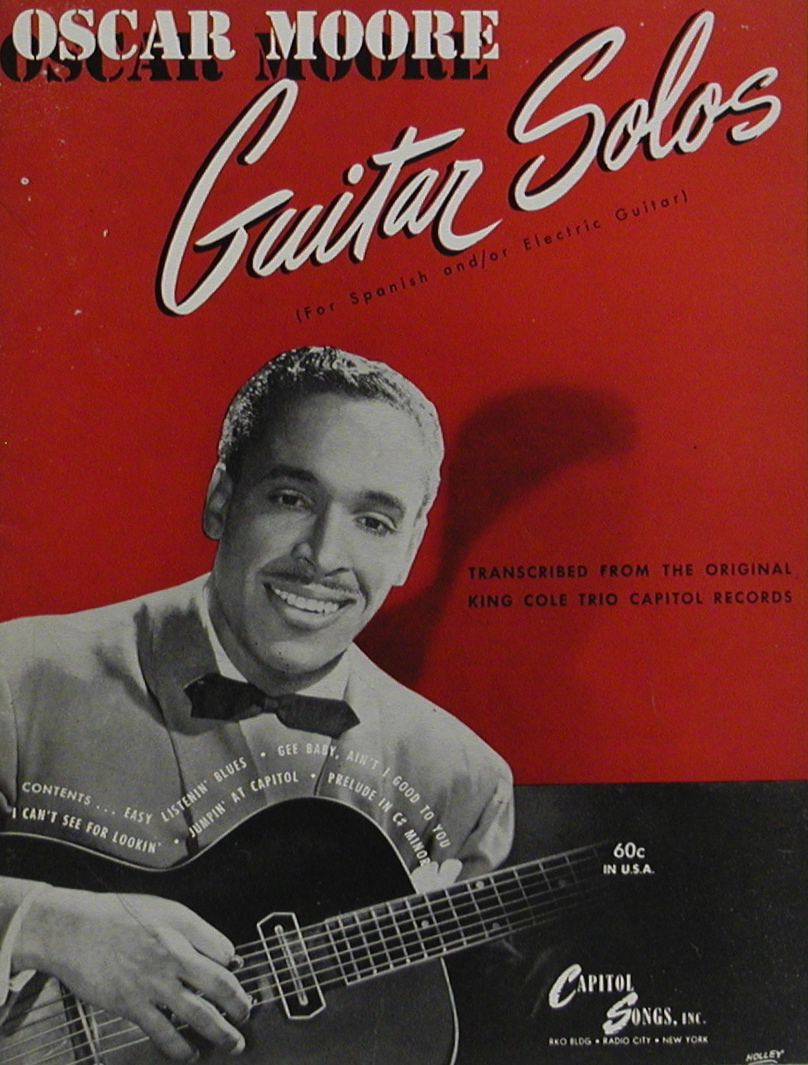
Oscar Moore was near the peak of his popularity in 1947. For over ten years, he had been a member of the King Cole Trio whose string of nationwide chart hits started in 1943, including in a number one pop record on the emerging independent Capitol Records, "(I Love You) For Sentimental Reasons" in the Autumn of 1946. The Down Beat readers voted Moore the top guitarist of 1945, 1946, and 1947. He appeared in print ads for Gibson guitars, had guitar transcriptions published, and appeared on all-star radio and recording dates. Moore also commanded a tremendous amount of respect among his peers and influenced guitar players ranging from his near-contemporay Barney Kessel to a then teenage Kenny Burrell.


Oscar Moore Guitar Solos, published by Capitol Songs, 1946

The King Cole Trio up until the time had been more or less a collective, with Moore an equal partner in the enterprise. But the hits all prominently featured the vocals of pianist Nat "King" Cole. Buoyed by success and reportedly encouraged by his soon-to-be wife among others in his management, Cole made a power-play in the latter part of the Summer of '47 that would regulate Moore to the financial role of a sideman. Moore called his bluff and walked. And why not? Moore had already released a handful of "solo" discs on Atlas Records (onetime home to the King Cole Trio) featuring the Los Angeles based combo, Johnny Moore's Three Blazers. Johnny (Oscar's older brother) and the group were experiencing their own run of popular chart hits that betrayed their blues-baked Texas roots. So it seemed not only natural but something of a lateral career move when Oscar walked away from Nat and into the Three Blazers.


Atlas Records, 1945

Unfortunately, the Three Blazers combo had vocalist issues of their own. Charles Brown, the trio's popular pianist and vocalist, decided to sign a solo recording contract in 1948 leaving the Three Blazers in the lurch. The age of the singer was in full swing, thanks in no small part to the extraordinary popularity of Frank Sinatra. The group struggled for years to find an adequate replacement but Oscar drifted further and further afield. At the dawn of the studio session era in Los Angeles, Moore found some work backing people such as Illinois Jacquet (Clef Records) and Billy Hadnott (Federal Records), as well as eventually cutting some discs on his own starting in 1954.


 Ooh Chica, Billy Hadnott And His Orchestra (featuring an uncredited Oscar Moore), 1952, Federal Records

As I discussed on this weblog before, it was around this time that Leo Fender was perfecting his first great contribution to musical instruments, the Fender Telecaster, just a few miles from Moore. Leo was known to be a fan of Western Swing and quite famously made sure his guitar got in the hands of top players like Jimmy Bryant. What is not as well known is the fact that he got one in the hands of Moore. To add to the obscurity, Oscar Moore's "Nocaster" (so named as it was produced in the early to middle of 1951 just before the Broadcaster was renamed the Telecaster) was one of the most unique examples of the guitar in terms of finish and hardware that is know to have existed.


   Fender "Nocaster" electric guitar, 1951, previously owned by Oscar Moore

What makes Moore's Fender so unique? The biggest aspect is it's gold hardware. Based on other examples of these guitars from the same era, this is the first as well as the only for several years to sport gold metal hardware. Gold metal hardware was commonplace on higher-end archtops at the time, which most jazz guitarists preferred. But Leo's guitar was a working man's instrument seemingly fairly devoid of any such loft aspirations. This shows that maybe this is not the entire story. The guitar is also finished in white. A simple enough characteristic and certainly a color that would become fairly commonplace on Fenders by the end of the decade, but in the nascent days of the company nearly all of instruments produced blond(e). The gold pickguard, again, seems to be a complete one-off and unlike anything Fender would produce for years to come. If Guitar Geekery is your thing, you can read more about the actual instrument here.


Telephone Blues, Aladdin Records 78, 1951 (#4 R&B chart hit)

There seem to be as many questions about Moore and Fender as there are answers. It almost certainly was a custom guitar produced specifically for Moore. But why a jazz man like Oscar who seemed to be on the lee-side of success? It turns out that Fender was fairly aggressive in their efforts to get the Broadcaster/Nocaster/Telecaster into the hands of top players regardless of their primary field of music, which explains why everyone from Jimmy Wyble to Les Paul ended up with guitars from the company around this time. Moore, only 3 years since his last Down Beat honor was still a celebrity of some note particularly in Los Angeles thanks to rhythm and blues hits like Floyd Dixon's "Telephone Blues". Plus, Cole's continued success certainly must have helped rather than hindered Moore, even though he no longer performed with the now successful pop star. Or did he?


Nat "King" Cole and Oscar Moore (possibly Jack Costanzo in foreground), 1951. Photo by Leo Fender.

Curiously, the only evidence that Moore ever used his Fender in public comes from a photo snapped by Leo himself according to Richard Smith's Fender: The Sound Heard 'Round The World. It shows Moore in 1951 performing with Nat Cole! Moore was never known to rejoin Cole's group after his 1947 departure. In fact, the two were known to have been estranged for years, a situation which was not remedied until Moore's appearance on the June 1960 episode of TV's This is Your Life which spotlighted Cole. But 1951 was a transition year for Cole's working group. Moore's replacement, Irving Ashby, made his final appearances with Cole in the studio of March of 1951. One can suspect that his live appearances ceased soon after. In the studio, Cole was aided by the talents of guitarists Barney Kessel and Bob Bain until he found a permanent replacement in John Collins who joined at the end of the year. In fact, 1951 was the year the King Cole Trio was officially disbanded and Cole begin appearing solely as a single. As there is little to no other known documentation of Moore and Cole working together in 1951, one can reasonably assume that Moore was temporarily filling the guitar chair, perhaps even for the night.


Letter to Syd Heller from Don Randall, 1953

One final Fender connection is worth talking about. Jon Raney on his EXCELLENT website devoted to his father, the legendary jazz guitarist Jimmy Raney, published a letter from his archives that will serve as something of a final chapter to this story. Don Randall had been a key part of Fender's early success from the first days of the company. By 1953 he was the President of Sales and responsible for bridging Leo's innovations with both musicians and the public. Syd Heller was the owner of the Columbia Music Company in San Francisco, which had no relation to the record company, but rather was a retail shop and point of connection for many of the West Coast musicians of the time. Through Heller, Randall actively pursued Raney and tried to get a Telecaster into his hands. His selling point? Oscar Moore's endorsement! You can read two of the letters in the correspondence here.


Presenting Oscar Moore, Five Star Recordings, reel-to-reel release, 1957

Oddly enough, there is very little aural evidence to support today's story. Moore's record appearances were sporadic in 1951 and it is difficult to tell for sure how much use his Fender got at the time. He continued to make records until 1957 (with one more 1965 session providing an epilogue to his discography), but nearly every photo of Moore in the 1950s shows him playing a Gibson archtop guitar. Perhaps some time in this great digital age, someone will compile all of Moore's 1950s sessions as a sideman. It would be more than appropriate for an artist who truly was both an innovator and one of the most popular of his time, but who is now sadly in danger of falling in between the cracks of time.

Thank you to Jon Raney for allowing me to reproduce the Randall/Heller letter.

Tuesday, July 3, 2012

Jazz on a Summer's Day (1958)

Now I am one of the last people anyone would accuse of being a flag-waiver. That said, I am actually looking forward to Independence Day (a.k.a the Fourth of July) here in the United States this year. Why? Well, I've begun a few little annual traditions that I very much look forward to. The first is tuning into Columbia University WKCR 89.9 FM's annual Louis Armstrong Birthday Broadcast. 24 hours of Pops who used to like to give his birthdate as July 4th. Tune in: you can do so online. And if you do, consider pledging a little bit of money to help support their amazing programming. The second tradition is taking the missus to the Marin County Fair up in her hometown of San Rafael. Not only are the fairgrounds in the shadow of Frank Lloyd Wright's beautiful Marin County Civic Center (completed in 1962), but it has all the hallmarks of a classic County Fair: corn dogs, rickety thrill rides, livestock, you name it. Plus Marin is always a few degrees warmer than the City, which helps one feel the Summer vibe. As an added bonus, the Preservation Hall Jazz Band has performed on the main stage on July 4th for the past 2 years. Once we return to the  City we usually barbecue something on the grill and, if we are feeling so moved by the spirit, head up to a local vantage point to watch the fireworks - or as they are known to San Francisco residents, "brightly colored fog".


I like to end the day off by watching one of my all-time favorite jazz-related films, Bert Stern's Jazz on a Summer's Day. It's easily one of the best documents of jazz music yet to be recorded. Before I wax rhapsodic on the topic. Take a look at the trailer:


Jazz on a Summer's Day, trailer


If you have never seen this film, you need to. As soon as possible. If it's been a few years since you've seen this film, you need to see it again. If you just recently have seen this film - well, you get the idea. It's one of those snapshots of history that reveals more and more every time one revisits it. And is it just beautiful to experience. Director Stern was a photographer perhaps most famous for his June 1962 shots of Marilyn Monroe - her last photo session conducted just weeks before her death. The eye of a still photographer shifts the perspective of the film. Rather than a staid documentary or straight-forward concert film, Stern is looking for something else, something fleeting and as beautiful as the music. Shot over the Fourth of July weekend in Newport, Rhode Island at the 1958 Newport Jazz Festival and intercut with footage from the America's Cup training which was going on concurrently in the area in advance of the finals held in September.


Bert Stern with his Rolleiflex


I will leave it to the jazz message boards to argue about what was and was what not included in the film. In short, Stern cut a deal with Columbia Records which greatly effected who was filmed and who ended up in the final cut. And for every historic performance that was not captured in the glorious color of the film (Ray Charles, being a notable example) there are plenty of unbelievable musical moments left for us to savor (Eric Dolphy with the Chico Hamilton Quintet). Taken as a whole, the film is a breathtaking snapshot of post-war America at work and play in 1958. Of course not everyone had access to this sort of lifestyle, but there is an impressive cross-section of people captured for posterity's sake. The film was completed in time to be shown at the 1959 Venice Film Festival in the Summer of that year and was saw limited release in the United States in March of the following year.


"The Train and the River" by the Jimmy Giuffre 3 featuring Jim Hall and Bob Brookmeyer in matching poplin sack suits


I learned about the film sometime in 1990 or so in a roundabout manner due to my mod/60s-revival scene interests. Van Morrison name-checked "The Train and the River" by the Jimmy Giuffre 3 in an article about his early influences as a jazz and blues fanatic in Belfast, Ireland. Steve Winwood (still my favorite English vocalist) went a step further and described in detail what an impact Jazz on a Summer's Day had upon him in his youth. The hunt was on. It took me a good year or so, but when I finally tracked down a copy of the film it made a major impact on me and my perception of jazz music. At a time when my concept of the music was limited mostly to Blue Note and Prestige reissue LPs, it opened be open to the width and breadth of the many musical traditions within the form. And something about the vivid colors as well as the balance between hot and cool in the film really captured my imagination. 


"As Catch Can" by the Gerry Mulligan Quartet featuring Art Farmer, Bill Crow, and Dave Bailey...and YES that is Beat Poet Gregory Corso a minute and eighteen seconds into the clip

Stern seldom returned to jazz after making this film, although he remanded a fan of the music. Most his of work was in fashion and advertising (he also shot the famous stills of Sue Lyon in 1962 for Lolita). And after this one, he never had another opportunity to make another film. Several large-scale folios of his photo work are available both new and use. A documentary was made about the photographer a couple of years ago, Bert Stern: Original Madman, although I have yet to see it and therefore won't comment on it. It's definitely on my list though. The Newport Jazz Festival (which began in 1954) continues to this day, around the same time of year, not too far from where it was filmed by Stern in 1958. Nearly all of the film's original performers have passed away, but a few of the legends are still with us and are worth celebrating by your support.

Hopefully, this entry has whetted your appetite and you are eager to watch Jazz on a Summer's Day in its entirety. If at all possible, try to do so on a big screen. If not in a revival house, try to see it at home on a large monitor. Most specialist video rental shops should stock it. But, if you MUST...here it is in all of its glory, thanks to YouTube...


Tuesday, June 26, 2012

Fender Telecaster (1951)


2011 Fender 1951 reissue "Nocaster", made in Corona, California 

To say much has been written about the Fender Telecaster, would indeed be an understatement. Officially introduced in 1951 by Leo Fender's then small Los Angeles County-based musical instrument operation, it arguably the most-popular electric guitar ever, transcending genres and generations. There are plenty of excellent online resources from a musician's and guitar geek's perspective, including a message forum dedicated entirely to the guitar. But what interests me most from the perspective of this weblog is the Fender Telecaster as an icon of modern California design.


2011 LACMA Exhibit Book, available here

A few weeks ago, I caught the tail-end of the LACMA's California Design, 1930-1965 "Living in a Modern Way". It was an excellent exhibit that did a great job of not only presenting the classics, but also making a good case for the zeitgeist modern California design. For example, just a few feet from an amazing recreation of the living room of Charles and Ray Eames was a pair of surfboards designed by Hobart "Hobie" Alter and Greg Noll. This sparked an interesting conversation between my brother and I about the validity of presenting two disparate design pieces that socially, if not culturally, may or may not have little to do with one another. It also successfully got my brain thinking more about how cultural trends did influence various industries. And this, in turn, got me to thinking a bit more about Leo Fender's Telecaster.


Eames living room re-creation (left), Hobie and Noll surfboards (right), LACMA, 2012

While conspicuously absent in the LACMA exhibit, the first commercially successful solid-body electric Spanish or standard (as opposed to Hawaiian or lap steel) guitar meets much of the criteria of California modernism. It can trace it's design heritage back to 1948 with the first prototype being produced in 1949. Leo Fender had a small operation at the time based in Santa Ana, California (40 miles West of the Eames home in the Pacific Palisades and the Coast). The big band era was in its last few bars and small combos were becoming the new economic reality in modern jazz, rhythm and blues, and western swing music. As the standard guitar gained became more prevalent as a front-line instrument (not just a part of the rhythm section), so the need arose for a cost-effective amplified instrument. Leo was keenly aware of this. 


 Leo Fender, early-1950s

Fender's axiom was that this new guitar had to be cost-effective to both make and sell. It also had to be simple and easy to service. Furthermore it needed to address the musical concerns of being easy to play as a lead instrument and able to be amplified at loud volumes without causing the loud, offensive sound known as "feedback" - that howling sound everyone panics about that you've heard come from the PA system at street fairs. You know the sound.


1951 advertising insert

What follows next is a textbook example of "form follows function", the modern design principle introduced by Louis Sullivan at the end of the 19th Century. The guitar Fender created addressed all of those needs remarkably well and was soon available commercially for $189 (approximately $1,500 in today's dollars). This was an affordable, versatile tool that reflected the times and has since proven to be timeless. From a strict design perspective the Telecaster sits comfortably alongside the wooden Eames Lounge Chair (1946) and molded plastic Side Chair (1948), as well as the surfboard designs mentioned earlier. One could almost believe that they all came from the same design firm. Well, almost. Fender was being self-consciously modern to some extent. He did desire to break from the traditional guitar shape, again very much following the functional needs of the burgeoning lead guitarist. Early advertising was very much aware of this and, in fact, used the term "modern" freely.


Heywood-Wakefield M308 Side Table(s), c.1950

Lines and shapes aside, the color and finish was meant to emulate contemporary "blonde" furniture, still a relatively new trend in the early-1950s. More than any other single firm, this was popularized by Massachusetts-based Heywood-Wakefield starting with their mid-1930s "Modern Series", itself influenced heavily by European (primarily French) Deco designs and styles. The look was particularly popular in affluent Southern California and did reflect some degree of the aspiration of the time. Long-before collectors started talking about butterscotch finishes, Fender Telecasters were blondes. 


1952 magazine advertisement


After a rocky start which saw 2 name changes, some minor legal squabbles, and a bit of tweaking; the Fender Telecaster as we pretty much know it today was available for purchase in local music stores in 1951. Fender was smart in that he got it the hands of everyone from Jimmy Bryant to Les Paul to Barney Kessel. Not only did it become tremendously popular with the working-class western swing and country bands playing throughout the State, but with the rise of rock & roll, it became standard Hollywood studio issue. By the end of the decade it was everywhere, from TV (NBC's legendary Peter Gunn theme featuring Bob Bain) to radio (James Burton on nearly every Ricky Nelson hit from 1958 onwards to name just one player) and beyond.


Barney Kessel, Fender Telecaster, c.1958

Was Leo Fender a modernist? Of course, although I doubt very highly he thought of himself as such or even would care about being mentioned in the same breath as Charles Eames. As proud of his achievements as he was over the years, I am sure he thought of himself as a pragmatist first and foremost. But for our discussion's sake, he was a modern man, to be sure.

Postscript - Although Fender sold the company a long time ago, you can still buy a brand new made in California Fender Telecaster today which has truly changed very little in the past 61 years.

Monday, November 1, 2010

The Joe Tex Show (1969)

Stockholm, Sweden, 1969


Madrid, Spain (same tour)


2 television programs featuring Joe Tex and his gigging band have been making the rounds on YouTube. Both probably recorded sometime in April 1969 in Stockholm and Madrid, respectively. The first has been uploaded to the site several times before but never in this quality. While the set-list is nearly identical and the sound quality a bit lackluster on the Spanish performance, it's Joe Tex! Of course watching both is worth your time.

Sunday, October 10, 2010

Solomon Burke (1940-2010)

Goodbye Baby (Baby Goodbye)

A good discography of his original releases...
...Red Kelly's excellent biographical weblogs entries on the man here and here...
...and one of his best (and fairly unknown) Atlantic recordings...

Solomon Burke, the King of Rock and Soul, was a true one-of-a-kind. I honestly don't think that anyone really knows what we lost when we lost him over the weekend. He is the stand-out in Peter Guralnick's compendium of stand-outs, Sweet Soul Music. He is the only voice that could fill the void left at Atlantic when Ray Charles left for ABC-Paramount. Heck he even beat Ray Charles to the Country & Western punch with his first hit, a 1961 recording of a Willie Nelson tune. I shall eternally regret every time I passed by the opportunity to see him perform (and there were a few).

Now do your self a favor and go download his version of Dan Penn's "Uptight Good Woman" - heck, go buy a copy of the original 1969 single on Bell. Although his Atlantic Records stretch provides much of the basis of his legacy, his 1969 sessions for Bell Records cut down in Muscle Shoals are pretty damn near perfect and completely unbelievable at times. They might even be some of the best records cut that year anywhere. Maybe. His version of "Uptight Good Woman" is a perfect reading of the tune, made all that much better by Penn's harmony vocal. This is soulful music of the highest order and a duet that is on par with Sam Cooke and Lou Rawls doing "Bring It On Home To Me". It's that good. Seriously.

Goodbye Baby. Baby Goodbye.

Saturday, September 11, 2010

Alvin Robinson (1937-1989)


1964 Promotional Photograph
Photographer Unknown

Alvin Robinson. Al Robinson. Shine. All names point back to one of the best voices in New Orleans Rhythm & Blues - who just never quite made it - but who left behind a string of excellent singles, some of them as close to perfect as you'd ever want to get. No less than Jerry Lieber, who produced a couple of Robinson's singles, stated in Hound Dog (his autobiography with Mike Stoller) that he would, "...put Alvin up against Ray Charles, James Brown - you name 'em." Now THAT is really saying something.

I first heard Robinson round about 1990 or so. I had recently moved to the San Francisco-Bay Area and was spending most of my weekends over in Berkeley with scene its self-styled mods. Now these weren't your average suburban kids in parkas listening to Two-Tone and 80s power pop that I had grown up with - they were the closest thing (in my mind's eye at the time, at least) to the my understanding of what the original mod thing was all about. Needless to say much of my weekend soundtrack consisted of 1950s-1960s R&B, from Chicago blues to soul music. At some point of time I got the gumption to ask one of the top DJs, Seth "Soul" Roehl, to make me an R&B compilation. What he delivered was 90 minutes of some of the best music ever recorded. Cheekily titled, "British Bashers", it consisted of original versions of tunes covered by 1960s UK groups such as The Beatles, The Rolling Stones, The Spencer Davis Group, etc. And somewhere on this cassette tape were not one by TWO tunes by the great Alvin Robinson: "Let The Good Times Roll" and "Something You Got."

"Something You Got" was an easy one. I knew the tune well. Van Morrison and Them had covered it on their second LP that my girlfriend at the time had. Chris Kenner had written it and scored a minor hit well before I was born, so perhaps it was already in my subconscious thanks to oldies radio. Why Seth chose to include the Robinson version - I don't know - I just chalk it up to excellent taste. "Let The Good Times Roll" was a little more obscure - or so I thought. I soon found out that the tune (as recorded by Robinson) had been a long time favorite of California R&B revivalist Ron Silva going back to his days with The Crawdaddys in the 1980s. Silva, at the time, was performing alongside Bart Davenport and Xan McCurdy (both of whom later played with me in The Loved Ones) in a R&B combo called The Driving Wheels. They walked the line between 1960s British style and American source material. Silva had quite an affinity towards New Orleans R&B, although where and when he discovered this fairly obscure single remains unknown to me and is perhaps a topic for another time. No matter. The point is, I was hooked.

[OK, one more tangent and then we will get back to Robinson. Interestingly I DID know the tune "Let The Good Times Roll" really well at the time. But I knew it as "Come On, Part 1" written by Earl King and recorded by Jimi Hendrix in 1968. In fact, I had covered that version along with John Kent (yes, another Loved One) in one of our suburban garage bands in high school. Being somewhat literary minded at the time, I was puzzled by the songwriting credit of Earl King. I knew the Johann Wolfgang von Goethe poem "The Erl-King" and a little bit about the mythology around it, but couldn't connect the lyric with the poem. Frankly, I just thought it was something Hendrix wrote and that the credit was one of those 1960s cosmic jokes that I had heard about. Little did I know at the time. More on Earl King some other time]

And finally back to Alvin Robinson. So why is he on my mind today? Well, one of the best weblogs around on New Orleans music, home of the groove, recently posted an excellent piece on the man. I HIGHLY recommend that you read that here. Robinson was partially featured in an earlier H.O. the G. post here. And fortunately his legacy has not gone unrecognized elsewhere by some of the best bloggers around. In fact, two of my favorites have spilled some virtual ink in his name. Red Kelly over at The "B" Side gave him the usually Red Kelly customary and very in-depth treatment here. And a couple of years before that, my friend Larry Grogan who runs several excellent music blogs, provided this nice overview of his Lieber & Stoller recordings which you can find here. Which takes us back to my intro paragraph and means that's all I got to say on the matter...for the time being.

Now kick back and listen to a few tunes by the man...


9/15/10 Update - Second part of the home of the groove spotlight has been posted here.

Wednesday, July 28, 2010

Gene Ludwig on vinyl (1962-1987)


I recently mentioned the passing of the one of the great, unheralded masters of the Hammond organ, Gene Ludwig. Although he was fortunate to enjoy some latter-day recognition, his name is not one often associated with the legends, but he truly possessed the chops to sit at their table. My childhood friend, John Kent (drummer for The Loved Ones and my own Nick Rossi Set), was the first person to hip me to Gene - slipping me a copy of his 1964 Mainstream LP Organ Out Loud sometime in the mid-1990s. I was floored and continued to pick up his discs where I could. I quickly figured out that much of his early discography consisted of 45s on various local independent labels, which endeared Ludwig even more to me.

A new weblog has been launched here devoted to "keeping record of Pittsburgh's unrecorded recorded history." Their inaugural post is dedicated to the vinyl discography of Gene Ludwig which spans 1962-1987. Many of the discs are illustrated and the site is VERY rich in information. On top of that, there is a sister site on YouTube which features many of the recordings, so you can get yourself a taste of Gene's excellent playing.

Side Notes: I was fortunate to play a role in helping set up a gig for Gene at Club Deluxe up on The Haight here in SF a few years ago, which was his first San Francisco performance in a LONG time. It was a truly ear-opening show. A couple of years later, Gene (without notice) called up onstage to play a tune with his trio at Jazz at Pearl's in North Beach. Nobody knew it at the time, but that was the last time I played the Hammond organ "live." Regardless, the experience was a swift kick in the behind - in the best way possible - and I will always remain grateful to him for that. Finally, while we are dishing out credit, I should mention that in addition to hipping me to Gene, John Kent was also the person responsible for turning me onto Willie Mitchell's unbelievable body of work as a bandleader. Thanks John, wherever you are.

Tuesday, July 20, 2010

Bermuda Palms (1967)

Bermuda Palms
737 Francisco Boulevard
San Rafael, California

The above postcard was taken from this Flickr photostream and is dated 1967. Judging from the cars in the lot the photo was taken MUCH earlier. The caption on the rear reads:

California's Las Vegas - a complete hotel resort. Coffee Shops - Cocktail Lounges - Banquet Rooms - Ballrooms for Dancing - Auditorium - Swimming Pool.

Perhaps. Many seem to remember The Palms as a fairly sleazy spot in a not very nice part of San Rafael in the 1970s-1980s. But it did certainly have a colorful history well before that time.

In 1955, Robert Mitchum was hired by John Wayne's production company to star in Blood Alley which was partially filmed in San Rafael. According to Lee Server's Mitchum biography, the actor had driven up to the hotel, where the production had booked several rooms, from Palm Springs in his Jaguar. Mitchum was reportedly (and violently) not happy with his initial room, so was upgraded to a room about the film's director. The actor was in a celebratory mood and with several friends and kept the director up for much of the night. A minor fracas occurred between the actor and director which was later blown out of proportion by the press and Mitchum was dropped from the film.

In 1962, San Francisco MUNI Driver and soon-to-be record label owner, W.C. Stone, "discovered" Doug Cox (guitar & bass guitar), John Allair (Hammond organ & piano), and Pete Lind (drums) appearing in the cocktail lounge as the resident Doug Cox Trio. Stone was floored and took them under his wing, released 3 singles (re-christened The Cals, using the first letters of each of their last names) by the group on his fledgling Loadstone Records label. They also became something of a house band for the label's R&B singers, with Allair sometimes providing arrangements.

By the late-1960s the hotel ballroom that once had hosted performances by the Duke Ellington and Count Basie Orchestras was known as The Citadel (and later Pepperland), presenting the likes of The Sons of Champlin, The Grateful Dead, and Big Brother & The Holding Company. A decade later it was more well known for its transient residents and links to the drug and skin trades.

The Bermuda Palms is now a Motel 6.

Monday, July 5, 2010

Brioni Roman Style and the origins of the Continental Look in the USA (1954)


In a series of recent conversations with a friend, I found myself describing the Continental Look to him but lacking a distinct sense of its history and origin. Sure, I knew that it's popularity rivaled the Ivy League look here in the United States by the early 1960s and in many ways had as much stylistic influence on the next few years as the English look (both of which would briefly eclipse Ivy by 1966 or so) - but apart from hunches and suspicions that was about it.

So, where to start? Well, what most of us know as Continental Style is also known as Italian Style due to its origins in Italy. Narrow lapels, a slightly pronounced shoulder, 2-buttons, and a shorter slim silhouette both in the jacket and trousers. But where did this style get its start? A good argument can be made that it all starts with Brioni Roman Style. Opened by tailor Nazareno Fonticoli and businessman Gaetano Savini in 1945 in Rome's Via Barberini, the shop quickly established itself a top-end retailer of hand-made suits. One can easily speculate the effect a shop like this might have had on the more sartorial-minded G.I.s celebrating the end of the Second World War in Rome, but more importantly the shop jumped to the head of the pack in pace-setting post-war Italian style. Seven years later, Brioni again innovated with not only its first fashion show, but the first fashion show anywhere to feature a male model as the primary focus on the catwalk. Similar presentations in nine U.S. cities in 1954, were quickly followed by the establishment of a New York shop. By the following year, the clothing line was not only featured in Life Magazine, but could be found in larger fine retailers in many major cities in the States. The Continental Style had arrived.

A second, concurrent major influence during this time period was cinema. Roman Holiday won the best picture for 1953 and was a huge popular favorite due in no small part to performances from Audrey Hepburn and Gregory Peck. But it also was the first American film shot entirely in Italy (Cincetta Studios, Rome) and was very likely the first exposure many people had in this country to any sense of Italian style - albeit in brief flashes and through the lens of director William Wyler. By the end of the decade, American movie stars filming in Rome was fairly commonplace as was American stars (such as Cary Grant) buying clothes at Brioni's now world headquarters in the Eternal City. But the cultural attention to Italian style may have hit a peak in 1961 when Fellini's La Dolce Vita was released in US movie houses. Another popular success, it showcased a much more articulate and vivid portrait of true Continental style. (Side note: both Paul Newman and Henry Fonda were early considerations for roles). By this time, taste-makers in Esquire, Playboy and beyond were proudly touting the joys of Continental Look.

One final nod must be made to some of the musicians of the time period, particularly jazz musicians such as Miles Davis. Always sartorially astute, once he cleaned up in 1954, Davis's attention to clothing and style seemed to shift into overdrive. He had already been an early adapter to and trendsetter of Ivy League style among his peers. His LP jackets were gaining notoriety often as much as showcases for his wardrobe as they were for the music contained therein (just ask clothes horse Eric Clapton who has pointed to Davis as a massive early style influence) and his 1956 disc Workin showed him wearing a custom tailored jacket with a distinct Continental influence. By the end of the decade the look was pervasive among both jazz and R&B musicians and eventually won out with the latter group, becoming the look of "soul" music through 1968.

Thursday, May 13, 2010

Sharon Jones & The Dap-Kings at The Apollo Theater (2010)

Harlem, New York, NY
Photo by Ryan Barkan

There are some more excellent pics here, including The Dap-Kings sporting continental cross-over ties, which of course get my whole-hearted seal of approval.

Monday, April 26, 2010

The MGs (1962)


I recently rented and watched Respect Yourself: The Stax Records Story and was somewhat disappointed. Chips Moman, Lewie Steinberg, and Packy Axton all got the short shrift to say the least. After grousing a bit on Facebook, I gave it a lot of thought. Admittedly, I do know quite a bit more than the average person about Stax and it's history, but my fear is that through these "definitive" statements, some folks often just end up getting marginalized - no disrespect intended to any of those involved with the documentary (or any other attempts to tell the story). So here are a couple of bits I culled over the years about the legendary Stax house band...

The MG's (or M.G.s or MG's or M.G.'s - all these variations appeared on their early singles and LPs) were "formed" in June 1962. While the actual date is unknown (early Stax session logs are not very helpful it would seem), it was recalled by participants to be a rare-for-the-label Sunday session. The focus was to be Billy Lee Riley who may or may not have recorded a couple tracks with a pulled-together backing band consisting of Booker T. Jones (Hammond organ), Steve Cropper (guitar), Lewis Steinberg (bass), and Al Jackson, Jr. (drums). All had done recording work for the label, but it was quite possibly the first time the four had played together as a quartet with no additional musicians. In fact, the first call drummer may not have been Jackson. Howard Grimes who appeared on a number of early Stax sessions - including a number of Mar-Keys recordings, missed the phone call for the session.

MG has come to be stand for "Memphis Group" in many of the official bios and blurbs. But the footnote version is a little more complicated. Initially, "The MGs" referred to the British sports car. Yes, a bit eccentric for the early 1960s in Tennessee, but true all the same. In fact, the instrumental combo who proceeded The MGs was named The Triumphs after producer Chips Moman's British sports car. Once "Green Onions" took off and the pick-up group had been established as a bona-fide recording act/house band (and not to mention, once Moman was out of the picture) - perhaps as late as the Al Bell era - publicity started to carry the more widely-known definition. In fact, if anyone knows the first mention of this, I would love to hear from you via the comments section.

One final note. Bass man Lewie Steinberg (pictured above, far right) played on every Booker T & MGs recording through the end of 1964 including both of their first 2 LPs. Lewie is still with us, living in Memphis. Wouldn't it be GREAT to read a full length interview with the man himself? His involvement in Memphis music goes deep, long before the Stax-era. Again, if anyone knows of any good links to Steinberg, please let me know.

Friday, January 8, 2010

The Madison Time (1960)


I woke up this morning with a yearning desire. A yearning desire to dance the Madison. Fortunately for both me as well as countless others out there who awoke with a disturbance in their minds, relief is just a few clicks away.

First, let's drop a coin in the jukebox and check out the Ray Bryant's hit.

Now, let's learn a bit about the history of the dance here.

Finally, in case you missed it, let's check out the dance steps.


Feel better? Yeah, me too.

Thursday, November 5, 2009

The Blues Busters (1964)


This is a VERY cool and interesting clip. I first heard the song via Italian-American "blue-eyed soul" man Steve Alaimo. Digging through the crates at Rooky's record shop off of Fillmore one day, owner Dick Vivian, put this one on the hi-fi saying that he knew I would love it. He was correct. Released in the US on ABC-Paramount Records in 1964, it was a rare early example of a US ska disc cut by Alaimo and featuring a solid, swinging backing (Capitol Records studio, NYC, perhaps?). A few years later I got my ears on the original version by Jamaica's Blues Busters - equally cool and groovy. The Blues Busters are still one of my favorite acts from this era - perhaps because of their slightly more overt soul/R&B influence. The above clip is from a wonderful 1964 documentary This is Ska! which my pal Domenic Priore hipped me to years ago. I would LOVE to see someone get a hold of the original film and put it out on DVD, Blu-Ray, or whatever format they come up with next. But the real inspiration behind this post is the fact that I am off to LA this weekend to appear with Ron Silva & The Monarchs opening up for LA's kings of classic ska, Hepcat. See how it all ties in now? I thought so.

Tuesday, October 27, 2009

House Of Shields (2009)

Design by Carlos Perez

Friday, October 2, 2009

Soul/Food! (2009)

Design by Carlos Perez