Sunday, May 22, 2011

White Oak Denim (1905-?)

A few days ago, on on May 20, 2011, Levi Strauss & Company celebrated the 138 anniversary of being awarded United States Patent Number 139, 121. This "Improvement in Fastening Pocket-Openings" is widely heralded as the birth of blue jeans, not only an American classic if there ever was one, but also a clothing icon.Contrary to latter-day publicity materials, San Francisco-based Strauss missed the California Gold Rush, but he most certainly sold garments to prospectors and beyond once production was active in the 1870s. For several decades, "Levis" (as we tend to call them now) were the provenance of West Coast workers from ranches to factories. But gradually, exposure to the garment grew. For example, the 1915 Panama Pacific International Exposition featured a hall where Levi's employees actively created garments.


In the 1930s, with Westerns riding high in the box office, the Dude Ranch fad/craze brought many Easterners in direct contact with genuine cowboys. What could be a better souvenir than a pair of the denim trousers that nearly every ranch-hand worth his boots could be seen wearing? The 1940s then saw an influx of folks of all classes, creeds, and colors into San Francisco, the greater Bay Area, and California thanks to both the armed forces as well as the war production effort. By the end of the Second World War, it is safe to say that Levi's were fairly well-known, if not well on their way to becoming ensconced in the cultural consciousness.


I celebrated Levi's achievement early this year by purchasing a brand new pair of Levi's Vintage Clothing line's 1947 501XX Selvedge Jeans at one of my favorite local merchants, Unionmade. Perhaps somewhat prohibitively pricey, they are impeccably and accurately fashioned after the surprisingly slim and modern cut of the 1947 501s. It would seem, by any measure, that Levi's Strauss & Company have firmly re-established themselves on the competitive (if not slightly overcrowded) premium denim scene.


Apart from what the attention to detail, two major things struck me about these particular reissues. First, they are made in the United States. And by made I mean: milled, cut, and sewn here in the United States. In fact, with a little research it turns out the cutting and sewing for these as well as some less pricey items from their regular line (such as 501s and 505s) are being cut and sewn in Los Angeles. Yes, that's right. Back in California after several decades in other states and countries!

But most impressive is the quality of the denim. It's quite simply some of the nicest I have ever come in contact with. It looks right. It feels right. And that's because it IS right! It turns out Levi's has been using Cone Denim from North Carolina. And not just any denim from Cone, but their premium White Oak denim that features unmistakeable narrow selvedge courtesy of original vintage shuttle looms. What more is that the White Oak Plant has been producing denim since 1905, which surely must be some sort of record. Compound this with the fact that the White Oak Mill has been supplying Levi's with denim since 1915 results in a pair of jeans that really are something special.

Herein lies a huge appeal to me. In so many ways a historic reissue is, by design, a period piece. But considering the source of the fabric and the continuum of its history, this is transcended in a no small way. And at the end of the day, the garment is still a piece of work wear more akin to other modern functional classics such as an Eames molded plastic chair rather than a museum treasure or mantlepiece.

Here's a brief video that focuses on another one of White Oak's customers, Raleigh Denim, but it does have some very cool images of the plants and the looms in action. Here's hoping those looms keep moving another 106 years!

Raleigh Denim: Handcrafted in North Carolina | UNC-TV from David Huppert on Vimeo.

Friday, April 29, 2011

Ellingtonia: Fred Guy (1946)

Today, April 29th, is the 112th anniversary of the birth of Duke Ellington. Frankly it should be celebrated MUCH more than it is. However, I will spare you a rant. Instead I encourage you to turn off this computer right now and go play a Duke Ellington record. Or listen to the Duke on your computer while you read this (WKCR 89.9 PM New York City devotes their entire day's programming to Duke all day long today). Even better, go toiTunes and gift some music to someone else you know that might not have any Ellington in their collection.

I thought I would use the occasion as an excuse to post a photo of Duke's long-time guitarist (and banjoist before that), Fred Guy, who was associated with The Maestro's organizations from 1925-1949.

Fred Guy
October 29 or 30, 1946
The Aquarium Restaurant, New York, New York
Photographed by William Gottlieb

Let's start with the musician, Unfortunately, a painfully small amount of
information is available on Guy. In short, he was born in Georgia just a month shy of 2 years before Ellington and grew up in New York City. He worked on his own as well as with Joseph C. Smith's dance band before joining Duke Ellington's Washingtonians in the Spring of 1925. Interestingly, he replaced the former bandleader of Duke's band, Elmer Snowden. Side note: Snowden has a San Francisco connection as he ended up in the Bay Area in the early 1960s and played with Turk Murphy! But back to Fred. As a couple of online writers have noted, his banjo playing is much more notable in many respects on the early Ellington sides if only because he is much more audible. Once he switched to guitar in the early 1930s he fell into the role of the classic swing guitarist, often felt more than heard on those old shellac discs. He is on most of Ellington's recordings during this era and can be seen in most of the few film clips of the orchestra. He departed from the group at a time when less and less big bands (the few that were left, I should qualify) were using a guitarist in their ranks. Duke never replaced him and to my knowledge never worked with another guitar player on a regular basis. Guy reportedly ended up in Chicago and managed a ballroom in the 1950s, although I have yet to turn up any specifics. He passed away in the year of my birth 1971.

The date of the photo is accurate within a day due to other shots from the same session. The late, great William Gottlieb photographed several wonderful shots of the Duke and his men this evening, all of which are available via the Library of Congress site. What helps determine the date is the presence of Django Reinhardt in several shots, who had just arrived in the United States and would soon appear with the Orchestra. We can thank the Django fanatics for providing a date.

Speaking of Django, Gottlieb snapped a couple of shots of the legend playing what turns out to be Fred Guy's archtop. For some time, these photos were a red herring for Djangologists as it was thought to have been a guitar he used, but it would seem these shots were just for the photographic occasion.

The guitar, itself, is a Levin. Never heard of it? Neither had I. At one point of time it was thought to have been Stromberg or Epiphone oddity, it was a Levin De Luxe circa 1937-1939. Another interesting point, Levin was a Swedish manufacturer, although the founder Herman Carlson had traveled to the United States at the beginning of the 20th Century and learned his craft there. But how the heck did Fred end up with it? If I had to hazard a guess, he picked it up on Duke's 1939 European tour.


By the way, you can purchase this VERY guitar on eBay. I am not kidding. Fred Guy's guitar is on eBay as I type this. Unbelievable.

Not much has survived the ages about The Aquarium Restaurant. It was located at 701 Seventh Avenue at 47th Street. A quick visit to the address courtesy of Google reveals that while the old building still stands, a sbarro now occupies the space. I won't even go into how many kinds of wrong that is. The slight balm though is the presence of Tad's Steaks next door.


One final aside. Check out the positioning of the guitar in the above photo. To contemporary guitarists, it might seem a little odd, but it is classic swing guitar positioning. In short this was a way a for un-amplified guitarists of this era to not only hear themselves but to be heard by the band and dancers. For more on this topic, head on over to Jonathan Stout's well-written and researched Swing Guitar Blog. Jonathan is quite a student of history when it comes to swing guitar and is currently performing with one of my favorite West Coast combos, D.J. Bonebreak's (yes, the drummer from X) Bonebreak Syncopators.

Happy Duke's Day Everyone!

Thursday, April 21, 2011

American Optical Flight Goggle 58 (1958)


American Optical Eyewear, Inc. has been making eyewear right here in the US of A since 1833. It can trace its origins back to William Beecher in 1826 and you can read their full story here. Other interesting date-related facts worth reading about include their first sunglasses (1876), their introduction of Ulta-Violet protection (1913), and polarized lenses (1940). But perhaps AO, Inc. is most well-known for their association with the US military.

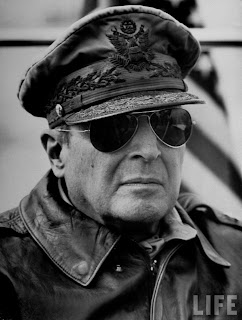
The design of the ubiquitous "aviator" sunglass generally credited to Ray Ban is, its classic egg-shaped glass favored by pilots around the time of the Second World War. Interestingly, pilots did not wear sunglasses while flying at this time, so their popularity had to have been reserved out of the cockpit. The most well-known Ray Ban man at the time? General Douglas MacArthur, of course.


A quick sidenote: the earliest hipsters (and I mean that in the true sense of the word), I have seen sporting aviators are in this photo of Afro-Cuban musicians in NYC from the late 1940s. By the way, that is Arsenio Rodriguez in the dark suit and tie in the center and Machito on the far right. Legendary bandleaders both.


But I digress.

American Optical, too, was producing and supplying aviator sunglasses to the military during World War II. In fact, they had been supplying sunglasses to the military as far back as the First World War, long before Ray Ban existed as a company. It was a fairly common practice for the quartermaster of any given branch of the military to source common goods such as these from multiple suppliers - take a look at the history of military watches some time for ample examples.

1958 saw the introduction of a newly-designed aviator sunglass courtesy of American Optical. And for my money, it is a design classic that surpasses the Ray Ban aviator. Its semi-rectangluar lenses have become almost as iconic as its egg-shaped predecessor. Living up to the modernist axiom of form following function, Flight Goggle 58 (as it was initially known) was/is streamlined and to the point. Their popularity quickly eclipsed that of the other aviator style for much of the subsequent decade, perhaps reaching a figurative and literal high point when they were the first sunglasses on the moon in 1969.

Jim Irwin (in blue) with fellow astronauts Alan Bean, Charlie Duke and Bruce McCandless before the July 1969 Apollo 11 launch.

Over the years, the popularity of the 58s has waxed and waned, but they have definitely seen an upsurge in popularity, again as an alternative to the egg-shaped aviators that ever Tom, Dick, and Supermodel seems to be sporting these days, irregardless of social status, political views, or face shape. But the 58s are around. Look for the discerning gentleman. And you can (in part) thank Don Draper while you are at it...


I will leave you with one piece of advice. If you get the itch for a pair, don't settle for any cheap (or expensive) imitations. You can purchase a pair of genuine American Optical Flight Goggle 58s (now called Original Pilot Sunglasses) direct form AO here. They are still made right here in the USA, with every customization option imaginable (within the confines of good taste of course). Be sure to order direct from them, it's worth the few extra dollars to know exactly what you are getting.

Thursday, April 14, 2011

Brooklyn Goes To San Francisco (1956)

Cool, short featurette (ask Grandma about that one) from 1956 featuring plenty of San Francisco scenic shots. This was part of a series of short films written and directed throughout the 1950s by Arthur Cohen. Other destinations in the series included Las Vegas, Detroit, Cleveland, and Rome. But who is Arthur Cohen you might ask?

Well, most of you know Arthur Cohen. Born in Brooklyn in 1913 as Fivel Feldman. Feldman took the surname Foster from Foster Avenue in Brooklyn, Phil Foster in fact - but was seemingly also known as Arthur Cohen throughout his early career. Although he started off as an actor, for the most part he was a standup comedian and eventually made his way into film and television. However, he is most widely known for his portrayal of Frank De Fazio on Laverne & Shirley. You know, as in Laverne's dad!

Friday, April 8, 2011

Bird at The Three Deuces (1948)

Recently, the wonderful Phil Schaap has posted several more installments of his (almost) daily radio show, Bird Flight on WKCR, to his online radio pagehere. Now if you are a fan of Charlie Parker and you are not familiar with Phil, I cannot urge you strong enough to give him some ear time. There are few people on the face of this earth that are able to marry such enthusiasm and scholarly knowledge of The Great One (Bird, with apologies to Wayne Gretzky).

The episode in particular that has caught my attention is from February 2, 2011 - incidentally his 41st Anniversary broadcast. You can listen to it here. Do note that you can download these for private use. In fact, I strongly suggest dropping it on your iPod/iPhone and taking a long walk outside. But I digress...

The gist of this particular installment is the argument offered that in March of 1948, Charlie Parker was at the peak of his musical prowess and his combo at that time - Charlie Parker and The All Stars - were never to be bettered. Highly subjective of course. But Schaap not only provides aural evidence by way of the Dean Benedetti recordings of the combo recorded at The 3 Deuces in NYC on 52nd Street. On top of that he has the written testimony of combo member Miles Davis, plus first-hand recollections from both Lennie Tristano and Tal Farlow, both of whom played interval combos opposite Parker's headlining combo at The Deuces. Bird at the top of his game? Perhaps. Give it a listen and give it some thought.

Subjective opinions aside, the most is compelling. Bird is easily in one of his most fluid and energetic modes and the excitement is still palpable - in spite of the low fidelity of the recordings (or computer speakers for that matter).

Here are a few images I trawled to give Schaap's narration some visual reference...

First, here is 52nd Street, in color, courtesy of photographer William Gottlieb in 1947 or 1948. We are looking East towards 5th Avenue. The 3 Deuces is on the South side of the street on our right...


Next, here is a close-up of the Deuces during the very engagement in question...


Next a somewhat familiar but still beautiful shot of Bird in flight, again courtesy of Gottlieb, quite likely shot during the same 1948 engagement...


Low res, I know, but here is a fairly rare shot of the All Stars on stage at the club. Nice bow tie, Miles. In fact, notice how everyone is wearing light-toned suits...


And finally, here is a shot of The Bill Harris-Charlie Ventura combo included only to show everyone just how damn small that stage was at The Deuces. Wow! I will never complain about a lack of square footage on a gig again...


Note: Schaap's broadcast does include the entire set of recordings from the March 31, 1948 date in question. Just be patient, he will get to them. It's just Phil's way of doing things.

Wednesday, March 30, 2011

Style File No.1

My 2010 year-end bonus was a gift card: a significant amount of money to shop at Sak's Fifth Avenue with. Downtown San Francisco features a 4-story Sak's men's shop with a wide variety of items, brands, etc. Unfortunately for me, I quickly learned two things. First, what I thought (and still think, frankly) was a significant amount of money really wasn't compared to the prices at the shop. And, second, SO much of these high-end goods were made offshore in countries well known for - let's just say, lesser quality goods. No, I have been not living under a rock. And, no, I am in no way a jingoist/nationalist/etc. But I do appreciate well crafted items, whether they be a pair of shoes or an archtop guitar. And I do like the notion of supporting businesses here in the USA (and California and San Francisco, for that matter) particularly in these days of The Great Recession. So, try as I might, I just couldn't bring myself to spending all of that money on an overpriced designer sweater made down the street from where my ragged Land's End cable-knit shawl collar sweater was hobbled together on the cheap. So after several visits, I finally used the money towards a pair of cool Oliver Peoples sunglasses. Of course, I had to pony up some cash to make up the difference. The model is called the Sheldrake.


Two things I should say about Oliver Peoples. First, they retail for WAY more money than I care to pay for sunglasses. But the aforementioned gift card eased that pain. Second, they are very well made (in Japan). My reading glasses which I have had for maybe 15 years or so are by the same maker and they have held up quite well. In fact, I can think of very little that I have had for that duration of time that has held up similarly.

The Sheldrake is supposedly "inspired by Andy Warhol" - although he was furthest from my mind when I saw them and tried them on. Well that's an exaggeration. Lady Gaga was perhaps further from my mind when I saw the pair of Sheldrakes and tried them on. More of an immediate connection was Miles Davis on the cover of his 'Round About Midnight LP or any number of musicians Francis Wolff photographed while recording for Blue Note. They have that later-1950s/early-1960s look down to the keyhole nose opening. Heck, they aren't even too far off from what President Kennedy was often photographed wearing.

Where am I going with this? Well, the whole experience above is one of the reasons I have been thrift shopping more and more as of late. There are some wonderful clothes being produced out there. I can even afford some of them these days. But I still don't feel right about dropping all that cash. Plus there is something intrinsically socially conscious about recycling clothing. I've started to think of what I use and refuse as "my pile." In other words, when I shuffle off this mortal coil, I am going to leave a pile of material possessions. How big is that pile going to be? Will people be able to use what's in that heap? Something to think about - or at least something that I think about.

Today's trawling was fairly rewarding. For a mere $23.98 total, I managed to pick up a couple items of note...


1960s Bass Weejuns. Size 10 1/2 B. The older brick red burgundy color, well before Bass switched to that kind of awful burnished brush-off finish. Made in the USA naturally, well before Bass started production of their shoes in Central America. OK, to be fair, they are too narrow for me, but I have already found a friend who wants them. With some basic cleaning and a "bullet" shine from my friends down at A. Shine & Co., they will be things of beauty.


Navy blue 3-button sack blazer. Tropical-weight wool, 3/4 lined. Tailored by Southwick for Lew Ritter. Ritter had his origins in 1936 in New York City, and eventually expanded to Los Angeles in the early-1950s. To the best of my knowledge the shops have all closed. But back to the jacket. It needs a few days airing outside, but Spring is indeed here and there is no rain in the forecast until the weekend. Add a new set of buttons and I will be ready for mocktails.

I might never need to step foot back into Sak's again.

Monday, March 21, 2011

Spring Is Here


Kim Novak, circa early-1950s
Photographer Unknown