Showing posts with label sculpture. Show all posts

Tuesday, August 20, 2013

Irving Harper (2013)


George Nelson Clock reproduction by Verichron, 2013

Every so often it is good to have the rug pulled out from under you. The experience sharpens your senses, wakes you up, and makes you question the firm ground that all too often is taken for granted.


Online ad, Modernica, 2013

My Mid-20th Century Design Road to Damascus was a flight to Spain with a long layover in JFK. It was 1998, Trans World Airlines was still operating, and the fates conspired to leave me with a few hours on my hands in Terminal 5. Almost needless to say, I was floored by the building. My appreciation of modernism as a design aesthetic became a primary interest and the name Eero Saarinen was elevated to hero status in my estimation. Move forward 5 years and I am now sharing the flat where I currently live in San Francisco with the now Missus. We purchase a pair of pendant lamps for our living room spaces from a local favorite, Inside. Our choice? Modernica's reproduction of the Howard Miller cigar bubble lamps designed by George Nelson. So here was my first legitimate design purchase. An iconic item by a name designer. So all things being equal, Nelson's stature is elevated in my little black Moleskine.


Print ads, Howard Miller Clock Company, 1956

And it grows. And it grows. My wife buys me a Vitra-produced Nelson reproduction clock as a gift. I find an oversize jack for my bookshelf. Our flatware is replaced with a set of vintage Hall Leisure designed by the Nelson and Associates. George Nelson becomes a touchstone in my mind's eye as I become more and more engrossed in this aspect of living.


Debut of the Herman Miller logo, 1947, logo by Irving Harper for George Nelson Design

Perhaps the only thing worse than being late to the party is being late to the party as well as being oblivious. The latter is how I felt when I first read about Irving Harper a few weeks ago. Who is Irving Harper? Only the most significant Mid-Century Modernist that you have (perhaps likely) never heard of! As it turns out Harper was THE man at George Nelson and Associates responsible for everything from the iconic Herman Miller logo to the now legendary Howard Miller "Nelson" clocks which hang on the wall of nearly every discerning modernist worth their salt. And, yes, even those lamps hanging in my living room are now attributed to Harper. Sure, I knew that George often took credit for the work of this firm. Of course he did, that is the way it had been done for decades if not centuries with the name on the masthead usually taking credit for the entire output. What is astonishing is just how many of these iconic works sprung from Irving Harper's obviously fertile, creative mind. The wonderful coda to this story is that Harper is still alive and finally getting the attention and notoriety he so clearly deserves.

For further reading, I highly recommend this article as well as this one

Tuesday, June 4, 2013

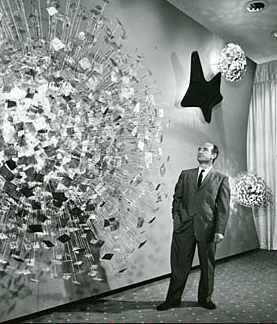
Zenith Radio Corporation Showroom Sculpture (1959)


Zenith Radio Coporation Showroom, Chicago, Illinois, c.1959

Recently, I visited the Smithsonian American Art Museum in Washington, DC for the the first time. Now I don't know why, but I had rather low expectations for this particular museum - perhaps I just did not know what to expect. And while I was certainly impressed in general, I was nearly awestruck when I rounded a corner only to find myself face-to-face with Harry Bertoia's massive Zenith Radio Corporation Showroom Sculpture


Harry Bertoia and his creation, c.1959 

I have something of an affinity for the artist and designer Harry Bertoia, whom I mentioned almost in passing a few weeks ago. He was the first 20th Century modernist designer that I knew by name, having been introduced to his iconic wire mesh chairs by a good friend and room-mate in my early-twenties. Bertoia was an Italian-American who had come to this country from Northern Italy (via Canada) at a young age, studied alongside some of the legends of modern design, and even spent a few years during the 1940s living in my hometown of San Diego, California. His first gallery show in 1945 was held at the San Francisco Museum of Art. On top of all this, I genuinely enjoy his wide-array of work, from his monotypes to his furniture and of course his sculptures.


sculpture detail, photo by author

The 1950s were a productive time for Harry. He started off the decade by accepting a job with Knoll, a company headed up by Florence Knoll, a former classmate at the Cranbrook Academy of Art. Supposedly Knoll gave him very little directive to start, but within a year Harry had designed is diamond chair, which may be his most well-known work. More gallery shows (including MOMA in New York) and art commissions, both public and private, followed in the subsequent years leading up to the piece in question. These commissions would continue into the late 1970s, although Bertoia would never again return to furniture design and became increasingly interested in his musical experiments that utilized his own sculptural creations.


sculpture detail, photo by author


According to the Smithsonian archives, Bertoia was very specific in what the elements represented in the piece he produced for the late-50s Zenith commission. From left, the largest structure represents the earth, followed by sight, sound, and what he termed electronic control. All were Bertoia's attempt to provide some physical representation of the forces behind the relatively new phenomena of television. Zenith had introduced its first television line in 1948, with color sets following in 1950, so by the end of the decade it was a major player in the ever-growing television market.


sculpture detail, photo by author

The sculpture itself has a sheer presence that photos can barely capture. The slow alternating pulsation of the lights gives the impression of some sort of bio-mechanical organism. Is the wall alive? Is it transmitting a signal from some distant satellite? For a generation immersed in science fiction pulp and soon to embrace Rod Serling's The Twilight Zone, it must have made quite an impression at the time both on the Zenith executives as well as those that were fortunate enough to see the pieces in the original showroom.

As one may expect, the piece spent a significant amount of time neglected in storage. Fortunately, the Smithsonian spent a significant amount of time restoring the work, the story of which is told here.

Tuesday, April 30, 2013

The MIT Chapel (1955)


The MIT Chapel, design by Eero Saarinen 1953-1956, photo by editor 2013

When one speaks of mid-century modern, I suppose one could not get any more mid than the year 1950. And it was in that year that the Massachusetts Institute of Technology (MIT), engaged Finnish-Amerian architect and industrial designer Eero Saarinen to design a chapel and auditorium on the grounds its campus located in Cambridge just across the Charles River from Boston. The Boston area is rarely thought of as a haven for modernism in the design sense: it is a North American city with deep and significant historical roots stretching back long before the American Revolution and much of the urban renewal that brought about New Boston occurred long-after the modernist ideal had been supplanted by later notions. But MIT was progressive in this sense, the legacy of which can still be seen  on its campus today.


Eero Saarinen, 1950

Saarinen at mid-century had a string of notable achievements and was a known quantity within the design community. His collaboration with Charles Eames resulted in recognition by the MOMA in New York City as well as their participation in the Case Study House program in California (Number 9 to be exact). Eero had spent a good portion of the 1940s working in his father's architecture firm but after the death of the elder Saarinen in July of 1950, the younger launched a shop of his own. At just 85 years old in that same year, MIT was something of a young university - particular compared to its many esteemed and much longer in the tooth neighbors. In some ways, it lacked the traditions that a school such as Harvard had by that time, which may account for it's more forward-thinking artistic engagements.


Interior, The MIT Chapel, photo by editor 2013

The Saarinen MIT commission spanned a period of approximately 6 years. After his selection by the university, Eero shifted his focus on a similar commission for Brandeis University in neighboring Waltham. The Saarinen chapel at Brandeis was eventually scrapped by the planning board as they could not come to an agreement on some of the basic details with the architect. Their loss was certainly MIT's gain, as Eero infused his next project with many of the more interesting and innovation design ideas that he had proposed for the larger structure at Brandeis. He also drew upon his travels in the mid-1930s through the ancient world, particularly Greece and specifically Sparta, which directly influenced his skylight design. Construction began in 1953 and was for the most part completed by 1955, although the roof sculpture was not added until the following year.


Podium sculpture, Harry Bertoia, The MIT Chapel, photo by editor 2013

The resulting building remains as stunning today as I expect it was on it's dedication day. Saarinen created a haven: a place of remarkable peace and tranquility. The brick, wood, and marble evokes the  pre-Christian world refashioned into something modern yet timeless. His use of light - both natural and artificial - is masterful.  The final touches are both contributions from other artists. Harry Bertoia, who like Eames had first met Eero at Cranbrook University, provided the metal sculpture which descends from the ceiling to the base of the podium/altar. Other writers have focused on the speculative literal meaning of the piece, but it is simply a beautiful accent that deflects the incoming light in a hundred different direction. Interpret it as you wish. Theodore Roszak designed the abstract bell tower or spire which was added to the building in 1956.

The MIT Chapel is a singular structure: devoid of any denomination, yet vibrantly spiritual and a shrine to solace. I would expect - if not hope - that its chairs have been full these past couple of weeks.